









Product Quick Navigation
Get a Quote
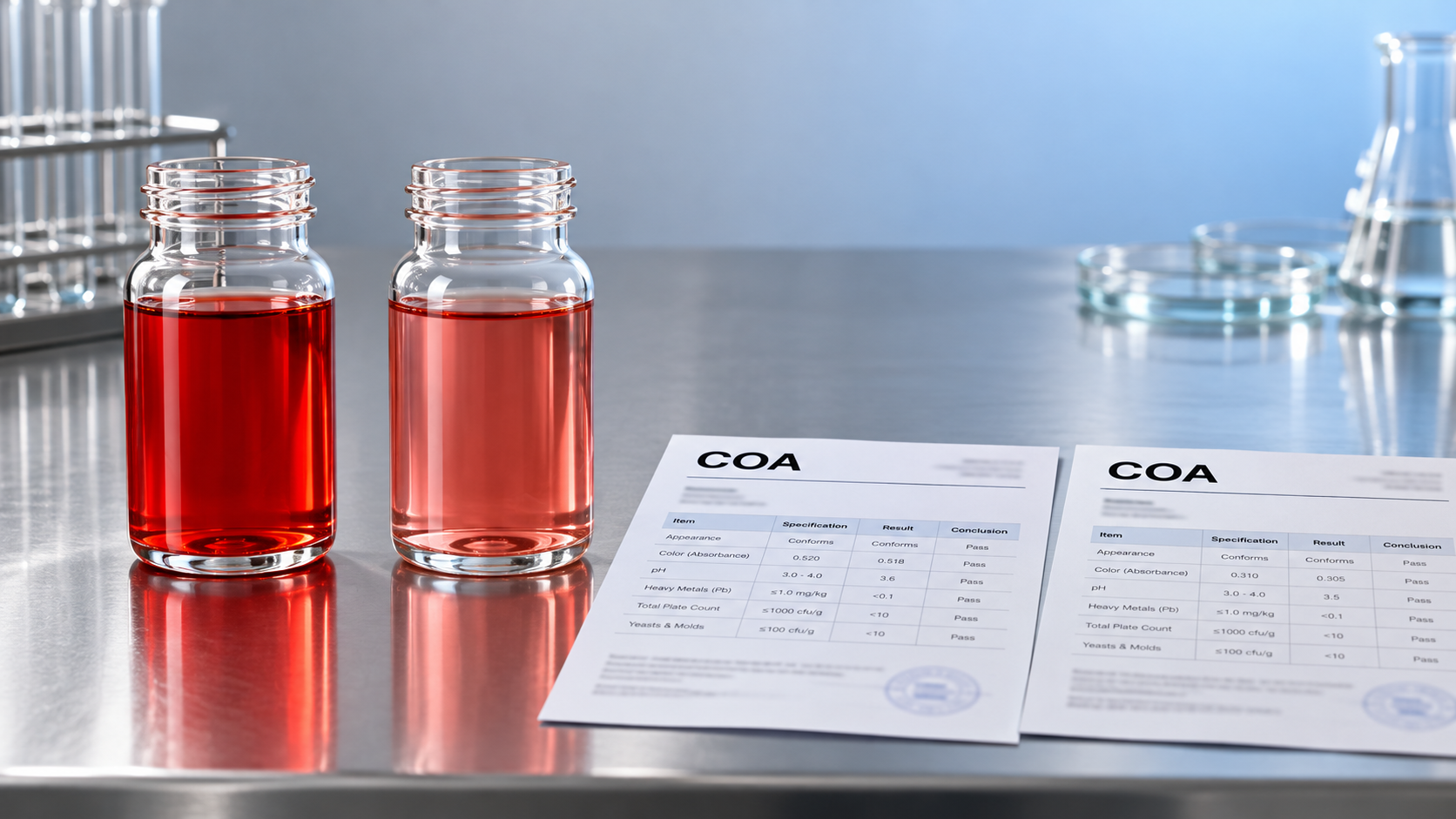
Can Matching COAs Guarantee Consistent Food Colorant Performance?
Matching certificates of analysis (COAs) may confirm that two food colorant batches meet the same specifications, but they do not guarantee identical performance in your formulation. A COA describes selected properties measured under defined laboratory conditions. Your production line introduces a different set of conditions: acidity, heat, mixing, ingredient interactions, packaging, and storage.
That distinction matters when a replacement batch passes incoming inspection but produces a different shade, fades during processing, or forms sediment during storage. The paperwork may be accurate while the product still falls short of the application requirement.
Which documents should a food colorants supplier provide? A batch-specific COA is the starting point. Buyers also need technical specifications, relevant regulatory statements, traceability information, and application guidance. The practical challenge is understanding what each document proves—and where formulation testing must take over.
A COA confirms conformity, not interchangeability
A food colorant COA normally identifies the product and batch, lists selected test parameters, and reports results against acceptance limits. Depending on the material, those parameters may include identification, coloring matter content, moisture, insoluble matter, contaminants, or microbiological criteria. Not every parameter applies to every colorant.
Two batches can satisfy the same specification without being analytically identical. A result near one end of an approved range and another near the opposite end can both pass. Whether that difference matters depends on dosing accuracy, formulation sensitivity, and the finished product’s color tolerance.
There is also a difference between matching limits and matching methods. Color strength measured using different solvents, pH conditions, wavelengths, or calculation conventions may not be directly comparable. Even the basis of reporting—such as “as supplied” versus dry basis—can change how a result should be interpreted.
A COA reporting only “passes” or “conforms” offers less visibility into batch variation than numerical results where quantitative testing is appropriate. Neither format automatically makes the material unsuitable, but buyers should understand how much evidence supports the release decision.
Why the same specification can produce a different result
Food colorants are not a single technical category. Soluble dyes, insoluble lakes, pigment dispersions, and preparations derived from natural sources behave differently. Comparing them only by shade name or nominal color strength can hide the properties that determine production performance.
The food matrix changes the colorant’s environment
Anthocyanin-based colors illustrate why pH deserves attention: their hue and stability depend strongly on the surrounding chemistry. A sample assessed in water cannot establish how it will behave in an acidic beverage or a protein-containing system. Other colorants have different sensitivities, so application advice must be specific to the material.
Proteins, minerals, oxidizing or reducing ingredients, and preservatives can also influence shade or stability. For dispersions, particle characteristics and the carrier system may affect settling, distribution, and appearance. An assay result alone does not describe these interactions.
Processing exposes differences that incoming tests may miss
Thermal exposure includes more than the peak temperature. Holding time, heating and cooling profiles, and the point at which the colorant enters the process can change the outcome. Mixing intensity and hydration sequence may also matter, particularly for preparations that must disperse rather than dissolve.
Storage creates another test. Light transmission through packaging, oxygen exposure, moisture ingress, and warehouse temperature can affect the material or the finished food. A supplier’s shelf-life statement for unopened colorant does not establish the shelf life of the product made with it.
Which documents should a food colorants supplier provide?
The document package should answer separate questions: Is the batch within specification? Is the material suitable for the intended market and food category? Can its origin and movement be traced? Is there enough technical information to use it reliably?
- Batch-specific COA: It should link clearly to the supplied lot and identify applicable specifications, results, units, and release authorization. Manufacturing, testing, expiry, or retest dates should be clear where relevant. Request test-method references when method differences could affect interpretation.
- Controlled product specification and technical data sheet: These should describe product identity, form, strength basis, relevant physical properties, storage conditions, and shelf life. For formulated preparations, information on carriers and other constituents should be sufficient for technical and labeling assessment.
- Market-specific regulatory statement: This should identify the material precisely and address the intended jurisdiction and use. A general “food grade” declaration is not evidence that every food category, dosage, or labeling approach is permitted.
- Composition and risk declarations: Allergen, genetically modified material, animal-origin, or other statements may be needed depending on the formulation and buyer requirements. Halal or kosher documentation should be requested where relevant, with its product scope and validity checked.
- Traceability records: Buyers need a reliable link between manufacturer, supplier, batch, packaging labels, and shipment. Detailed upstream records may remain with the manufacturer, but access arrangements should support investigations and recalls.
- Application and stability guidance: Useful guidance identifies suitable systems, known incompatibilities, dispersion or dissolution procedures, and the conditions behind stability claims. Supporting data should state the tested matrix and processing conditions.
- Safety and logistics documentation: A safety data sheet, where applicable, supports handling and transport decisions. Commercial and shipping records support delivery and clearance. Neither substitutes for food-use compliance evidence.
Requesting every possible declaration is not necessarily better due diligence. A focused package tied to the product, destination, and application is more useful than a large folder of generic statements.
Regulatory suitability needs its own review
Permission to use a colorant depends on more than chemical identity. Food category, conditions of use, purity requirements, and labeling obligations can differ between markets. An identifier such as an E number or Color Index number helps identify a substance; it does not establish unrestricted permission to use it.
For the European Union, assessment should consider the applicable food additive authorization and specifications, including category-specific conditions. In the United States, certain color additives are subject to FDA batch certification, while others are exempt from certification. Exemption does not remove the need to meet applicable identity, use, and other regulatory requirements.
Where official batch certification applies, a manufacturer’s COA is not its replacement. The purchaser should verify the relevant certification and batch linkage. For color preparations, carriers and other components also need review rather than assuming that approval of the coloring substance covers the entire mixture.
Build an application test that reflects the actual failure risk
The right qualification question is not simply, “Does the new batch look the same?” It is, “Does it remain acceptable through our process and intended shelf life?” Start with the approved reference material and compare it with the candidate under the same conditions.
- Define the comparison basis. Test at the intended production dosage. If a separate strength-normalized comparison is useful, document it rather than silently adjusting dosage until the shades match.
- Use the real formulation and process sequence. Include relevant pH, ingredients, heat exposure, mixing, and addition order. Water-only screening can help diagnose differences, but cannot replace application testing.
- Agree on acceptance criteria beforehand. Assess shade, intensity, dispersion, sedimentation, or other relevant attributes. Instrumental color measurements can support visual assessment when sample preparation, measurement geometry, and viewing conditions are controlled.
- Check performance over time. Include relevant packaging and storage conditions. Accelerated testing can reveal vulnerabilities, but its ability to predict shelf life must be established for the product.
For applications sensitive to small changes, qualification should consider multiple production batches rather than one selected sample. A retained reference also helps distinguish supplier variation from changes in ingredients, equipment, or measurement practice.
Consistency also depends on the export supply chain
Cross-border sourcing adds handovers between manufacturing, export, freight, warehousing, and receiving. Documentation needs to remain connected throughout that chain. A technically sound COA loses practical value if the receiving team cannot reconcile its batch number with the labels and shipment records.
Based in Shandong Province, a major Chinese chemical industry hub, Shandong Huafeng Chemical Co., Ltd. operates as a chemical export service provider with a broad product portfolio and comprehensive foreign trade capabilities. For businesses working with an export partner such as Huafeng Chemical, those capabilities are most relevant when they support clear specification communication, document coordination, and responsive handling of supply questions.
Buyers should nevertheless confirm the responsibilities for each product: who manufactures it, who authorizes release, who provides technical answers, and who communicates changes. An export intermediary and a manufacturer have different roles; neither relationship should be assumed from a company name on an invoice.
Change control deserves particular attention. Agree which changes require advance notification, including changes to manufacturing site, formulation, carrier, test method, or packaging. These can affect application behavior even when the headline specification remains unchanged.
Use matching COAs as a checkpoint, not a guarantee
Consistent food colorant performance rests on three distinct forms of evidence: batch conformity, regulatory suitability, and demonstrated application performance. A strong document package supports the first two and helps design the third, but cannot eliminate the need for formulation testing.
Before approving a new source or replacement batch, align the test methods, verify the destination-market requirements, and define what acceptable performance means in the finished food. If a critical property is missing from the specification, address that gap with the supplier. Repeatedly accepting matching paperwork will not control a variable that the paperwork never measures.
Send Us Your Inquiry Today
