









Product Quick Navigation
Get a Quote
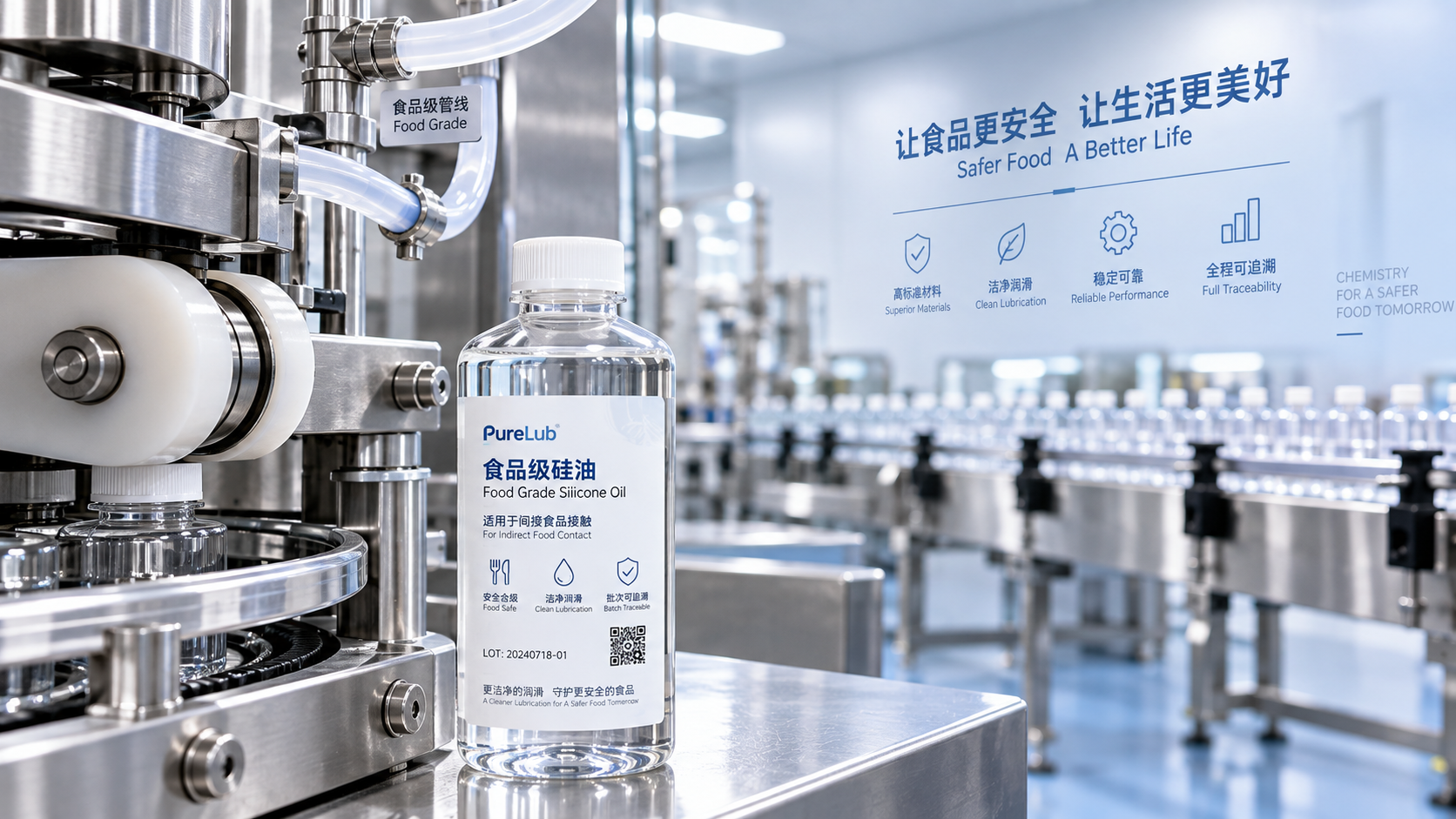
The Short Answer: Safe When the Grade, Use, and Documentation Match
Is food grade silicone fluid safe for indirect food contact? In many applications, it can be—but “food grade” is not a blanket permission to use any silicone fluid anywhere near food. Safety depends on the actual formulation, the intended function, processing temperature, possible migration route, local food-contact rules, and the documents supporting the supplied batch.
This distinction matters in real factories. A silicone fluid used as a release aid on an external conveyor component does not face the same assessment as a lubricant that may reach a packaging seam, a bakery mould surface, or a filling-machine seal. The closer the material can get to food, food-contact surfaces, or food packaging interiors, the more carefully its compliance status must be reviewed.
For importers and processors, the practical question is rarely just whether the liquid is silicone-based. It is whether that specific product, at that viscosity and purity level, is suitable for the defined indirect-contact condition. A reliable answer comes from technical and regulatory review, not from a generic product label.
What “Indirect Food Contact” Actually Means
Indirect contact generally describes situations where a chemical is not intentionally added to food and is not designed to remain on the food itself, yet incidental transfer may occur. Typical examples include lubricants in food-processing machinery, release fluids used on non-food-facing equipment parts, antifoam-related uses, and fluids associated with packaging or handling systems.
The phrase can be misleading because it sounds like a low-risk category. In practice, incidental contact may still occur through splashing, leakage, misting, transfer from rollers, worn seals, improper maintenance, or excessive application. A processing line operating at elevated temperature creates another concern: heat can alter viscosity, increase fluid mobility, and affect the likelihood of transfer to adjacent materials.
Polydimethylsiloxane, commonly called PDMS or dimethyl silicone fluid, is valued for thermal stability, water repellency, low surface tension, and broad compatibility with industrial equipment. Those characteristics explain its presence in many industrial formulations. They do not, by themselves, establish food-contact suitability. Additives, residual components, contamination risks, and intended use conditions still matter.
Why the Same Silicone Fluid May Be Acceptable in One Use but Not Another
A common purchasing mistake is to compare only viscosity or appearance. Two clear silicone fluids may perform similarly as lubricants but differ in their production controls, impurity profile, additive package, or documentation. One may be supplied for general industrial use; another may be manufactured and controlled for a food-contact-related application. They should not be treated as interchangeable merely because both are described as silicone oil.
The application conditions are equally important. Consider a fluid used in a closed gearbox with no credible path to the product area. Its risk profile differs from a fluid applied near open food, high-speed packaging equipment, or heat-sealing operations. Exposure duration, food type, cleaning procedures, machine design, and the probability of accidental overuse all influence the evaluation.
Food type can also change the conversation. Oily or fatty foods may interact differently with materials than dry products. High-temperature processing, long storage periods, and repeated contact with packaging components can create circumstances that require more careful migration assessment. There is no useful one-line answer that covers every food plant, every market, and every silicone chemistry.
Compliance Is a Documentation Exercise as Much as a Chemistry Exercise
In the United States, food-contact evaluations may involve requirements administered by the U.S. Food and Drug Administration, while European sales may require review against the applicable EU food-contact framework and the rules of the destination market. Other jurisdictions have their own systems. A declaration that a material is “food grade” should therefore be tied to a stated regulatory basis, rather than accepted as a universal claim.
Buyers should ask what the supplier is actually confirming. Is the declaration for direct or indirect contact? Does it identify the substance or formulation? Does it define conditions such as temperature, food category, or maximum use level? Is it current, traceable to the manufacturer, and applicable to the manufacturing site supplying the material? Vague paperwork becomes a serious weakness during an audit or quality investigation.
A technical data sheet is useful, but it is not automatically a food-contact declaration. Likewise, a safety data sheet addresses hazards and handling; it does not necessarily establish legal suitability for contact with food. These documents answer different questions. Experienced procurement teams keep them together, but they do not confuse one for another.
Documents Worth Reviewing Before Approval
- Product specification, including silicone type, viscosity range, appearance, and relevant quality indicators.
- Batch certificate of analysis where available, matched to the delivered lot rather than a sample from another production period.
- A food-contact or compliance statement that clearly names the applicable market and intended use conditions.
- Safety data sheet, transport information, and storage guidance for warehouse and maintenance teams.
- Traceability details covering manufacturer, production site, batch number, packaging format, and shelf-life or retest information.
None of these documents removes the need for the user’s own process assessment. They do, however, provide the foundation for a defensible purchasing decision. If a supplier cannot explain the difference between a general-purpose silicone fluid and a documented food-contact-related grade, that is a signal to slow down.
The Supply Chain Can Change the Risk
Silicone fluid is often stable in storage when handled correctly, but logistics still deserve attention. Cross-contamination can occur through reused containers, poor filling practices, unclear relabelling, or mixed warehouse zones. For a material intended for a sensitive processing environment, clean packaging and lot traceability are not administrative extras. They are part of product control.
This becomes more relevant in international trade, where a product may move through manufacturers, exporters, freight providers, distributors, and local repackers before reaching the plant. Documentation must follow the shipment, and the commercial description should remain consistent with the material actually supplied. A buyer should be cautious when product names change across invoices, certificates, labels, and technical files.
For chemical exporters, responsiveness is especially valuable when a customer needs clarification before customs clearance or a quality review. Shandong Huafeng Chemical Co., Ltd., based in Shandong, operates in a region with a substantial chemical manufacturing base and serves overseas supply requirements across a broad product portfolio. In this type of trade relationship, the useful service is not simply arranging shipment; it is helping ensure that specifications, export documents, packaging details, and customer questions remain aligned.
Practical Selection for Food-Processing Equipment
Start with the equipment, not the catalogue. Map where the fluid will be used, whether food is exposed nearby, and how a leak or overapplication could travel. Maintenance staff often have the clearest view of those routes. A fluid selected by purchasing alone may look acceptable on paper but be unsuitable for the actual maintenance practice on the shop floor.
Then define the performance requirement. Viscosity affects film formation, pumping, drainage, and application control. Temperature range affects whether the fluid remains where it is intended. Compatibility with elastomers, plastics, coatings, and cleaning chemicals should be considered before a line-wide change. A lower-cost material that causes seal swelling, difficult cleanup, or uncontrolled spreading is not a practical saving.
It is also wise to distinguish silicone fluid from finished food-machine lubricants. A neat silicone fluid may be a raw material or process aid, while a finished lubricant can contain additional components and be marketed for a specified equipment use. The documentation needed for each can differ. Asking for the exact functional description avoids an easy but costly category error.
Common Misjudgments to Avoid
One frequent assumption is that colourless, odourless material must be suitable around food. Physical appearance says very little about regulatory status. Another is that a supplier’s verbal assurance is enough. It may be well intentioned, but it is not a substitute for controlled documentation tied to the supplied material and destination market.
Buyers should also avoid copying approval decisions from another facility without checking the use conditions. A silicone fluid accepted for a closed process in one plant may not be appropriate beside an open filling line in another. Equipment layout, food exposure, cleaning routines, and local regulatory expectations can all differ.
The sensible conclusion is conditional rather than absolute: food-grade silicone fluid may be safe for indirect food contact when it is correctly formulated, supported by applicable compliance documentation, and used within the conditions for which it was assessed. Before placing a repeat order, confirm the exact grade, batch traceability, destination-market requirements, and realistic path of incidental contact. That is where a confident “yes” becomes a responsible one.
Send Us Your Inquiry Today
