









Product Quick Navigation
Get a Quote
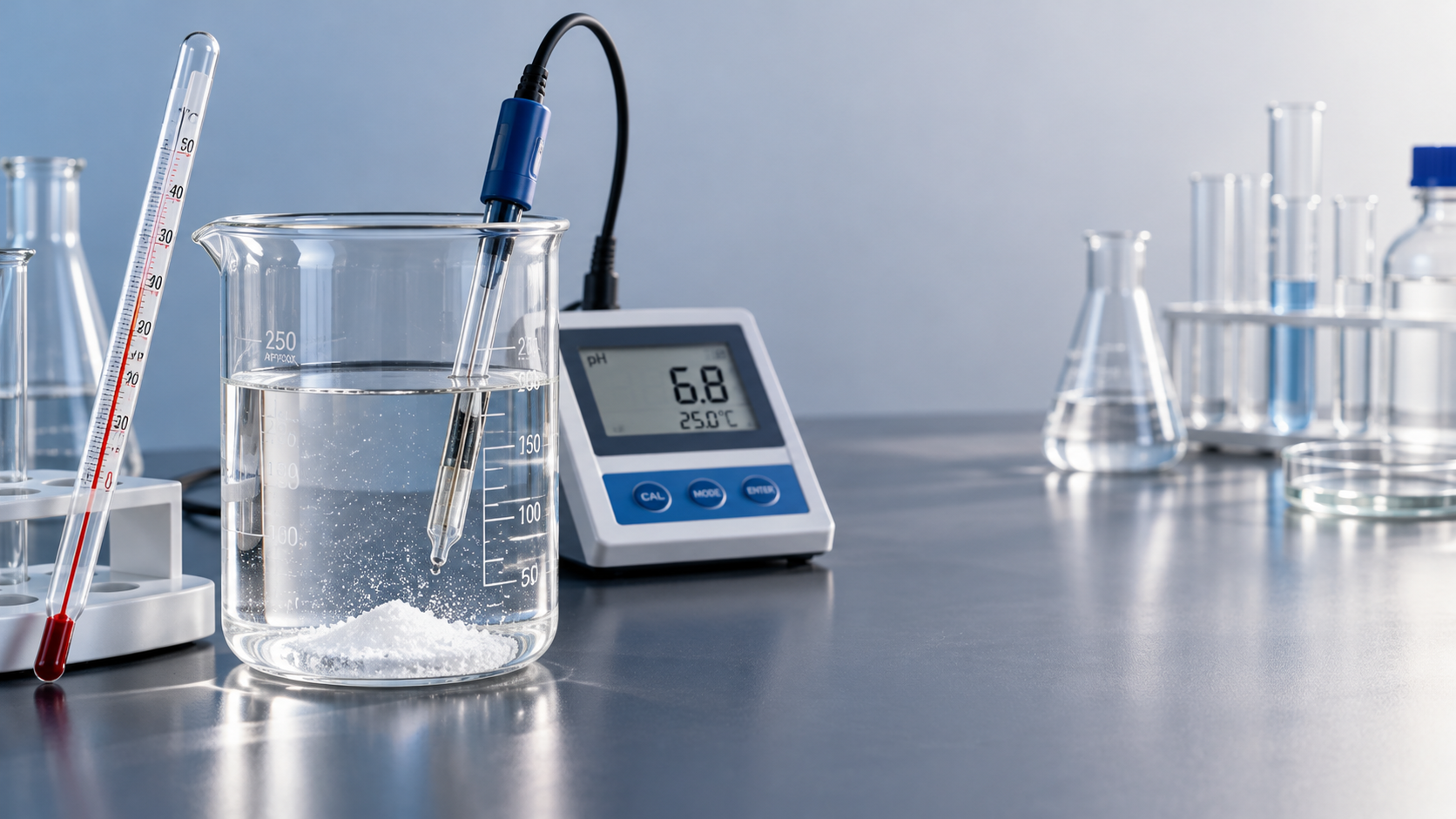
A water solubility value is meaningful only when it identifies the substance, temperature, water composition and basis of measurement. A figure reported in milligrams per litre at a specified temperature is not directly equivalent to an unqualified statement such as “insoluble” or “miscible.” Before using either result in a formulation, process calculation or environmental assessment, establish what was measured and under which conditions.
Safety data sheets often provide a concise physical-property entry, while technical data sheets may include a numerical result or application-specific observations. Neither format guarantees that the underlying test conditions are complete. A value without a temperature, pH or method can still provide a preliminary indication, but it has limited value for comparing materials or predicting behavior in a different water system.
What the reported value represents
Water solubility commonly describes the equilibrium concentration of a substance dissolved in water at a stated temperature and pressure. For a solid, the test generally involves contact between excess material and water until the dissolved concentration approaches equilibrium, followed by separation of undissolved material and analysis of the liquid. The exact procedure matters: the measured concentration is only as representative as the equilibration and separation steps allow.
A solubility result is distinct from the rate at which a material dissolves. A finely divided powder can reach a given concentration faster than a large lump because more surface area is exposed. That faster dissolution does not necessarily change the equilibrium concentration for the same solid phase and water conditions. Conversely, a short test on a slowly dissolving solid can report a low concentration even though equilibrium has not been reached.
Apparent dissolution also requires scrutiny. A cloudy suspension can contain fine particles that pass through a coarse filter or remain dispersed during sampling. An instrument that measures total elemental content after digesting the sample could then include material that was never truly dissolved. The report should identify whether the result refers to a filtered dissolved fraction, a total concentration, or another operationally defined fraction.
Read units and qualifiers before comparing figures
Numerical values are often expressed as mg/L, g/L, mass percent or moles per litre. Convert them only after confirming the basis. For example, 0.2 g/L is 200 mg/L when both values refer to the same solution volume and temperature. Converting a mass fraction to a volume-based concentration requires the solution density; assuming that one litre always has a mass of one kilogram becomes less reliable for concentrated solutions.
Molar concentrations introduce an additional identity issue. A result in mol/L refers to a specified chemical entity, so conversion to g/L requires its molar mass. A reported concentration of an element is not automatically the concentration of the original compound. The calculation must account for stoichiometry and for whether the dissolved species actually contains that element in the assumed form.
Do not treat a less-than value as an exact measurement. If a model requires a single concentration, substituting the reported limit produces a conservative numerical input only for that specific bound and assumption; it does not establish the actual equilibrium concentration. Similarly, “not determined” or a blank field is missing information, not evidence that a substance has low solubility.
Temperature and water chemistry change the answer
Temperature should accompany every numerical comparison. Solubility often changes with temperature, but the direction and magnitude are substance-specific. A value measured in cooled laboratory water cannot simply be applied to a heated mixing vessel. A solution prepared hot may form crystals as it cools, while a concentration below the room-temperature solubility does not establish how quickly a solid will dissolve during a short process cycle.
For ionizable substances, pH can strongly affect the measured dissolved concentration. A weak acid, for example, can form a greater proportion of dissolved ionized species as pH increases; a weak base can behave in the opposite direction. The relevant pH is the measured pH of the test mixture, including any change caused by the material itself. A nominal starting pH alone does not establish the final condition.
Buffer composition deserves separate attention. Buffers maintain pH to a degree, but their constituents can also interact with a substance. Dissolved salts, complexing agents and other ions can change speciation, activity or precipitation behavior. A result in purified water therefore cannot automatically predict the concentration in process water, wastewater or a formulated product containing other ingredients.
The distinction is especially important for reactive solids. Neodymium oxide CAS#1313-97-9 is described as insoluble in water and soluble in dilute acid solutions. Those descriptions concern different chemical conditions: an acid can promote dissolution through reaction, so the acid-soluble behavior should not be used as a numerical water solubility value. For a glass or ceramic formulation, a separate assessment of the actual processing medium and solid form is needed.
Exposure to air can also alter a test system. Carbon dioxide uptake can change pH and introduce carbonate species; evaporation can increase concentration. If those effects are relevant, the report should describe the vessel, headspace and exposure conditions. A sealed vessel reduces some sources of change but can introduce other considerations, including pressure and compatibility with the sample.
Test method details that affect the result
A standard method reference is useful only when the report also describes how it was applied. The method edition, sample preparation, loading, temperature control, equilibration time and analytical procedure provide context that a standard number alone cannot. For a slowly dissolving material, sampling at several times and obtaining consistent concentrations can support an equilibrium claim. Repeated readings alone do not prove equilibrium if a surface coating, transformation or analytical interference controls the result.
The solid remaining at the end of the test can differ from the starting material. Hydration, conversion to another solid phase, or precipitation of a reaction product can control the concentration in solution. If a different phase has formed, the reported value may describe equilibrium with that phase rather than the supplied material. Where this distinction matters, solid-phase characterization before and after testing adds useful evidence.
Separation and analysis are particularly important at low concentrations. Filtration removes visible solids but can also retain dissolved material through adsorption, while particles smaller than the filter rating can pass through. Centrifugation has its own size- and time-dependent limitations. A method report should identify the separation technique and any sample preservation or dilution, because each step can change what reaches the instrument.
Analytical selectivity matters as well. Measuring a constituent element can establish its concentration in the separated liquid, but it does not by itself identify the molecular species present. For mixtures or substances that degrade, a total concentration and a parent-compound concentration answer different questions. The reporting limit must also be low enough to distinguish the concentrations relevant to the intended use.
From a data-sheet entry to an application decision
Start by matching the tested material to the material under consideration: chemical identity, salt or hydrate form, purity and physical form should be clear. Impurities can contribute measurable dissolved species, and a commercial mixture cannot always be represented by the solubility of its main component. Particle size is particularly relevant when the available contact time is limited, even if the final equilibrium value is unchanged.
Next, compare the test medium with the proposed system. A data-sheet result in pure water at room temperature is a useful reference point for a similar laboratory mixture. It is weaker evidence for a hot, buffered or saline process stream. When pH or dissolved salts differ substantially, use a measurement in a representative medium rather than adjusting the original value by intuition.
For a concentration target, distinguish equilibrium capacity from operating performance. A target below the reported solubility may still be impractical if dissolution is too slow, mixing is insufficient or the material transforms during preparation. A target above the equilibrium value can leave undissolved solids, although a temporarily supersaturated solution is also possible. The presence or absence of visible particles at one moment does not establish long-term stability.
When the available documentation is incomplete, request the original test report or supporting details: measured temperature and pH, water composition, sample identity, contact time, separation procedure, analytical method and reporting limit. Record any assumptions alongside a calculation. That preserves the distinction between a documented measurement and a value adopted for a particular process condition.
Send Us Your Inquiry Today
