









Product Quick Navigation
Get a Quote
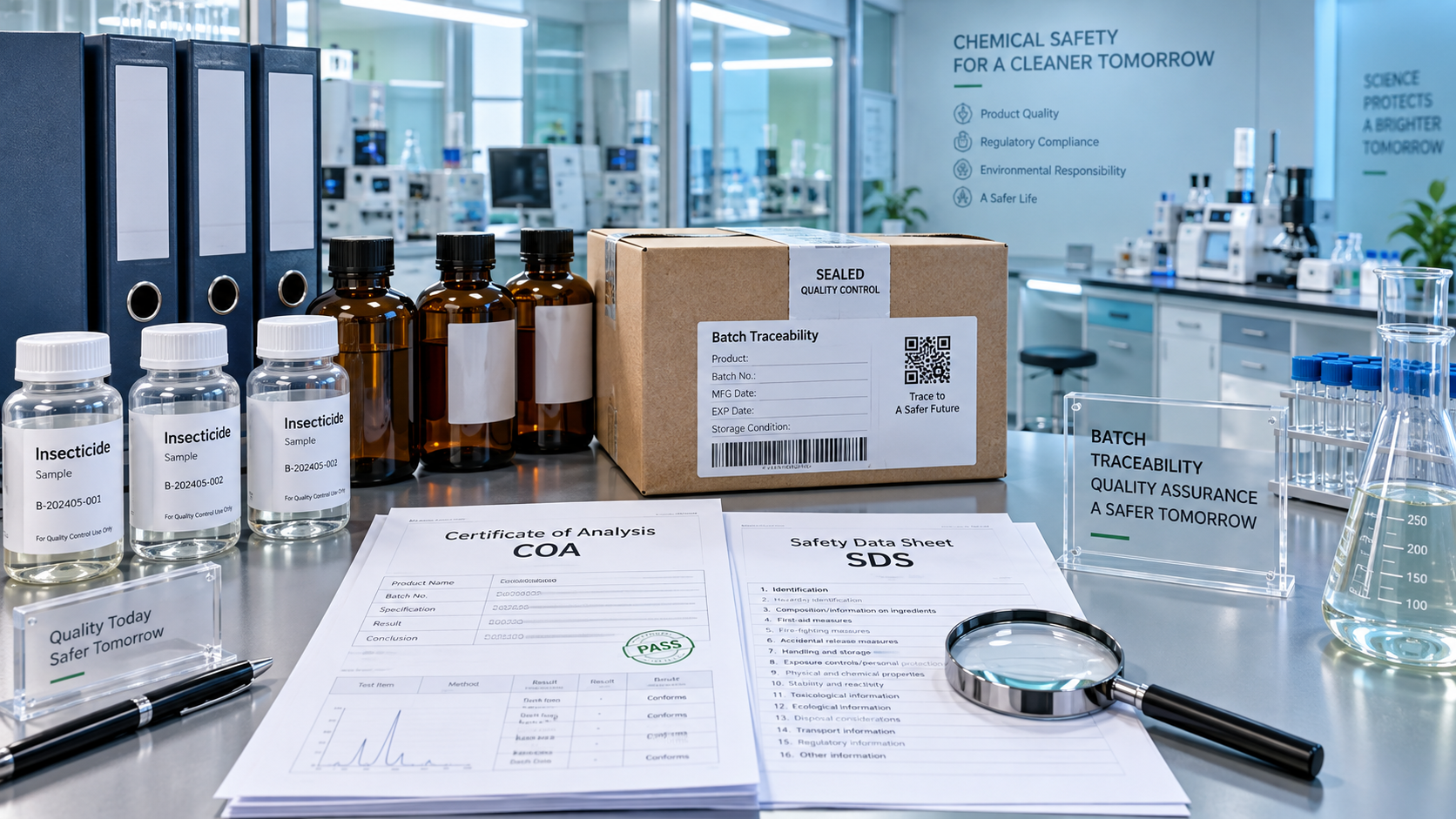
A purchase order for insecticides can look complete on paper—product name, active ingredient, concentration, packaging, destination, and price—yet still carry serious risk if the supplier cannot provide the right supporting documents. This problem often becomes visible only when a shipment is ready to depart, a customs broker requests missing information, or the receiving quality team finds that the Certificate of Analysis does not match the delivered batch.
Buyers should request a document package that proves three things: the material is what the supplier says it is, the specific batch meets the agreed specification, and the product can be legally and safely transported and used in the intended market. For insecticides, the core package normally includes a technical specification, a batch-specific Certificate of Analysis, a Safety Data Sheet, product registration or authorization evidence where required, label information, and shipment safety documents. The exact package should be confirmed before price negotiations are finalized, not after production or loading has started.
Start by separating product quality from market compliance
Quality documentation and regulatory documentation overlap, but they answer different questions. A Certificate of Analysis may confirm the active ingredient assay, moisture level, pH, particle size, emulsion stability, or other agreed parameters. It does not, by itself, prove that the formulation may be imported, sold, or applied in a particular country.
Likewise, a registration certificate or authorization record may show that a product has been accepted in a target market, but it does not demonstrate that the current shipment meets the purchase specification. Procurement teams should avoid accepting one type of document as a substitute for the other.
The technical specification should be agreed before requesting a COA
A supplier’s standard specification is not automatically the right specification for your purchase. Insecticides with the same active ingredient may differ in formulation type, concentration, appearance, solvent system, impurity profile, packaging compatibility, storage expectations, and performance-related characteristics. A buyer sourcing technical material will need a different specification from a buyer sourcing an emulsifiable concentrate, suspension concentrate, wettable powder, water-dispersible granule, bait, or ready-to-use product.
The specification should state the product identity clearly, including the active ingredient name, formulation type, and concentration basis. “Content” can be expressed in different ways, such as mass fraction, volume fraction, or acid equivalent where applicable. The basis must be clear enough that both parties test against the same standard.
Relevant parameters depend on the formulation, but a purchasing specification may include:
- active ingredient assay and acceptable tolerance;
- identity of active ingredient and declared co-formulants where needed for review;
- moisture or water content;
- pH, acidity, alkalinity, or density;
- appearance, color, odor, and physical form;
- particle-size distribution, wettability, suspensibility, dispersibility, or persistent foam for applicable formulations;
- emulsion stability for liquid formulations;
- relevant impurity limits and test methods;
- net content, packaging material, closure type, and labeling requirements;
- storage conditions and shelf-life statement.
Do not accept a specification that lists only a broad active ingredient percentage without identifying the test method, tolerance, or formulation characteristics. It may be impossible to resolve a receiving dispute if the contract says “high quality insecticide” but contains no measurable acceptance criteria.
Request a batch-specific Certificate of Analysis, not a generic sample
The COA is the document most often requested by buyers, but it is also the document most often misunderstood. A useful COA must identify the exact production batch being supplied. It should include the product name, batch or lot number, manufacturing date, retest or expiry date where applicable, test date, results, specification limits, and the test methods or method references used.
Before shipment, compare the batch number on the COA with the batch number shown on the packaging list, container labels, and any release documentation. If the supplier provides a COA before packing, request confirmation that the final packed goods will carry the same batch identification. Mixed batches are not necessarily unacceptable, but each batch should have its own COA and should be traceable to the quantities loaded.
A COA should show actual numerical results rather than only “pass” or “conforms.” A pass/fail statement may be acceptable as a supplementary release status, but it is insufficient when a buyer needs to assess consistency over repeated orders, investigate a quality complaint, or compare a batch against a destination-market limit.
There is also a practical distinction between a pre-shipment sample COA and a shipment COA. A sample may demonstrate that a supplier can make a product within the expected range. It cannot confirm the quality of the commercial batch later produced. Keep both records, but use the batch-specific COA as the release document for the shipment.
Safety Data Sheets need a destination-market review
An SDS is more than a document for the warehouse. It affects freight classification, packaging decisions, emergency response procedures, storage segregation, and the information that downstream users may require. Buyers should request the SDS early, especially when the cargo may move by sea, air, road, or a combination of modes.
Check whether the SDS identifies the same product and formulation being quoted. Product names that sound similar may have different solvent systems or concentrations, resulting in different hazard classifications. Review the sections covering composition, hazards, first-aid measures, accidental release, handling and storage, exposure controls, physical properties, stability, toxicological information, ecological information, transport classification, and regulatory information.
The document should be current, internally consistent, and written in a language accepted for the intended use. A mismatch between the SDS and transport declaration is a warning sign. For example, if the SDS indicates a transport classification but shipping paperwork presents the product as non-regulated cargo, pause the release process until the supplier and freight parties clarify the discrepancy.
Storage details deserve close attention. Some formulations may be sensitive to low temperatures, heat, direct sunlight, or prolonged storage after opening. A buyer planning longer transit times or storage in warm climates should ensure that the agreed shelf-life and storage instructions are suitable for the actual route and warehouse conditions.
Registration evidence must match the product actually being purchased
Insecticides are regulated products in many markets, and registration requirements are often tied to specific active ingredients, formulation types, concentration ranges, intended uses, label claims, and local registrants. A document showing that an active ingredient is known in a market does not automatically authorize every formulation containing it.
Before placing an order, ask for the documents needed to verify the product’s status in the destination market. Depending on the transaction, that may include a registration certificate, authorization number, permit, approved label, letter of access, or documentation identifying the local registration holder. The buyer should verify the applicable requirements with the responsible importer, local regulatory team, or qualified compliance adviser rather than relying only on a supplier’s assurance.
Key matching points include:
- the active ingredient and concentration;
- the formulation type;
- the trade name or product identifier where relevant;
- the intended use and target pest claims;
- the country or region covered by the document;
- the legal entity permitted to import, distribute, or place the product on the market;
- the validity period and any conditions attached to the approval.
This check should happen before artwork is approved. Labels often require precise hazard statements, precautionary language, application instructions, disposal information, and local registration references. Changing labels after goods are packed can create avoidable delays and extra packaging work.
Ask for the label, packaging specification, and batch traceability records
Packaging is part of product quality for chemical procurement. A technically compliant insecticide can still become unusable if containers leak, seals fail, labels detach, or packaging is incompatible with the formulation. Request product label artwork or text, container specifications, net weight or volume tolerances, and palletization details appropriate to the shipment.
The label should identify the product, batch number, net quantity, relevant hazard communication, storage guidance, and supplier or responsible-party details as required for the destination. Confirm whether labels must be applied before export, after arrival, or both. This is especially important where local language requirements apply.
For traceability, ask the supplier to explain how the batch code links to production, testing, and packing records. The answer does not need to reveal confidential manufacturing details. It should, however, allow a buyer to determine which containers belong to a given batch and which COA applies to them. This becomes critical if only part of a shipment is questioned during receiving inspection.
Do not overlook transport and origin documents
Not every transport document is a quality certificate, but missing or inconsistent paperwork can prevent a compliant product from moving. Depending on the route and cargo classification, buyers may need a dangerous goods declaration, transport classification information, packing certificate, container packing documentation, or other carrier-required records. The SDS should support, rather than contradict, these documents.
Commercial documents should also describe the product consistently. Check alignment among the purchase order, proforma invoice, commercial invoice, packing list, COA, SDS, labels, and shipping instructions. Differences in formulation description, net quantity, batch number, or product identity can trigger questions at customs or complicate an insurance or shortage claim.
Where origin documentation is commercially relevant, confirm the requested format early. It is far easier to align invoice wording and product descriptions before documents are issued than to correct them after the vessel has departed.
Use document review to detect supplier risk before committing volume
A buyer does not need to perform a laboratory audit to identify basic documentation weaknesses. The first review should focus on consistency and responsiveness. Are the documents product-specific, legible, dated, and complete? Do the technical specification, SDS, COA, and label use the same formulation description? Does the supplier answer direct questions about test methods, batch coding, and revisions without replacing one vague file with another?
Be cautious when a supplier provides only a generic PDF with no version date, an undated COA, a COA without batch identification, or a safety document for a different concentration. These issues do not automatically prove that the product is unsuitable, but they should be resolved before the order progresses.
Documentation discipline in one chemical category can also indicate how a supplier manages controlled records across its portfolio. For example, when reviewing non-pesticide materials such as Poly(vinyl alcohol) CAS#9002-89-5, buyers may still expect clear specifications, batch-level analysis, storage guidance, and traceable packaging information. The exact hazard and compliance package differs from insecticides, but the principle remains the same: documents must describe the actual material being shipped, not a loosely related product family.
Build document requirements into the purchase order
The strongest approach is to make the required documents part of the purchase terms. State which documents must be approved before production, which must be issued for each shipment, the acceptable language, required format, and the deadline for submission. For repeat purchases, include a change-notification requirement covering changes to active ingredient source, formulation, manufacturing site, specification, packaging, label, or SDS revision.
It is also useful to define what happens when results fall outside the agreed range or when documentation is incomplete. The purchase order can require written notice before shipment, retain the buyer’s right to inspect incoming goods, and specify that batch records must correspond to the packed product. These are operational controls, not legal guarantees, but they reduce ambiguity when an exception occurs.
For an initial order, request the full review package early: technical specification, recent representative COA, SDS, label draft, relevant registration evidence, and packaging details. Before each shipment, request the final batch COA, final invoice and packing data, confirmed label information, and applicable transport documents. That sequence gives procurement teams enough time to identify mismatches while correction is still possible.
The goal is not to collect the largest possible file set. It is to obtain a coherent, verifiable record that supports product acceptance, safe logistics, and lawful market entry. When documentation is complete before the goods move, buyers are better positioned to compare offers on real value rather than discovering hidden cost and compliance exposure after the shipment is already in transit.
Send Us Your Inquiry Today
