









Product Quick Navigation
Get a Quote
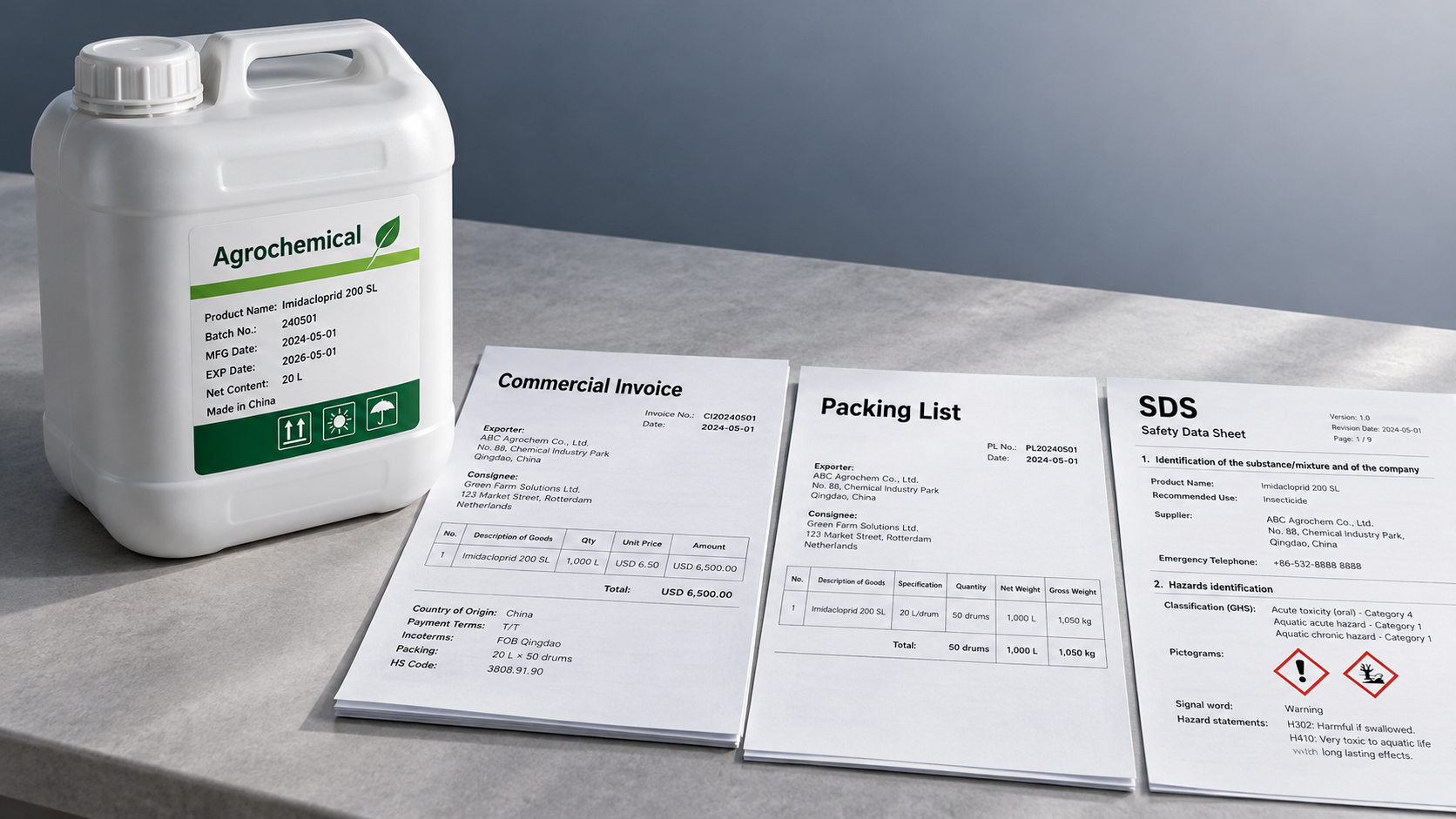
Exporting agrochemicals to Russia requires a commercial and transport document set, supported by evidence that the exact product is eligible for import and its intended use. The core paperwork includes a commercial invoice, packing list, transport document, and customs declaration, with a safety data sheet supporting chemical identification and handling. Pesticide or agrochemical registration evidence, conformity documents, import permissions, and dangerous goods documentation depend on the product and the applicable requirements.
The first decision is whether the shipment contains a finished pesticide, a fertilizer, another agricultural chemical, or an industrial raw material. These categories do not share one universal approval route. A complete shipping file cannot compensate for missing market authorization, and a certificate covering a similar formulation does not automatically cover the goods being shipped.
Establish the product’s regulatory identity before preparing certificates
“Agrochemical” is too broad to determine the required documents. Classification starts with composition, concentration, formulation, intended function, and the claims on the label. A product presented for controlling pests raises different registration questions from a nutrient mixture. An ingredient supplied for further manufacture also requires separate assessment from a finished, packaged product.
Prepare a product identity record containing the trade name, chemical names, CAS numbers where relevant, active ingredient or nutrient content, formulation type, manufacturer, manufacturing location, and intended use. Include the proposed Russian customs classification under the EAEU commodity nomenclature. A CAS number alone does not establish the correct customs code or regulatory category for a mixture.
Intended use also prevents unrelated chemicals from entering the wrong documentation route. For example, Boron nitride CAS#10043-11-5 is associated with industrial applications such as lubricants and semiconductor materials. Its chemical identity or presence in a broader chemical catalog does not establish approval for agricultural use. An industrial material requires classification according to its actual composition, presentation, and declared purpose.
Use the same identity record throughout the shipment file. Differences such as an abbreviated trade name, an omitted formulation suffix, or a different production address can make an otherwise relevant approval difficult to match to the consignment.
The commercial and customs document set
The following documents establish what was sold, how it was packed, how it moves, and how it is declared. Their supporting role differs from product registration or conformity assessment.
An export declaration in the country of departure and an import declaration in Russia serve different customs processes. Neither replaces the other. The agreed delivery terms allocate commercial responsibilities, but they do not remove statutory obligations attached to the importer, declarant, or authorization holder.
A certificate of analysis is also useful for connecting the shipment to its specification. It should identify the batch, tested characteristics, results, and relevant test methods. For a formulated pesticide, active ingredient content and relevant impurities deserve particular attention; fertilizer documentation should reflect the nutrient composition and other controlled characteristics applicable to that product.
Registration evidence must cover the goods actually shipped
For products regulated as pesticides or agrochemicals in Russia, establish whether state registration is required and confirm the current registration status before dispatch. Obtain the registration document or verifiable official record, together with the approved product information needed to establish its scope. A certificate supplied without a match to the current official record leaves an important gap.
The comparison must go beyond the product name. Relevant particulars include the registrant, manufacturer, production site where specified, formulation, active ingredient or nutrient composition, and authorized uses. The goods must correspond to the registered product. Registration of an active substance does not, by itself, establish authorization for every finished formulation containing it.
Consider a formulation whose trade name remains unchanged while the active ingredient concentration changes. The commercial paperwork might look consistent, yet the registration scope could no longer match. A manufacturing transfer creates a similar question when the authorization identifies a particular manufacturer or site. Resolve these differences through the applicable amendment or authorization process before shipment.
Registration validity also needs to be assessed against the planned import and subsequent activity. An old certificate in a document archive does not establish that registration remains effective. Suspension, cancellation, expiry, or changes to approved uses can alter the shipment’s position even when previous consignments cleared successfully.
Where registration information is held electronically, retain a traceable reference to the official record and the relevant supporting documents. A translated commercial summary is useful for coordination, but it cannot replace the authoritative registration particulars.
Conformity documents and import permissions are separate questions
Russian registration requirements and EAEU conformity requirements address different legal obligations. Determine whether an applicable technical regulation or other mandatory conformity measure covers the exact product. For mineral fertilizers, this includes assessing whether the product falls within the relevant EAEU technical regulation and identifying the conformity procedure it specifies.
Do not request a generic “EAC certificate” as though every chemical follows the same route. Depending on the applicable measure, the required evidence could take the form of a declaration, certificate, or another prescribed record. Its scope, applicant, manufacturer, product identification, and validity must correspond to the goods and the permitted conformity procedure.
An EAC mark on packaging does not independently prove that the underlying documentation is valid. Obtain the document details and verify the associated official record where available. Conversely, applying the mark without establishing that the product is subject to the relevant requirements creates a labeling problem.
Import licensing and other non-tariff controls require a separate assessment using the product description, composition, customs code, origin, and customs procedure. If a controlled category applies, establish the exact license or permission required, its holder, and its quantity or validity limits. Registration does not automatically replace an import license, and a customs code alone may not resolve a control that also depends on chemical composition.
A free sale certificate, ISO management system certificate, or evidence of compliance in another country can support a commercial file. None independently establishes permission to import or market an agrochemical in Russia. Similarly, US TSCA inventory status does not demonstrate Russian registration or EAEU conformity.
Russian-language safety information and labels
Prepare a current safety data sheet that accurately describes the shipped substance or mixture, and establish the Russian-language version required for its circulation and use. Translation must preserve chemical identities, concentration ranges, hazard classification, first aid measures, storage conditions, and transport information. A document for a concentrated ingredient cannot substitute for the safety data sheet of a diluted formulation.
The label and accompanying use instructions must reflect the applicable Russian requirements and, for registered products, the approved particulars. Product identity, use directions, hazard statements, manufacturer details, batch identification, and shelf-life information need to agree with the authorization and shipment records wherever those particulars are required.
Several differences merit resolution before printing:
- A trade name translated differently across the registration record, invoice, and label can obscure whether they describe the same product.
- Concentration expressed by mass in one document and by volume in another requires a technically supported reconciliation. Matching numerical values do not establish equivalence.
- Repacking changes the immediate packaging and its markings. The resulting presentation must remain within the applicable authorization and packaging requirements.
- Marketing claims must stay within the approved uses. Adding a crop, pest, or application claim can change the regulatory assessment even when the formulation remains unchanged.
Complete the document review before labels are produced in volume. Corrections made after goods have been packed can require replacement labels, revised instructions, or further authorization work.
Dangerous goods paperwork follows transport classification
Agricultural use does not determine whether a chemical is dangerous goods. Transport classification depends on the actual formulation and relevant hazard criteria. Flammable solvents, toxic ingredients, corrosivity, oxidizing properties, and environmental hazards can affect the result. A powder and a solvent-based formulation containing the same active ingredient need separate assessments.
Where dangerous goods rules apply, establish the UN number, proper shipping name, hazard class, packing group where assigned, and any additional information required for the selected transport mode. The shipment file must include the applicable dangerous goods transport documentation and supporting packaging information. Mode-specific requirements also govern package marks, labels, and container or vehicle placarding.
The transport section of the safety data sheet provides a starting reference, but it must agree with the formulation and current shipping classification. A carrier’s acceptance does not validate product registration, while customs clearance does not establish compliance with dangerous goods carriage rules. Each document answers a different operational question.
For multimodal movements, review the full route. A sea leg followed by road or rail carriage can introduce additional documentary and packaging conditions. Any permitted exemption must be supported by the shipment’s actual quantities, packaging, and classification.
Build a consignment file that remains traceable
Before dispatch, assemble one controlled set of documents linking authorization to the physical goods. Record the registration or conformity reference, approved product identity, batch number, certificate of analysis, package quantities, invoice number, and transport reference. This makes discrepancies visible while corrections are still practical.
A change to the shipment should trigger review of the documents it affects. Substituting a batch requires the corresponding analysis record; changing package size affects packing information and potentially labeling; changing the manufacturer demands examination of the authorization scope. Reusing the previous shipment’s file without reviewing those changes is a common source of inconsistent declarations.
Retain the final issued versions, including Russian-language documents and any required originals or authenticated copies. Confirm which records must accompany the cargo and which must be available electronically for customs or other competent authorities. The release file should describe the goods that actually leave the warehouse, with unresolved identity, approval, or classification discrepancies settled before loading.
Send Us Your Inquiry Today
