









Product Quick Navigation
Get a Quote
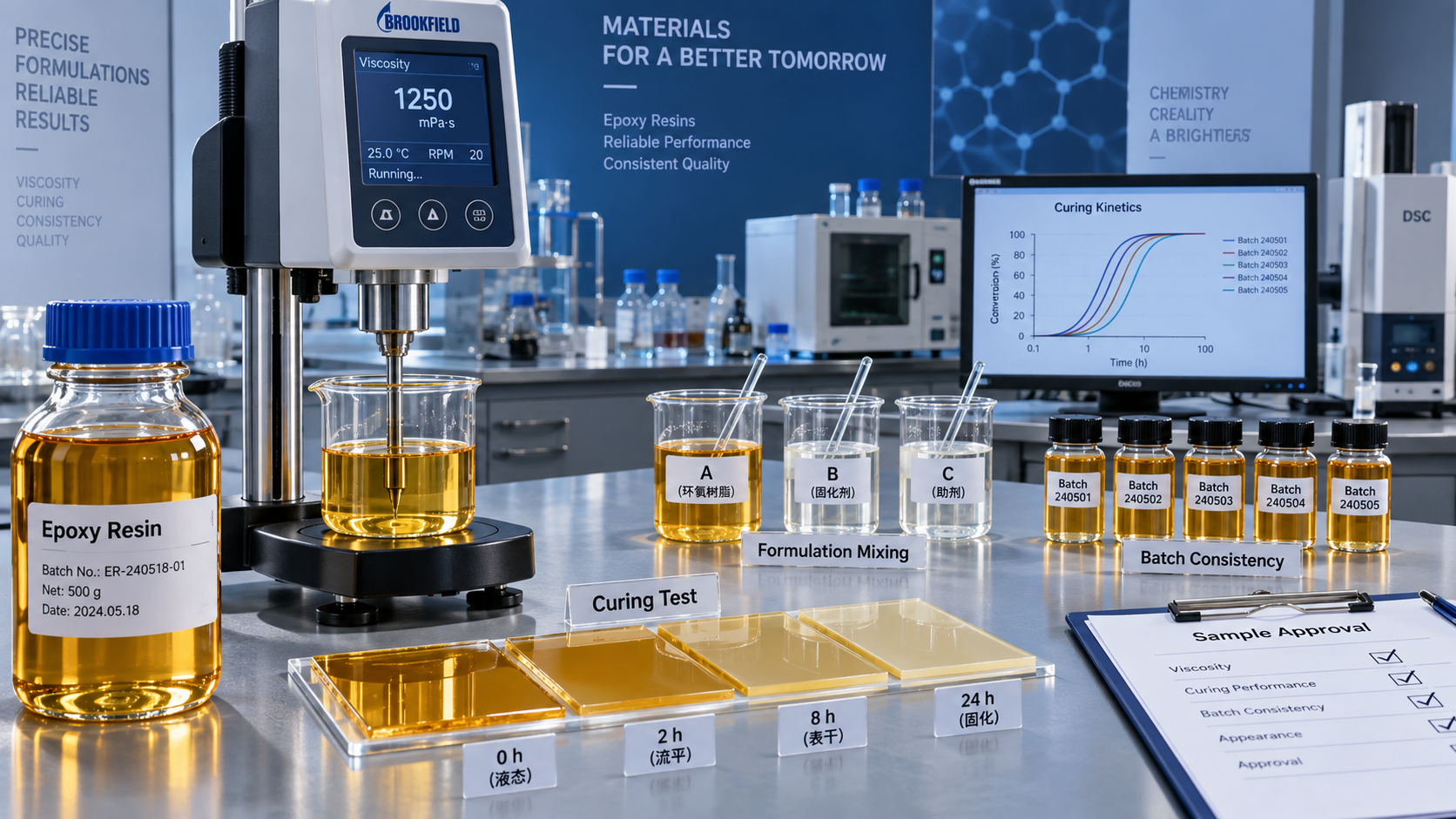
Sample approval for an epoxy resin should be treated as a process-performance decision, not a quick comparison of a certificate of analysis. A resin can look clear, fall within a quoted viscosity range, and still create problems in coating, adhesive, composite, casting, or electrical applications. The specifications that matter most are those that control reactivity, formulation balance, processing window, and consistency from one delivery to the next.
For most buyers, epoxy equivalent weight, viscosity, color, hydrolyzable chloride or total chlorine where relevant, moisture, and curing behavior form the starting point. Their importance changes with the intended system. A resin used in a fast-curing flooring formulation should not be approved by the same logic as a resin for filament winding or a high-voltage encapsulation compound.
Start with the application, not the data sheet
Before setting acceptance limits, define what the resin must do after it enters the formulation. The same base epoxy may be workable in one system and unsuitable in another because the hardener, reactive diluent, pigment package, filler loading, temperature, and production equipment all affect the result.
This is similar to the question, “How do I test polycarboxylate superplasticizer compatibility?” A laboratory value alone rarely answers the commercial question. The material must be tested with the actual downstream ingredients and under conditions close enough to production to expose incompatibility. For epoxy resin, the relevant test is usually a small but representative formulation trial rather than a resin-only inspection.
A useful sample approval brief should state:
- The resin grade and intended end use.
- The curing agent, accelerator, diluent, filler, pigment, or reinforcement to be used in the trial.
- The required mixing temperature, application method, and allowable processing time.
- The performance properties that determine acceptance, such as cure speed, hardness, adhesion, chemical resistance, electrical behavior, or appearance.
- Which properties are critical release controls and which are only reference values.
Without this definition, buyers can overemphasize easy-to-measure properties while missing the variables that later drive rejected batches or unstable production.
Epoxy equivalent weight sets the formulation basis
Epoxy equivalent weight, commonly abbreviated as EEW, is usually the first specification to review because it determines how much curing agent is needed for stoichiometric balance. It expresses the mass of resin containing one equivalent of epoxy functionality. When EEW changes, the required hardener dosage changes as well.
For a fixed hardener ratio, a resin with a higher-than-expected EEW may leave the cured network under-crosslinked. A lower EEW can push the formulation toward excess hardener or a faster, less controllable cure. The outcome can include reduced mechanical properties, softer films, incomplete chemical resistance, altered pot life, or variation in exotherm.
The right approval question is therefore not simply whether the supplier’s EEW value appears reasonable. It is whether the batch-to-batch range is narrow enough for the buyer’s dosing method and formulation tolerance. A manual laboratory adjustment may hide a range that becomes expensive in a plant running fixed recipes or automated metering.
Ask for the supplier’s stated specification range and compare it with the formulation’s allowable adjustment range. If hardener addition is adjusted batch by batch, verify that the adjustment method is practical, traceable, and fast enough for production. If the process uses a fixed ratio, tighter EEW control usually deserves more weight during qualification.
Viscosity matters because it controls processing, not because it defines quality
Viscosity is often the most visible resin specification in a sample evaluation, yet it is easy to interpret too broadly. A viscosity value is meaningful only when the test temperature, test method, and resin condition are understood. Temperature changes can shift viscosity sharply, and a result measured at one laboratory temperature may not predict behavior in a warmer mixing room or a colder warehouse.
For coatings and adhesives, viscosity affects wetting, leveling, sag resistance, sprayability, and filler incorporation. In composites, it influences fiber impregnation and air release. In casting and encapsulation, it affects mold filling, bubble removal, and heat transfer during cure.
A sample should therefore be checked at both the stated test condition and the buyer’s actual processing temperature. Observe more than the starting viscosity. Record how the resin behaves after adding the intended hardener, diluent, fillers, or pigments. A resin that mixes smoothly on its own may thicken unexpectedly after filler addition, while another may have acceptable initial flow but an unworkably short viscosity rise during the working period.
Viscosity should also be linked to storage. If a resin will be shipped across climates or held in inventory, assess whether temporary low-temperature exposure causes crystallization, haze, or a persistent viscosity shift. A material can pass a fresh-sample test and still become operationally difficult after transport or storage.
Curing behavior is where many sample approvals succeed or fail
Epoxy resin does not deliver its final performance until it reacts with the selected curing package. That makes cure evaluation more important than appearance alone, particularly when the buyer uses a proprietary hardener blend, accelerator, or filled system.
At minimum, the trial should examine gel time, pot life, time to handling strength, cure temperature, exotherm tendency, and final cured condition. The exact test sequence depends on the application, but the principle is consistent: measure the process window as well as the final property.
A resin that cures faster than expected is not automatically better. In a high-throughput process, it may improve cycle time. In a large casting, thick coating, or hand-layup operation, the same shift may create excessive heat, trapped bubbles, reduced working time, or uneven cure through the section. Conversely, a slower material may improve flow and impregnation but delay demolding or create a bottleneck in the line.
Evaluate the sample using the intended mix ratio and cure schedule. Avoid approving a resin based solely on a “best result” obtained after changing hardener dosage, cure temperature, or accelerator level unless those changes are acceptable for normal production. The purpose is to qualify a repeatable supply option, not to optimize a one-off laboratory panel.
Look for cure consistency, not only peak performance
A cured plaque with good hardness or adhesion is useful evidence, but it does not prove that the system has a stable processing window. Compare duplicate mixes and observe whether gel time, peak exotherm, tack-free time, and final appearance remain close. Large variation in these results can indicate that a small change in resin properties will be difficult to manage at scale.
For applications with demanding service conditions, final testing should reflect the actual failure mode. A decorative coating may prioritize gloss, color stability, and surface flow. A structural adhesive may require bond strength after moisture or heat exposure. An electrical compound may need dielectric performance and low ionic contamination. Approval criteria should be tied to the product’s job, rather than a generic list of epoxy resin properties.
Color, clarity, and moisture can signal downstream risk
Color is often specified through Gardner or APHA-type scales, depending on the resin and local practice. It matters directly for clear coatings, light-colored floor systems, decorative castings, and formulations with limited pigment loading. Even where color is not a customer-facing requirement, an unexpected shift may indicate oxidation, storage history, raw-material variation, or contamination.
Visual checks should include clarity, suspended particles, haze, gel particles, and evidence of crystallization. These observations do not replace analytical testing, but they can quickly reveal a sample that is not representative of a clean, stable commercial material.
Moisture deserves attention when the curing agent or application is moisture-sensitive. Water can contribute to surface defects, amine blush, reduced adhesion, bubbles, or inconsistent curing behavior, depending on the system. The acceptable level should be defined by the complete formulation rather than copied from an unrelated resin grade. A moisture level tolerable in a robust filled compound may be unacceptable in a clear coating or electrical insulation system.
Check impurity-related specifications when the end use demands them
Not every epoxy application requires the same impurity controls. However, hydrolyzable chloride, total chlorine, ionic contamination, and related parameters can become important in electrical, electronic, corrosion-sensitive, and high-reliability applications. These values may affect insulation behavior, corrosion risk, cure chemistry, or long-term service reliability.
Buyers should avoid treating a general-purpose resin specification as automatically suitable for a high-reliability application. If the finished product has an internal requirement for chlorides, extractables, ionic residues, or low contamination, establish whether the resin test method and reported limit actually align with that requirement. Different methods can produce values that are not directly comparable.
The same caution applies to residual solvent or volatile content where a formulation is sensitive to odor, film defects, porosity, or emissions. A supplier’s standard certificate may not include every item needed for a specialized downstream use. Those additions should be agreed before commercial qualification, not after a production issue appears.
Regulatory documentation should be reviewed alongside the sample
Physical performance and compliance are separate approval tracks. A resin can perform well in a lab formulation yet remain unsuitable for a target market if its documentation does not support the buyer’s regulatory, customer, or restricted-substance obligations.
For an export supply chain, buyers commonly need to confirm the resin identity, safety documentation, transport classification where applicable, country-specific chemical inventory status, and the availability of declarations required by the finished-product market. The exact documents depend on destination and use. Food-contact, medical, consumer, electronics, and industrial applications can have very different expectations.
Do not assume that a safety data sheet establishes all downstream compliance claims. It is designed primarily for hazard communication. Product composition statements, substance declarations, and application-specific compliance evidence may require separate review. Where a claim depends on the cured article rather than the liquid resin alone, evaluate the whole system, including hardener, additives, pigments, and processing conditions.
Approve the commercial grade, not only the laboratory sample
A sample can be technically acceptable but still insufficient for approval if its production identity is unclear. Confirm whether it represents routine commercial production, a pilot batch, retained stock, or a specially selected lot. This is especially important when the material is sourced internationally and the buyer expects repeat supply over multiple purchase cycles.
The specification sheet should define the grade, test methods, acceptance ranges, packaging, storage conditions, shelf life, and batch traceability. For properties that strongly affect the formulation, agree on what happens when a batch falls near either end of the stated range. A broad supplier range may be commercially valid while remaining too broad for a particular formulation.
A practical qualification sequence is to test the initial sample, then verify one or more subsequent batches using a reduced but targeted test plan. The follow-up batches do not need to repeat every development test, but they should confirm the properties most likely to disturb production: EEW, viscosity, color, cure response, and any application-specific impurity control.
Sample approval becomes reliable when the buyer can answer three questions clearly: Is the resin chemically within the formulation’s control range? Does it process predictably with the intended curing system? Can the supplier document and reproduce the same commercial grade over time? When those answers are supported by defined tests rather than a favorable first impression, the approval decision is far more defensible.
Send Us Your Inquiry Today
