









Product Quick Navigation
Get a Quote
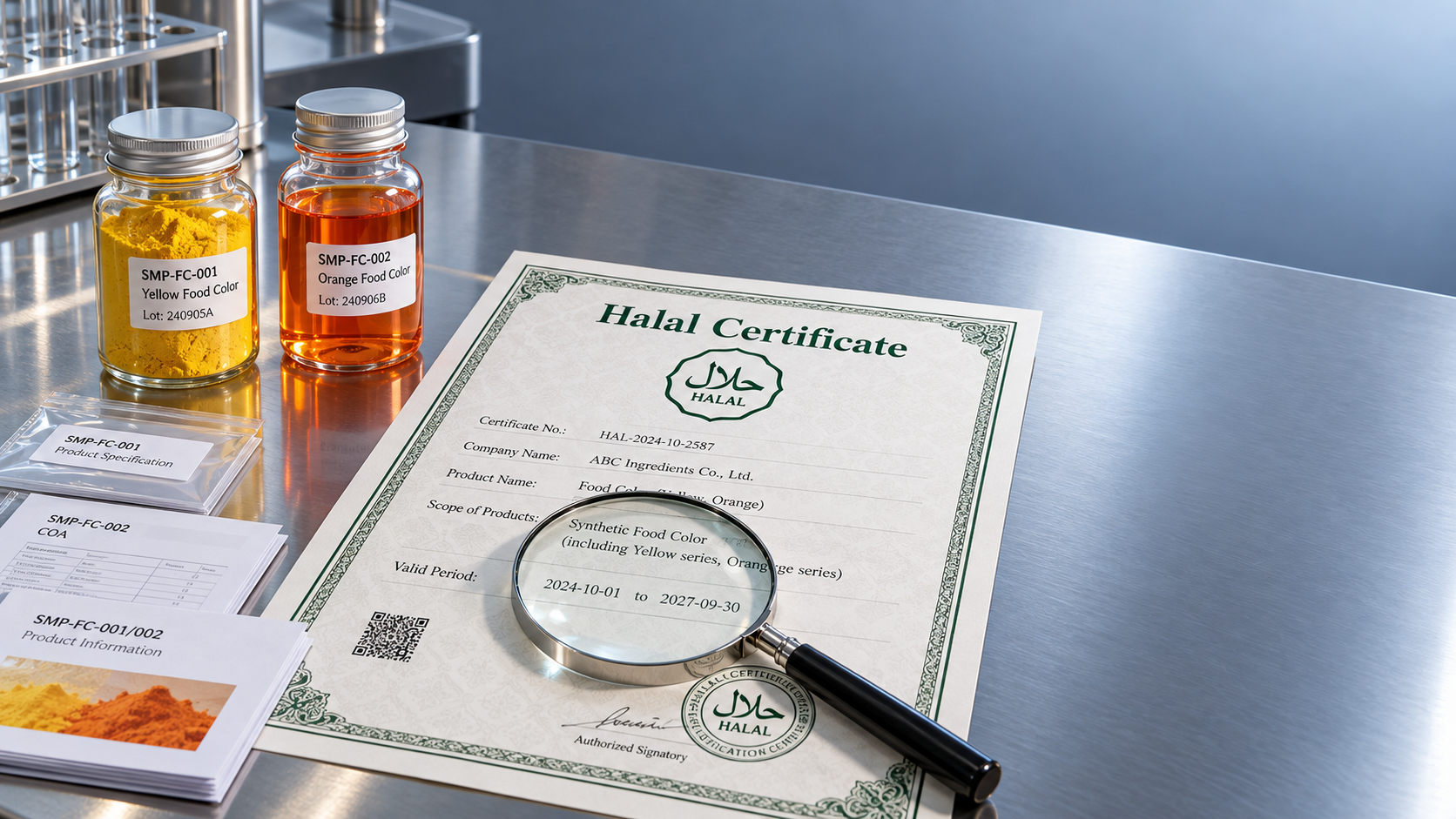
How Do You Verify a Food Colorant Supplier’s Halal Certificate?
A halal certificate can look convincing without covering the food colorant you intend to buy. For importers and food manufacturers, verifying a supplier’s food colorants halal certificate means checking more than an expiry date: the issuing body, product scope, manufacturing site, and recognition in the destination market all matter. In cross-border chemical sourcing, these checks help reduce compliance risks and avoid costly shipment delays. This guide explains how to authenticate certification, match it to your order, and identify gaps that require clarification before you commit to a supplier.
Start with the product you are actually buying
Before reviewing the certificate, establish a clear purchasing identity. “Yellow food coloring” is not specific enough. Your verification file should identify the commercial product name, supplier code, chemical or colorant identity, grade, physical form, and manufacturing location. Where relevant, include the INS, E-number, or CAS identifier, but do not treat any single identifier as proof that two commercial preparations are identical.
A concentrated dye powder and a liquid preparation containing the same coloring substance may have different certification implications. The liquid can introduce carriers, preservatives, emulsifiers, or other ingredients absent from the powder. Likewise, a standardized natural extract may contain a carrier that is not obvious from its trade name.
Ask for the full certificate and every referenced product schedule or annex. A cropped image showing a company name and halal logo cannot establish product coverage. If the quotation uses a different name from the certificate, request a documented cross-reference rather than accepting “it is the same product” by email.
Verify the issuer independently—not through the PDF alone
Use the certification body’s official directory or verification service where available. Reach it through an independently located official website, not solely through a link or QR code embedded in the supplier’s document. A QR code is convenient, but it can lead to an unofficial page or a record that does not match the supplied certificate.
Compare the certificate number, legal certificate holder, site address, covered products, issue date, and expiry date with the official record. Check the status as well: a document may display a future expiry date even though its certification has subsequently been suspended or withdrawn.
If no public record is available, contact the issuer using independently verified contact details. Send the complete document and ask whether it is authentic, currently valid, and applicable to the named product and site. Some issuers may require the certificate holder’s authorization before sharing details. That is a reason to involve the supplier, not to abandon verification.
Formatting differences, spelling errors, or altered-looking dates deserve investigation, but appearance alone is not a reliable authenticity test. An attractive certificate can be invalid; an unfamiliar layout can be genuine.
Authenticity and destination-market acceptance are separate checks
A genuine certificate is not automatically acceptable wherever the colorant will be sold. The destination market may impose requirements concerning recognized foreign certification bodies, product categories, registration, labeling, or imported halal products. Your customer’s own certification scheme may also specify acceptable evidence for incoming ingredients.
For Malaysia-bound supply, consult JAKIM’s current official information on recognized foreign halal certification bodies and the relevant scope. For Indonesia, consult current BPJPH requirements concerning foreign halal certification and any applicable registration procedures. Recognition and administrative requirements can change, so an old recognition letter or a supplier’s previous shipment is not sufficient evidence for a new order.
Avoid reducing this check to “Is this certifier internationally recognized?” The useful question is narrower: “Is this issuer’s certification accepted for this product category, origin, and intended market under the applicable requirements?” Confirm uncertainties with the importer, responsible authority, or your finished-product certifier before shipment.
Match the certificate to the manufacturing chain
Chemical export transactions often involve different legal entities for manufacturing, sales, invoicing, and logistics. A trading company may legitimately provide a manufacturer’s halal certificate. The difference in names is not automatically a problem, but the connection must be traceable.
Establish who manufactures the colorant, who performs any blending or standardization, and who repacks it. Then compare those activities and locations with the certification scope. Certification for one factory should not be assumed to cover a sister plant, contract processor, or separate blending facility.
Repacking deserves particular attention. A certified product supplied in sealed original packaging presents a different verification task from material opened and repacked elsewhere. Whether additional certification or controls are required depends on the relevant scheme and handling arrangements. Ask who takes custody, whether packaging is opened, and how product identity and segregation are maintained.
Shandong Huafeng Chemical Co., Ltd., based in Shandong Province, operates as a chemical export service provider with a broad product portfolio and comprehensive foreign-trade capabilities. In this type of sourcing relationship, practical value comes from coordinating manufacturer records, export documents, and timely clarification. A trading intermediary’s role does not replace verification of the actual production site or establish that every product it offers is halal-certified.
Look beyond the coloring substance itself
“Synthetic” does not mean automatically halal, and “natural” does not settle the question either. Certification may involve ingredient origin, processing aids, production practices, and controls against contact with non-compliant materials—not merely the identity of the main pigment.
The formulation determines which questions matter. Relevant points can include:
- Carriers and standardizing agents used to achieve the declared color strength.
- The origin of glycerol, fatty-acid derivatives, emulsifiers, or encapsulating materials where present.
- Extraction solvents and their treatment under the applicable halal standard.
- Fermentation nutrients, enzymes, or processing aids where fermentation is involved.
- Shared-equipment controls, cleaning procedures, and segregation during manufacture and storage.
Carmine or cochineal-derived colors require particular care because halal positions can differ between authorities and schemes. Similarly, solvent-related acceptability should not be reduced to a blanket statement that every use of ethanol is either permitted or prohibited. The source, application, residual conditions, and applicable standard may affect the assessment.
Procurement teams do not need to reproduce a certification audit. They do need enough information to identify a mismatch and refer it to the responsible certifier. Where formulations are confidential, the manufacturer may be able to disclose supporting information directly to that certifier under suitable confidentiality arrangements.
Use supporting documents for their proper purpose
A halal certificate answers a different question from a certificate of analysis, technical data sheet, or safety data sheet. None should be used as a substitute for the others.
The certificate of analysis helps connect a delivered batch to agreed quality parameters, such as identity, color strength, moisture, or specified contaminants. It does not prove halal status. A safety data sheet supports hazard communication and may not disclose every non-hazardous ingredient; it is not a complete formulation declaration.
Likewise, halal certification does not establish that a colorant is legally permitted in your intended food application. Authorized colorants, use levels, purity criteria, and labeling requirements must be assessed separately for the destination market and finished food.
Bring these records together through consistent product codes, manufacturer details, and batch references. If the certificate names a product family while the analysis report uses an internal code, obtain a controlled mapping document explaining the relationship. An unexplained naming gap can undermine an otherwise credible file.
Resolve exceptions before releasing the order
Not every discrepancy requires rejecting a supplier. An abbreviated company name or a translated product name may be resolvable with documentary evidence. Missing product coverage, an unverified production site, or a suspended certification status is more serious and should stop approval until resolved.
“Renewal is in progress” also needs careful handling. A renewal application is not proof of continuing certification. Ask the issuer whether coverage remains valid, whether any formal extension applies, and which production dates or batches it covers. Do not infer that material produced before expiry remains acceptable in every subsequent transaction; confirm the relevant scheme and customer requirements.
Record the evidence behind approval rather than keeping only the certificate PDF. A practical file includes the verified certificate and annexes, the source and date of verification, destination-market acceptance evidence, product-code mapping, and any written clarification of site or scope discrepancies.
Keep verification connected to delivery
Supplier approval is not permanent clearance for every future shipment. Require notification of changes to the manufacturing site, formulation, raw-material sources, certification status, or repacking arrangements where these could affect halal compliance. Recheck status at relevant purchasing and shipment milestones, particularly when certificate expiry is close.
At receipt, reconcile the manufacturer, product code, batch number, and packaging details with the approved records. Investigate unexpected substitutions or relabeling before releasing the material into production.
Before committing to a food colorant supplier, you should be able to identify the issuer, establish current certification status, match the exact product and manufacturing chain, and confirm acceptance for the intended market. If one of those links is missing, obtain specific written evidence before approving the order—not after the shipment arrives.
Send Us Your Inquiry Today
