









Product Quick Navigation
Get a Quote
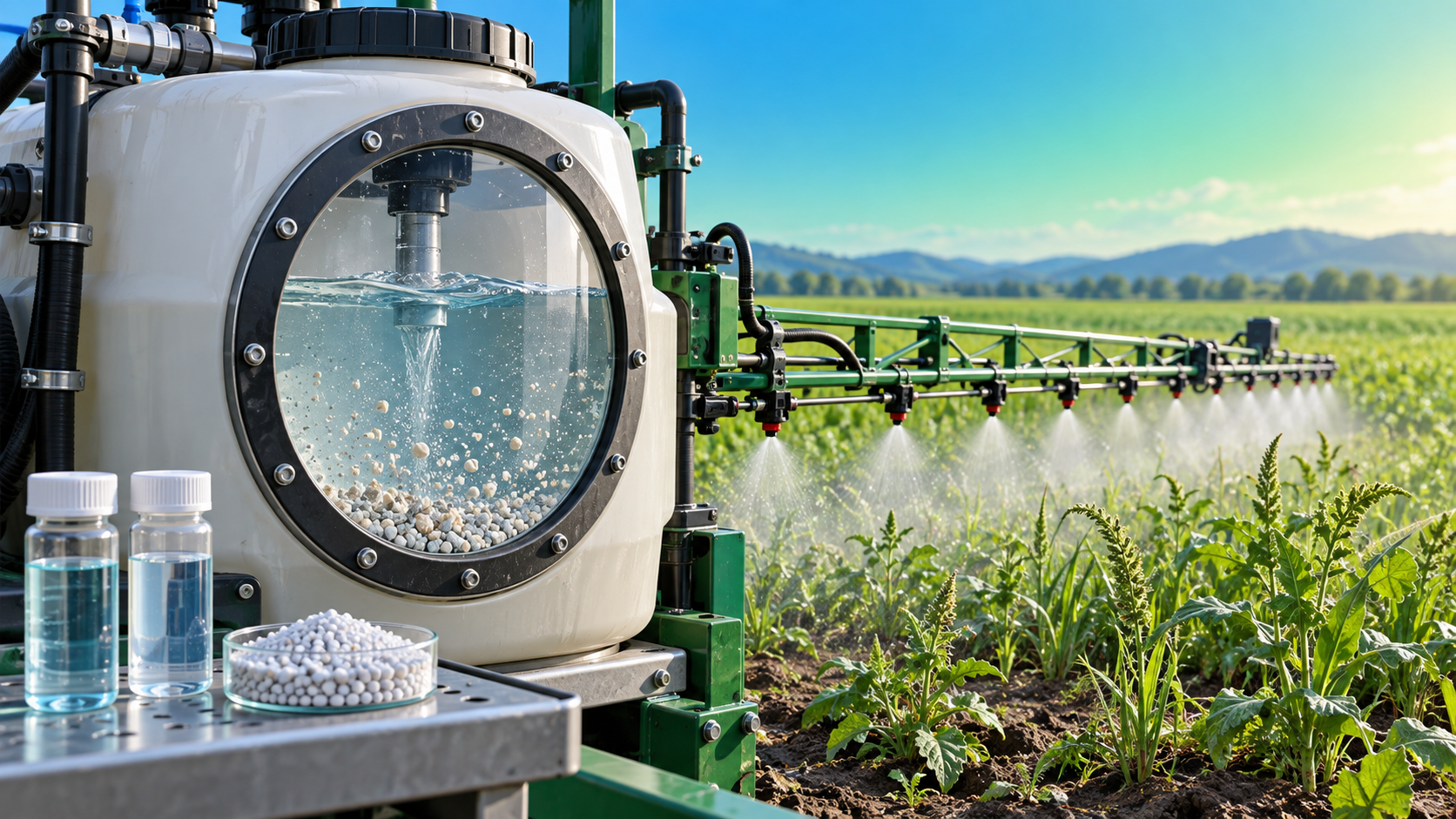
Hard water can reduce glyphosate performance before the spray ever reaches a weed. The problem begins when dissolved mineral ions, especially calcium and magnesium, contact the herbicide in the spray tank. Glyphosate is highly water-soluble and carries acidic functional groups that can associate with positively charged ions. When those ions are abundant, part of the herbicide may form less readily absorbed complexes.
The visible result is often disappointing rather than dramatic: weeds may yellow slowly, regrowth may appear unevenly, and areas supplied by a different water source may show better control even though the same product, rate, nozzle, and weather conditions were used. Increasing the herbicide rate after such a result can waste product if water quality remains the underlying cause.
Why calcium and magnesium interfere with glyphosate
Glyphosate must move from the spray droplet through the leaf surface and then translocate within the plant to growing tissues. Calcium and magnesium do not necessarily make a tank mixture look unstable. A spray solution may remain clear and still contain glyphosate associated with hard-water cations. The concern is reduced biological availability at the leaf surface and reduced uptake after deposition.
This differs from a simple sediment problem. A visible precipitate, flakes, or granular residue signals an obvious compatibility issue, but a clear mixture is not proof that the spray water is suitable. Hard-water antagonism is a chemical interaction that may occur without cloudiness, nozzle blockage, or a change in odor.
Iron, aluminum, and other multivalent ions can also be relevant where water chemistry is unusual, but calcium and magnesium are the routine focus because they are common in well water, irrigation reservoirs, and municipal supplies with elevated hardness. Water drawn from different points on the same property should not automatically be treated as equivalent. A shallow well, a deep well, a storage tank, and a surface-water source can have materially different mineral content.
Hardness is not the same as pH
pH is often checked first because it is simple to measure, yet pH alone does not describe hard-water risk. It measures acidity or alkalinity, whereas hardness reflects dissolved minerals, primarily calcium and magnesium. A water source can have a moderate pH and still contain enough hardness ions to interfere with glyphosate. Conversely, a high pH reading does not by itself establish that glyphosate will be strongly antagonized by hard water.
Alkalinity is another separate measure. It describes the water's capacity to resist pH change, commonly related to bicarbonates and carbonates. Alkalinity can affect how readily the spray solution changes after acidifying additives are introduced, but it should not be used as a substitute for hardness information. Confusing these three measurements leads to poor treatment choices: lowering pH does not necessarily remove calcium and magnesium from solution.
A laboratory water analysis gives the clearest picture when a source will be used repeatedly. Portable hardness strips or field kits can support day-to-day screening, provided they are used according to their stated range and stored correctly. Conductivity meters are useful for detecting a change in water source, but conductivity cannot determine whether the dissolved material is calcium, magnesium, sodium, or another salt. Treat it as a warning signal rather than a dosing tool.
Conditions that make the loss more noticeable
Hard water does not produce identical results in every application. The effect becomes more apparent when the herbicide solution has little margin for error: large, established weeds; species with waxy or hairy leaves; dry conditions that slow active growth; low spray coverage; or short intervals before rainfall. Each of those conditions can limit uptake independently. Mineral antagonism added to them can turn marginal control into a visible failure.
Spray volume also changes the chemistry. Higher carrier volumes introduce more hard-water ions per treated area when the same source water is used. This does not mean low-volume spraying is automatically better; droplet coverage, canopy penetration, drift management, and label directions remain important. It means water volume should be considered when comparing applications from different rigs or deciding whether a conditioner is warranted.
Formulation matters as well. Glyphosate products are supplied in different salt forms and concentrations, and label directions may specify compatible adjuvants or water-conditioning requirements. A practice that works with one formulation should not be transferred blindly to another. The product label is the controlling document for approved uses, mixing order, carrier requirements, and adjuvant restrictions.
Use the correct conditioner for the actual problem
A water conditioner works by managing the ions that would otherwise associate with glyphosate. Ammonium sulfate is widely used for this purpose when allowed by the herbicide label. In addition to supplying ammonium ions, it helps tie up calcium and magnesium before glyphosate is added. Commercial conditioners may combine ammonium sulfate with sequestrants, compatibility agents, or acidifiers, but their names do not guarantee identical function.
Do not assume that every product described as an acidifier, surfactant, spreader, or drift-reduction additive conditions hard water. A surfactant addresses droplet spreading and leaf contact; it does not necessarily neutralize calcium or magnesium. An acidifier can shift pH while leaving hardness ions available. A deposition aid changes droplet behavior. These functions can be useful in their own contexts, yet substituting one for a true water conditioner is a common source of inconsistent results.
The material selected for a tank mixture must have a documented agricultural use and compatibility with the glyphosate product being applied. Chemical catalog listings alone do not establish a spray-tank role. For example, Puerarin CAS#3681-99-0 is a plant-derived flavonoid glycoside associated with functional food, pharmaceutical, and traditional herbal applications; it is not a glyphosate water conditioner and should not be treated as one.
Conditioner dose should follow the label or supplier directions for the particular product and the known water condition. Applying an arbitrary amount based only on tank size is unreliable because two equal-volume tanks can contain very different mineral loads. More conditioner is not automatically better, particularly where additional spray components, sensitive crops, or equipment-cleaning constraints are involved.
Mixing order determines whether the conditioner can work
Adding glyphosate to hard water first and adding a conditioner later is less reliable than conditioning the carrier water before herbicide addition. The objective is to make the problematic ions unavailable before they encounter glyphosate at high concentration. This is especially important when filling a large tank slowly, because the earliest portion of the mixture can be exposed to untreated hard water for a considerable period.
- Begin with a clean tank and partially fill it with the intended carrier water. Residues from prior applications can create separate compatibility or crop-safety problems that resemble a water-quality issue.
- Start agitation and add the approved water conditioner at the required point in the fill sequence. Allow enough circulation for soluble materials to disperse fully.
- Add glyphosate according to the product label, maintaining agitation. If dry formulations or other pesticides are included, use the label-required order rather than a generic tank-mix rule.
- Complete filling with water while agitation continues, then apply without unnecessary delay. Long storage can introduce settling, temperature changes, foam issues, and compatibility changes unrelated to hardness.
For a new combination of water source, herbicide formulation, and additives, a small jar test is useful for observing physical compatibility. Use the same water and approximate mixing proportions planned for the field. A jar test can reveal clumping, layers, excessive heat, gel formation, or precipitate. It cannot prove biological performance, so a clear jar result should never be interpreted as proof that hard-water antagonism has been eliminated.
Separate water problems from application problems
Uneven weed control has several possible causes. Hard-water antagonism is more plausible when poor performance follows a change in water source, when the same application program works with softer water, or when treated weeds show broadly weak response despite acceptable coverage. It is less convincing as the sole explanation when misses occur in narrow bands corresponding to nozzle spacing, boom height, plugged tips, wheel tracks, or shielded foliage.
Leaf condition deserves close attention. Dust-covered leaves, drought stress, cold conditions, mature cuticles, and weeds that were recently mowed or damaged can all limit absorption. Rainfall shortly after application can reduce retained dose. In dense vegetation, droplets may land on upper leaves while target foliage lower in the canopy receives little spray. Hard water cannot be diagnosed from symptoms alone; the application record must be read alongside weather, weed stage, equipment condition, and source-water information.
Keep a simple record of source water, hardness test result or analysis, conditioner product and rate, glyphosate formulation, carrier volume, spray date, and notable weather conditions. When results differ between fields, this record makes it possible to identify a changed variable rather than relying on memory. It also prevents a recurring pattern from being incorrectly blamed on herbicide quality or resistance without evidence.
Water source management between applications
Seasonal changes can alter water chemistry. Surface water may become more concentrated as water levels fall, while stored water can differ from the source that filled it because of evaporation, blending, or sediment disturbance. Switching to a backup well during dry weather is a practical moment to retest hardness rather than carrying forward an old assumption.
Filtration and water softening should be evaluated carefully. Sediment filtration protects pumps and nozzles but does not remove dissolved calcium and magnesium. Household softeners often exchange hardness minerals for sodium, which changes the water chemistry without necessarily making it appropriate for every spray program. Reverse-osmosis water can have very low mineral content, but the operational cost and water volume required may make it impractical for broad-acre spraying. A correctly selected conditioner is often the more direct response, provided the label permits it.
Reliable glyphosate performance starts with treating water as an active part of the formulation. Measure hardness when the source is uncertain, condition the water before adding herbicide, avoid confusing pH adjustment with mineral control, and investigate coverage and weed condition before assigning every weak result to the tank mix.
Send Us Your Inquiry Today
