









Product Quick Navigation
Get a Quote
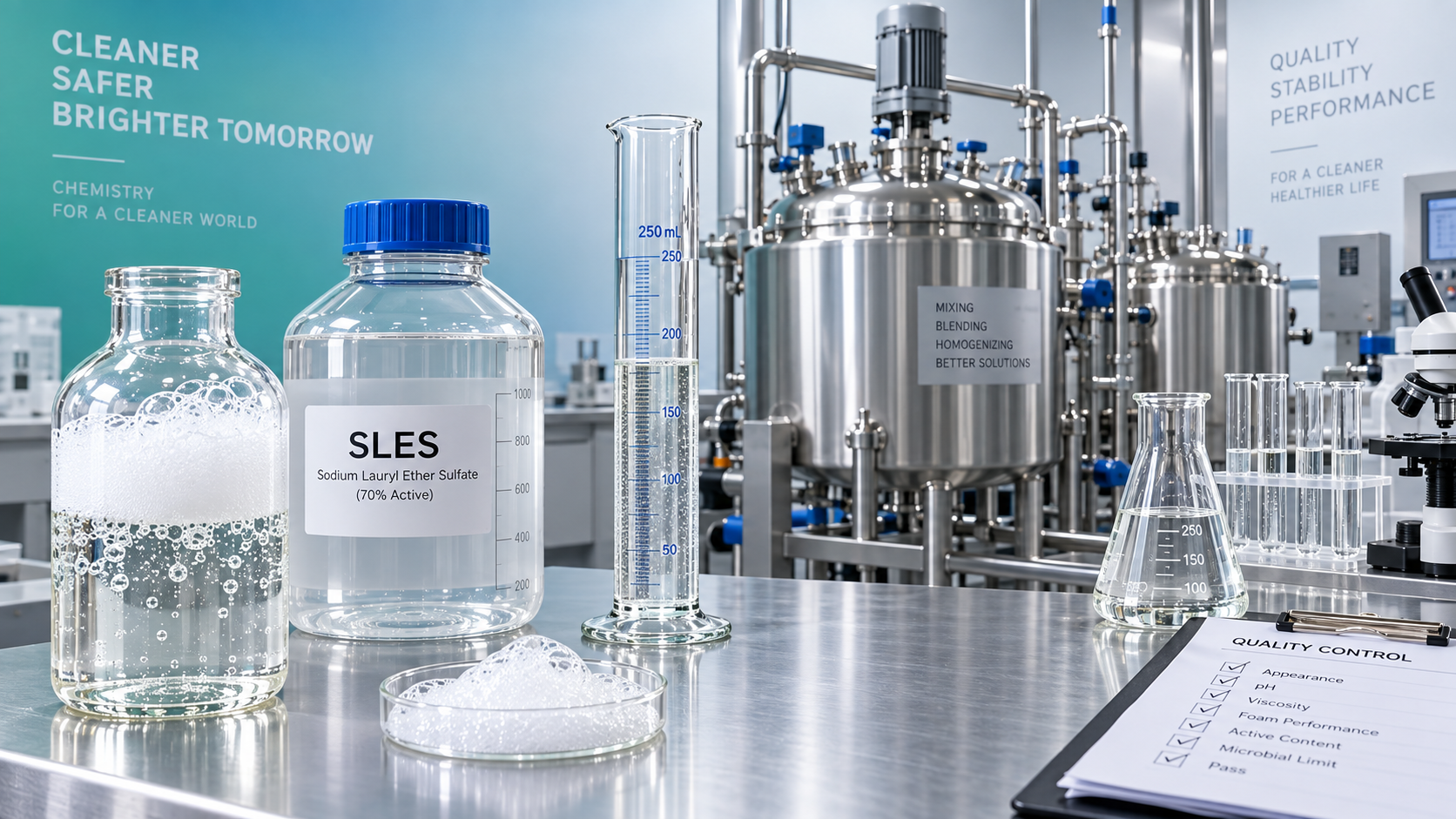
The practical answer is yes: sodium lauryl ether sulfate (SLES) can be used safely in detergent formulations when the finished product is designed for its intended exposure pattern and the raw material is properly controlled. It is widely selected because it provides detergency, wetting, emulsification, and foam at a workable cost. Yet safety is not a property that can be assigned to the surfactant in isolation. A high-active SLES paste, a hand dishwashing liquid, a laundry detergent, and an industrial degreaser place very different demands on the formulator.
For anyone asking is sodium lauryl ether sulfate safe for detergent formulation, the useful question is more specific: safe for whom, at what concentration, under what contact conditions, and with what impurity profile? A formula can perform well in cleaning tests and still create avoidable skin irritation, viscosity instability, excessive foam, or compliance problems if those questions are handled late in development.
Safety depends on the finished detergent, not the ingredient name alone
SLES is an anionic surfactant. In detergents, its surface activity allows oils and particulate soil to be lifted from a surface and dispersed in wash water. That same action can affect the skin barrier when exposure is frequent, prolonged, or concentrated. The presence of SLES in a product does not automatically make the product harsh, just as the use of a lower concentration does not automatically make it mild.
Rinse-off household products usually give formulators more room to use SLES than leave-on products because consumer exposure is shorter and the surfactant is diluted during use. Even within rinse-off detergents, the situation varies. A machine laundry detergent has limited direct skin contact during normal use, while a hand dishwashing liquid may contact the user's hands repeatedly every day. A concentrated detergent pouch can also expose workers or consumers during dosing before the product is diluted.
The final safety profile is influenced by several connected choices:
- SLES active matter and the use concentration in the finished product;
- duration and frequency of skin contact during dosing, washing, and cleanup;
- the presence of co-surfactants, solvents, builders, alkalis, enzymes, fragrances, and preservatives;
- product pH, viscosity, dilution instructions, and packaging design;
- the quality and impurity control of the supplied SLES grade.
For a standard household detergent, SLES is often combined with amphoteric surfactants or nonionic surfactants to balance foam, cleaning power, salt response, and skin feel. That is a formulation decision, not a universal safety fix. A blend that is acceptable in a hand wash product may not be appropriate for a heavy-duty alkaline cleaner, where builders and solvents contribute far more to irritation potential than the surfactant system alone.
Exposure conditions change the judgment
Many discussions about SLES focus on whether it is “safe” or “unsafe” as though there were one answer for every application. That framing is too broad for detergent development. The relevant assessment starts with foreseeable exposure.
For consumer laundry products, assess accidental splashes during dosing, contact with concentrated liquid on skin, inhalation potential from aerosols or powders, and residue remaining after a normal wash cycle. For hand dishwashing liquid, repeated dermal exposure is usually the more demanding issue. For industrial cleaning formulations, the likely users may be trained operators handling concentrates, foam applications, spray equipment, or recirculating wash systems. Those conditions can require controls beyond a label statement, including suitable packaging, dosing equipment, personal protective measures, and workplace handling procedures.
Sprayable systems deserve particular attention. SLES is not chosen primarily for volatility, but a formulation can still generate airborne droplets when sprayed, foamed under pressure, or atomized through equipment. The risk assessment should therefore consider the complete use method rather than looking only at the vapor behavior of individual ingredients.
Raw-material quality is part of the safety case
Two SLES materials described by the same general name may not perform identically in a detergent plant. Commercial grades can differ in active matter, sodium chloride content, pH, color, odor, viscosity, ethoxylation distribution, residual alcohol, and levels of process-related impurities. These differences affect more than appearance. They can alter batch-to-batch viscosity, foam behavior, preservative demand, fragrance stability, and the amount of adjustment required on the production line.
One issue that should be addressed through supplier documentation and applicable market requirements is residual 1,4-dioxane. It can arise as a process-related impurity in ethoxylated surfactants, including SLES. The appropriate control level, test method, and documentation depend on the destination market, intended product category, and customer requirements. Treating this as a procurement checkbox is insufficient. The formulator needs to know whether the supplied grade and its supporting documents are suitable for the regulatory and product-positioning claims planned for the finished detergent.
A purchase specification should be more useful than a request for “SLES 70%” or “SLES 28%.” It should identify the required active matter range, appearance, pH range, sodium chloride range where relevant, color limit, and any impurity or documentation requirements. For export supply, the specification should also align with the language, safety data, transport, labeling, and chemical inventory obligations of the destination country.
Incoming inspection remains valuable even when a supplier has a consistent history. A simple check of active content, pH, appearance, odor, and viscosity can prevent a raw-material variation from becoming a finished-product problem. For formulas sensitive to salt-thickening behavior, pilot adjustment with the received batch may be necessary before full-scale production. SLES systems can show substantial viscosity changes with modest shifts in electrolyte balance or temperature.
Formulation choices can reduce avoidable irritation
When skin contact is expected, formulation work should focus on the whole surfactant package. Reducing SLES concentration may help, but it can also weaken detergency or require compensating changes elsewhere. The better route is often to optimize the ratio of anionic, amphoteric, and nonionic surfactants for the required cleaning job. Cocamidopropyl betaine and other amphoteric materials are commonly considered where foam quality and mildness are important, although each co-surfactant must be evaluated for its own purity, compatibility, and regulatory status.
pH adjustment also requires care. A pH selected only to achieve viscosity or preservative performance may create a product that is less comfortable in use. Conversely, setting pH solely for mildness can compromise cleaning efficacy, product stability, or microbial control. The appropriate target is application-specific and should be confirmed through stability, performance, compatibility, and relevant safety testing.
Fragrance, essential oils, dyes, solvents, and preservatives can complicate the picture. In a consumer complaint investigation, the visible foam is often blamed first, while the contributing factor may be a fragrance allergen, excessive alkalinity, preservative sensitivity, or poor rinse instructions. A disciplined formulation review considers the complete ingredient list and likely consumer behavior.
Claims and compliance need a separate review
“Mild,” “gentle,” “suitable for sensitive skin,” and similar statements should not be inferred merely because SLES has been blended with other surfactants. Such claims can change the evidence expected by customers, retailers, or regulators. They may also create a mismatch between product positioning and normal use conditions.
Likewise, a supplier safety data sheet is essential but does not replace a finished-product assessment. The raw-material classification describes hazards associated with the supplied chemical, often at much higher concentration than the marketed detergent. The finished formulation needs its own classification, labeling review, and safety evaluation based on its final composition and intended use. This distinction is especially important where a formulation is diluted, filled into consumer packs, relabeled by a distributor, or shipped across national borders.
Regulatory requirements differ by market and can change. Buyers should confirm the requirements that apply to the product category and destination before locking the formula, packaging artwork, and technical documentation. Reworking labels or reformulating after goods have been produced is far more disruptive than resolving these questions during supplier qualification.
A practical decision path for buyers and formulators
SLES is a sound choice when its cleaning and foaming profile matches the detergent's job, the expected exposure is understood, and the supplied grade is controlled to the needs of the target market. It is less suitable as a default choice when the product must deliver very low irritation potential under frequent hand contact, when the formula is heavily alkaline, or when the desired claim cannot be supported by the final product evidence.
Before approving an SLES-based detergent, review the intended use, surfactant active level, pH, dilution behavior, packaging, impurity specification, and destination-market documentation together. Then verify the formula under realistic storage and use conditions. That process gives a more reliable answer than either broad reassurance or broad concern about SLES alone.
Send Us Your Inquiry Today
