









Product Quick Navigation
Get a Quote
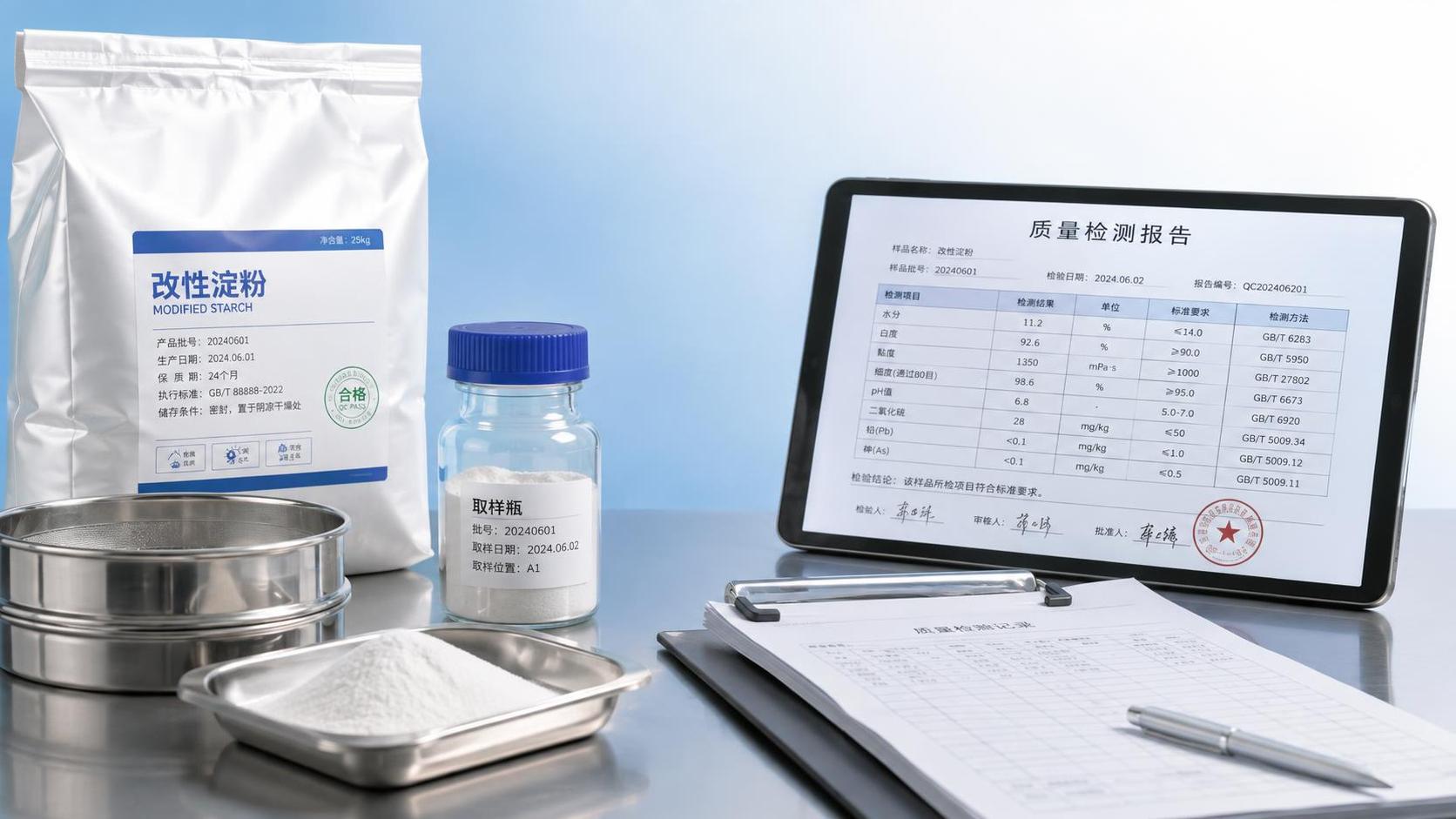
What Should I Check in a Modified Starch Quality Report Before Payment?
Before releasing funds for modified starch, verify that the quality report proves the delivered batch meets your approved specification, application requirements, and importing-market obligations.
A basic certificate of analysis is not enough. Buyers should compare physical, chemical, microbiological, documentary, and batch-traceability details before authorizing final payment.
What Buyers Are Really Trying to Confirm Before Payment
The core search intent behind “what should I check in modified starch quality report before payment” is practical risk control, not laboratory theory.
Buyers want to know whether the report represents the actual shipment, whether performance will remain stable, and whether discrepancies can be defended contractually.
For procurement managers, an unsuitable batch can cause production interruptions, customer complaints, reformulation costs, delayed deliveries, and disputes involving freight or customs clearance.
For quality teams, the immediate concern is whether reported figures fall within agreed limits and whether the test methods are credible and repeatable.
For importers, compliance evidence matters equally. A batch that performs well can still create losses if supporting documents fail regulatory or customer requirements.
Therefore, the best review process is not simply checking whether every result says “pass.” It is confirming identity, relevance, consistency, and commercial usability.
Before payment, place the supplier’s report beside the purchase contract, approved sample specification, technical data sheet, and any customer-specific requirements.
This comparison reveals whether the supplier is reporting useful acceptance data or merely presenting a generic document designed to look complete.
Start With Batch Identity, Shipment Linkage, and Document Control
First, confirm the certificate of analysis clearly identifies the exact product grade, batch number, production date, packaging date, and report issue date.
The batch number on the quality report must match the number printed on bags, pallets, container loading records, commercial invoice, and packing list.
If a supplier provides one report for multiple batches, request separate batch records unless your contract explicitly permits a defined composite sampling procedure.
Modified starch performance can vary between production runs because raw material quality, reaction control, drying conditions, and blending practices influence final properties.
Check the quantity covered by the report. It should correspond to the shipment quantity or identify exactly which portion of the shipment it represents.
Also confirm that the report names the manufacturing site. Trading companies may issue documents, but the analytical source and actual producer should remain transparent.
Look for an authorized signature, stamp, electronic approval trail, or quality-control release reference. Unsigned reports provide weak evidence during later claims discussions.
Verify the report date is logical. A report issued before production, after loading without explanation, or reused across unrelated orders deserves immediate investigation.
Confirm the Modification Type and Product Grade
“Modified starch” is a broad category. The report should state the specific modification, such as oxidized, acetylated, cationic, hydroxypropylated, cross-linked, or pregelatinized starch.
Do not accept a report that only describes the product as “modified starch” when the intended application depends on a defined chemical modification.
The modification type controls practical behavior, including gelatinization, viscosity stability, film formation, ionic interaction, freeze-thaw resistance, and compatibility with other ingredients.
Confirm the botanical source as well, including corn, tapioca, potato, waxy maize, wheat, or another agreed feedstock source.
Botanical origin can affect viscosity profile, clarity, texture, allergen considerations, labeling requirements, and processing behavior in paper, textile, food, adhesive, or industrial systems.
Where relevant, compare the report against the approved technical data sheet for degree of substitution, oxidation level, nitrogen content, or other modification-specific indicators.
For cationic starch, nitrogen content or degree of substitution may be commercially critical because it affects retention, drainage, and bonding performance.
For oxidized starch, carboxyl content, fluidity, viscosity, and pH can indicate whether oxidation has been controlled within the required performance window.
Review Moisture, pH, Whiteness, and Particle Characteristics
Moisture is one of the most important values to check because it affects storage stability, net dry solids, handling, microbiological risk, and usable material yield.
A moisture result within specification may still be commercially concerning when it sits near the upper limit, especially for long sea shipments or humid destinations.
Ask whether moisture was measured before or after packaging and whether the product uses moisture-barrier bags suitable for the planned transport conditions.
pH should match the agreed range because it influences chemical stability, compatibility with additives, process safety, and downstream formulation performance.
Unexpected pH movement may signal inconsistent modification, contamination, inadequate neutralization, or product aging during storage before shipment.
Whiteness matters for paper coating, food applications, pharmaceutical excipients, textiles, and any finished product where color appearance affects acceptance.
Review the measurement method and scale for whiteness. Different instruments and standards can produce results that are not directly comparable.
Particle size, sieve residue, or fineness data is important where dusting, dispersion speed, screen blockage, slurry preparation, or coating smoothness affects operations.
If particle-size data is absent for a sensitive application, request it before payment instead of assuming that an identical product name ensures identical processing behavior.
Examine Viscosity Using the Correct Test Conditions
Viscosity is frequently the most commercially important modified starch property, but the number is meaningful only when test conditions are clearly specified.
Check the starch concentration, water quality, temperature, heating procedure, shear conditions, instrument type, spindle, rotation speed, and measurement timing.
A viscosity value measured at five percent solids cannot be compared reliably with one measured at ten percent solids or under a different cooking cycle.
For instant or pregelatinized grades, confirm whether viscosity was measured in cold water, warm water, or after a defined hydration period.
For cooked starches, examine the full preparation method. Small differences in heating rate, holding time, and agitation can materially change reported results.
When production depends on stable rheology, request a viscosity curve or application-relevant profile rather than relying only on a single endpoint measurement.
This is especially important for paper coatings, textile sizing, corrugated adhesives, tablet processing, sauces, and high-speed industrial mixing systems.
Compare the reported result with the approved sample and historical batches. A passing value near a specification boundary may still create unacceptable process variation.
Check Microbiological and Food-Safety Requirements Where Applicable
For food, feed, pharmaceutical, personal-care, and certain fermentation-related uses, microbiological limits must be reviewed before payment and shipment release.
Typical checks may include total plate count, yeast and mold, coliforms, Escherichia coli, Salmonella, Staphylococcus aureus, and Bacillus cereus where required.
The correct panel depends on the product application, destination regulations, customer standards, and whether the starch will receive further heat treatment.
Do not treat a broad statement such as “microbiologically acceptable” as sufficient. The report should show numerical limits, test results, and test methods.
Check whether results are reported as absent, not detected, below a quantification limit, or below a regulatory limit. These terms are not interchangeable.
Microbial results should be linked to the same batch as the physical and chemical data. Separate undated microbiology sheets create avoidable uncertainty.
For food-contact or edible uses, also review allergen declarations, genetically modified organism status, pesticide residue information, and heavy-metal limits when contractually relevant.
Requirements differ across markets. Importers should map report contents to the destination country’s rules and to the standards imposed by their downstream customers.
Verify Chemical Safety, Residuals, and Regulatory Compliance
The required chemical safety checks depend on the modification process, intended use, and destination market. There is no universal compliance package for every modified starch.
For food applications, ask for evidence aligned with applicable food additive, food-contact, contaminant, and labeling requirements in the importing jurisdiction.
For industrial uses, buyers may need Safety Data Sheets, REACH-related information, TSCA status, chemical inventory declarations, and restricted-substance confirmations.
Check whether the report addresses residual reagents, sulfur dioxide, heavy metals, ash, insoluble matter, chlorinated by-products, or other relevant process contaminants.
Never assume that a low-risk raw material eliminates compliance risk. The modification chemistry, processing aids, and packaging materials can introduce additional obligations.
Request current declarations rather than relying on expired files from prior orders. Regulatory status, supplier formulations, and market rules can change over time.
Where a customer requires specific certifications, verify the issuing organization, certificate scope, validity date, manufacturing-site coverage, and product applicability before payment.
Examples may include ISO systems, FSSC 22000, BRCGS, Kosher, Halal, non-GMO, organic, pharmaceutical suitability, or food-contact compliance statements.
Assess Sampling, Test Methods, and Laboratory Credibility
A quality report is only as trustworthy as its sampling and testing process. Buyers should ask how samples were selected, retained, and protected from contamination.
Ideally, the sample should be drawn from finished, packed goods using a documented plan that represents the production batch and shipment quantity.
For large orders, specify in the contract whether sampling occurs per batch, per container, per pallet group, or according to an agreed statistical approach.
Review whether the report cites recognized methods, such as ISO, ASTM, AOAC, GB, USP, EP, or a validated internal laboratory procedure.
An internal method is not automatically unacceptable, but it should be documented clearly enough to establish repeatability and comparison with agreed acceptance limits.
For high-value or sensitive applications, require testing by an accredited third-party laboratory, especially for microbiology, contaminants, regulatory residuals, or disputed performance characteristics.
Third-party inspection is most useful when payment terms, product complexity, destination risk, or the cost of production failure exceeds the inspection expense.
Consider retaining a sealed reference sample from each shipment. This creates an objective basis for re-testing if claims arise after delivery.
Look Beyond Pass or Fail: Evaluate Batch Consistency
Modified starch buyers should not judge only whether a single report meets limits. They should also evaluate consistency against previous approved shipments.
Trend moisture, viscosity, pH, whiteness, ash, and modification-specific indicators over time. Repeated movement toward limits often predicts later production problems.
A supplier may technically meet the specification while delivering increasingly variable quality that forces your operators to adjust formulations or process settings.
Establish internal alert ranges that are narrower than contractual limits for properties that strongly affect your production efficiency or final product quality.
For example, your contract may allow a broad viscosity range, while your coating line performs efficiently only within a much tighter operating window.
Use supplier scorecards to track report accuracy, delivery punctuality, complaint frequency, corrective-action quality, document completeness, and batch-to-batch stability.
This approach changes quality review from a payment checkpoint into a practical supplier-management system that supports stable global supply chains.
Reliable suppliers should be able to explain normal variation, provide historical trend data, and investigate unusual results without delaying essential commercial communication.
Set Clear Payment Hold Points and Escalation Rules
Before placing orders, define which report items are mandatory for payment release and which deviations require written approval from technical or quality personnel.
Payment should be held when the batch identity is unclear, a critical value exceeds specification, a required test is missing, or compliance documents conflict.
For borderline but technically conforming results, assess the application risk, shipment urgency, historical consistency, and cost of mitigation before making a commercial decision.
Ask the supplier for raw laboratory records, retained-sample re-tests, explanation of deviations, additional certificates, or independent testing when report credibility is uncertain.
Do not allow procurement pressure alone to override unresolved quality concerns. The short-term benefit of releasing payment can be outweighed by downstream losses.
Contracts should specify acceptance criteria, test methods, sampling responsibility, claim windows, independent laboratory procedures, and remedies for nonconforming goods.
Clear contractual language reduces disputes because both parties know whether a reported number, method difference, or sampling result constitutes acceptable performance.
For international trade, align these clauses with Incoterms, inspection timing, document-release conditions, and the practical point at which cargo becomes difficult to recover.
A Practical Pre-Payment Checklist for Modified Starch Shipments
Before approving payment, confirm that the report identifies the exact product grade, modification type, botanical source, production batch, quantity, and manufacturing location.
Verify that batch numbers match the packing list, invoice, labels, loading documents, and any pre-shipment inspection records without unexplained differences.
Compare moisture, pH, viscosity, whiteness, particle size, ash, solubility, and other critical values against your signed specification and approved sample history.
Ensure viscosity testing includes complete conditions, including concentration, temperature, cooking or hydration method, equipment, timing, and units of measurement.
Review microbiological, contaminant, residual, and regulatory data according to the actual application and destination market, rather than using a generic template.
Confirm testing methods, sample representativeness, laboratory authorization, report date, and document authenticity before treating the certificate as evidence of release quality.
Escalate any missing test, unusual result, near-limit value, mismatched batch number, expired declaration, or unexplained change before final funds are transferred.
Conclusion
A modified starch quality report should function as a commercial control document, not merely a formality attached to an invoice or shipping file.
The most important checks are shipment-to-batch traceability, correct product identity, application-relevant performance values, credible test conditions, and destination-specific compliance evidence.
Buyers who review reports against approved specifications, historical trends, and contractual acceptance rules make better payment decisions and reduce costly supply-chain surprises.
Before payment, focus on whether the documented batch can perform reliably in your process and enter your market legally, not simply whether the report appears complete.
Send Us Your Inquiry Today
