









Product Quick Navigation
Get a Quote
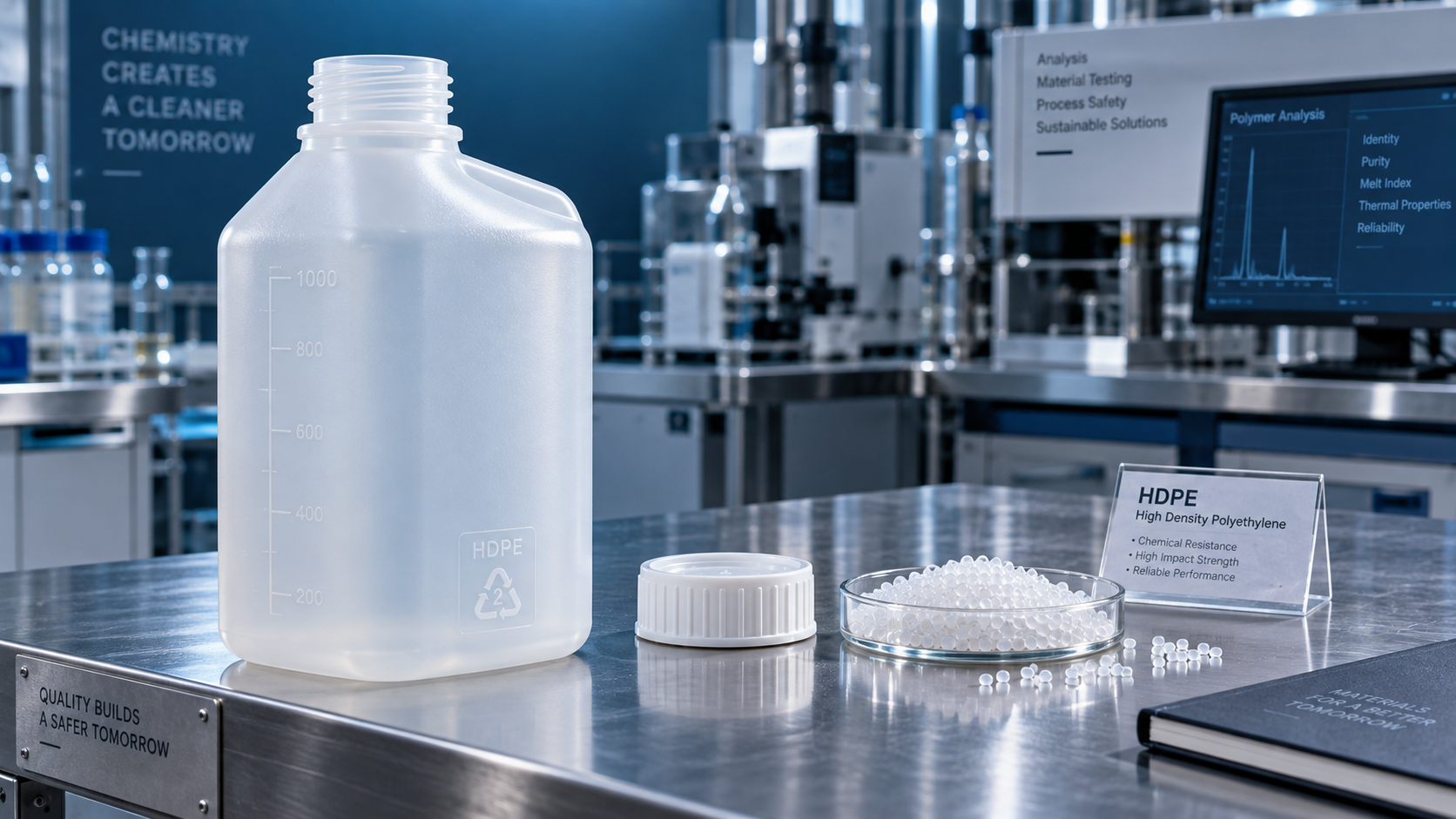
What Causes Stress Cracking in Polyolefin Resin Containers?
A polyolefin container can look perfectly acceptable when it leaves the production line and still fail weeks later in storage, during transport, or after contact with the packaged material. The failure may begin as a faint haze near a shoulder, handle, thread, weld line, or base corner. In more serious cases, visible cracks develop and the container leaks under load. For chemical operations, this is not merely a packaging defect. It can create exposure risks, contaminate secondary packaging, interrupt shipment schedules, and raise questions about compliance with transport and product-safety requirements.
Stress cracking in containers made from Polyolefin Resins is usually the result of several interacting factors rather than one obvious mistake. Mechanical stress, resin characteristics, molded-in defects, the chemical nature of the contents, and temperature history all matter. The practical challenge for quality and safety teams is that a container may pass a short visual inspection while carrying the conditions for delayed failure.
The most useful way to investigate the problem is to stop treating “polyolefin” as a single material category. High-density polyethylene, low-density polyethylene, polypropylene, copolymers, recycled-content formulations, and multilayer structures can respond very differently to the same liquid, filling process, or transport route.
Stress cracking is a combined chemical and mechanical event
Environmental stress cracking, often abbreviated as ESC, occurs when a polymer under tensile stress is exposed to a substance that accelerates crack initiation or crack growth. The substance does not necessarily dissolve the container or visibly attack it. That is why the problem can be missed during basic compatibility checks. A liquid may appear harmless in a short immersion test but still promote cracking when the same resin is under sustained stress from a tight closure, a stacked pallet load, or distortion from handling.
In polyethylene containers, the vulnerable areas are often locations where polymer chains are already constrained or oriented by molding. In polypropylene, low-temperature brittleness and stress concentration can become more significant depending on the grade and service conditions. A crack often starts at a local imperfection, then propagates through the wall under the combined effect of stress and exposure.
This explains why a container can survive an initial drop test yet fail on a warehouse shelf. Drop resistance measures one type of performance. Long-term resistance to a chemical environment under static load is another.
Residual stress from molding is often the hidden starting point
Residual stress is locked into the container during extrusion blow molding, injection molding, injection stretch blow molding, or similar conversion processes. Uneven cooling, excessive orientation, poor parison control, abrupt wall-thickness changes, and unsuitable processing temperatures can all leave stressed regions in the finished part. These areas may not be apparent to the naked eye.
A common field pattern is cracking around the neck finish after capping. In that situation, the mold may be only part of the story. An over-torqued closure, an incompatible liner, or a neck geometry that concentrates load can push an already stressed area beyond its tolerance. Similarly, cracks at the handle root or container shoulder often point to a combination of thin-wall design, molding orientation, and the repeated flexing caused by lifting a filled package.
Quality control should therefore compare failed containers with retained samples from the same production lot. Look at wall-thickness distribution, flash, weld lines, gate or pinch-off areas, neck dimensions, closure torque records, and molding conditions where available. It is rarely enough to conclude that the resin “was weak.” The failure location usually provides a better clue than the overall appearance of the container.
Chemical exposure can trigger cracks without obvious corrosion
Certain surfactants, detergents, wetting agents, solvents, oils, plasticizers, and formulations containing mixed ingredients can reduce the time required for stress cracks to form. The risk is formulation-specific. Concentration, water content, pH, impurities, additives, and temperature can change the result. It is not safe to assume that compatibility with one grade of detergent, for example, proves compatibility with every detergent blend.
The relevant exposure is not always the primary product. External contamination can matter too. Residues from line cleaning, label adhesives, pallet treatments, lubricants, or leaked neighboring goods may contact the container surface. For export shipments, the container may also sit for extended periods in secondary packaging where any small leak or condensate has little opportunity to evaporate.
A useful distinction is between chemical resistance and environmental stress-crack resistance. A resin supplier may provide a general resistance guide, but a guide cannot replicate the actual combination of product formulation, container geometry, closure load, fill level, and shipment duration. When the consequence of leakage is high, testing the final package with the actual formulation is the safer decision.
Temperature cycling changes the risk profile
Temperature is frequently underestimated because containers are often tested at room conditions and shipped through far less stable environments. Heat can accelerate chemical interaction and stress relaxation; cold can reduce impact tolerance and make some materials less forgiving of existing flaws. Repeated warming and cooling also cause the contents, container, closure, and headspace to expand and contract at different rates.
A sealed drum or jerrican filled close to capacity is particularly sensitive to thermal expansion of the contents. Internal pressure does not need to be extreme to add meaningful stress at the shoulder, neck, and closure. Containers packed tightly on pallets may also experience distortion when wrap tension, stacking loads, and temperature change are combined.
For shipments moving through different climate zones, the question should not be simply, “Will the package survive the destination temperature?” It should be, “What thermal cycle will it experience from filling through warehousing, container loading, transit, and unloading?” This is a more realistic basis for package qualification.
Resin selection matters, but grade selection matters more
Polyolefin Resins are selected for packaging because they can offer low weight, good moisture resistance, processability, and broad chemical tolerance. Those advantages do not make every grade interchangeable. Molecular weight distribution, density, crystallinity, copolymer content, additive package, melt flow characteristics, and recycled-content level can influence stress-crack behavior and molding consistency.
For a high-risk formulation, specifying only “HDPE” or “PP” is too broad. Procurement and technical teams should identify the intended processing method, target wall thickness, chemical exposure, fill temperature, closure design, stacking load, and expected service life. A resin that performs well in a light household bottle may not be appropriate for a heavy chemical container subject to long-term storage.
Regrind and recycled resin deserve a similarly practical review. Their use may be appropriate in some packaging programs, but source consistency, contamination control, odor, mechanical performance, and regulatory suitability need to be assessed for the actual application. The issue is not whether recycled content is categorically acceptable or unacceptable; it is whether the formulation and quality controls are sufficient for the exposure and failure consequences involved.
Where inspection programs commonly fall short
Visual inspection remains necessary, but it is a weak standalone defense against delayed stress cracking. Early-stage damage can be microscopic, and a container may only reveal its weakness after days of contact with the product. Better control comes from linking incoming-material checks, molding records, filling-line settings, and retained-package testing.
- Retain filled samples from representative production batches, especially after a resin, colorant, closure, supplier, or formulation change.
- Inspect typical initiation zones: neck threads, corners, handle transitions, pinch-off lines, seams, label edges, and areas rubbed by secondary packaging.
- Record actual closure torque rather than relying only on machine settings.
- Evaluate packages under realistic storage orientation and stacking conditions. Upright-only testing can miss closure-area failures.
- When a crack is found, preserve the failed package, its contents, closure, label, and batch information before cleaning or disposal.
Fracture appearance can help guide the investigation, although laboratory examination may be required for a reliable conclusion. A brittle-looking crack near a stressed feature may suggest a stress-concentration issue. Widespread fine crazing after product contact may indicate an ESC mechanism. The two can coexist, so the investigation should not be narrowed too early.
Packaging compatibility also applies to dry and hygroscopic materials
Stress cracking is often discussed in relation to liquids, but dry products can create packaging concerns of their own. Hygroscopic powders may change flow behavior when exposed to moisture, while repeated opening, reclosing, and handling can fatigue closures or distort lightweight containers. In food and specialty chemical supply chains, packaging decisions should account for moisture protection, dust control, pallet stability, and whether the product may be dissolved or processed by the customer after delivery.
For example, Xylitol CAS#87-99-0 is supplied as a white crystalline, water-soluble, hygroscopic powder and is used in applications such as beverages, confectionery, chewing gum, baked goods, and throat lozenges. Its normal room-temperature storage profile does not make it a typical ESC challenge for polyolefin packaging in the way an aggressive surfactant blend might be. Still, the package should be assessed for moisture ingress, seal integrity, handling stress, and the conditions of the full export route. The correct packaging question is always product-specific.
A practical response when cracks appear
When stress cracking is reported, isolating all inventory immediately may be necessary where leakage or exposure is possible, but the technical response should be organized rather than speculative. Start by identifying when cracks appeared: before filling, after capping, after warehouse storage, after transport, or after customer use. Then map their location and direction. A pattern concentrated at one feature is more informative than a simple count of failed units.
Next, review what changed. Resin substitutions, masterbatch changes, higher regrind percentages, faster molding cycles, altered cooling, new closure suppliers, modified torque settings, product reformulation, and different freight conditions are all credible contributors. In practice, a “minor” change made by separate teams can create a major interaction at package level.
Corrective action may involve changing the resin grade, reducing residual stress through process adjustment, increasing wall thickness at a critical feature, revising container geometry, changing the closure system, or introducing a barrier or alternative package construction. The best choice depends on the actual failure mechanism. Adding material everywhere may be expensive and still fail to solve a chemical compatibility problem. Conversely, changing resin grade alone will not correct excessive closure torque.
Why supply-chain visibility affects container safety
For international chemical trade, package performance is tied closely to document control, batch traceability, realistic transit planning, and communication between resin supplier, converter, filler, and exporter. A container that is technically acceptable in a local, short-duration distribution cycle may need additional verification for a long export route.
Shandong Huafeng Chemical Co., Ltd., based in Shandong Province, works across chemical export supply chains where product range, documentation responsiveness, and delivery coordination must be considered together. In this setting, packaging information should travel with the product: storage requirements, lot identification, material specifications where applicable, and any handling limitations should not remain isolated within one department.
Stress cracking is preventable more often than it is predictable by appearance alone. The sound approach is to qualify the finished package under conditions close to reality, investigate failure patterns before assigning blame, and treat resin, design, processing, contents, and logistics as one connected system. That is the level of control that reduces unpleasant surprises after a shipment is already in motion.
Send Us Your Inquiry Today
