









Product Quick Navigation
Get a Quote
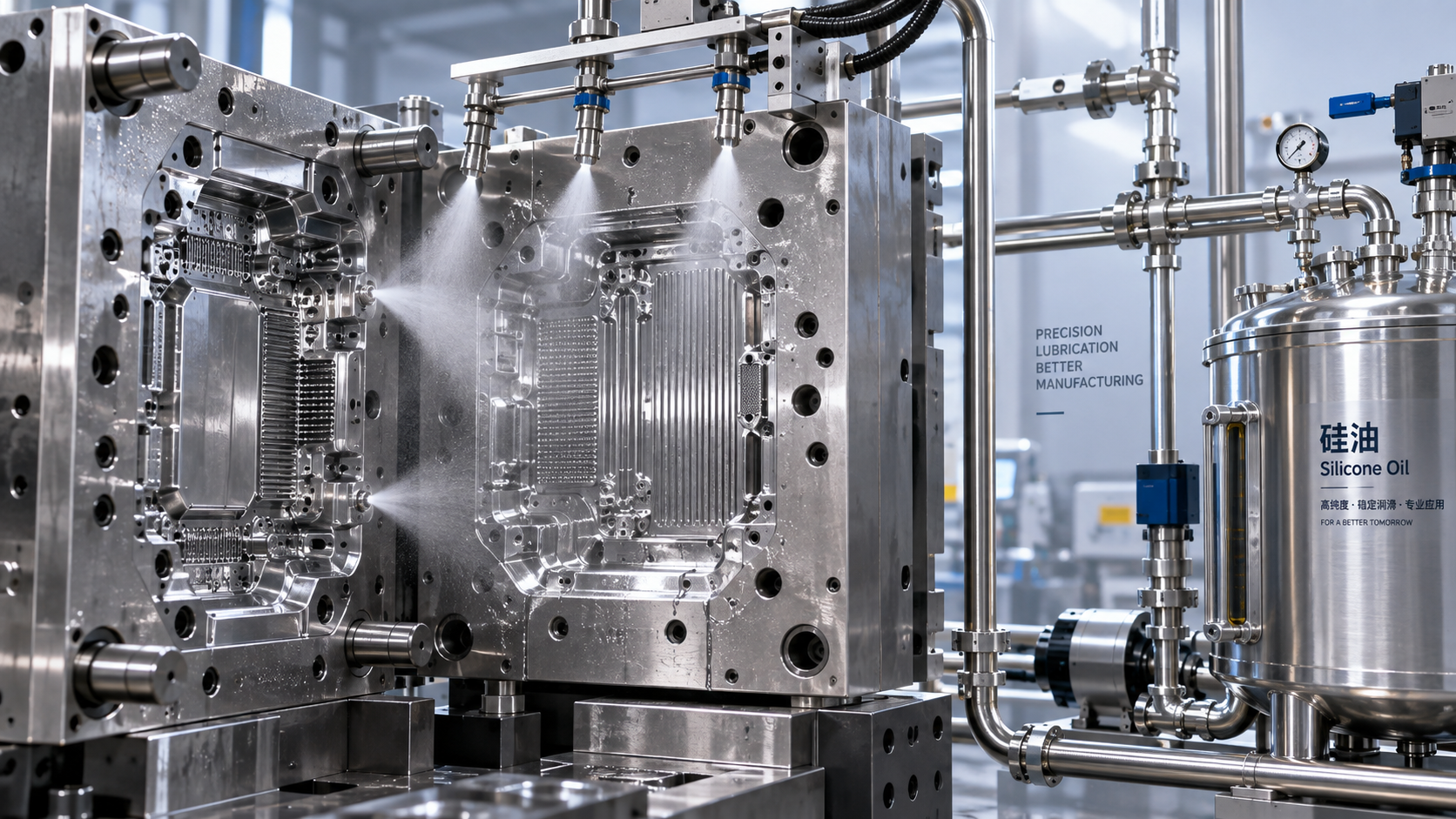
What Silicone Fluid Viscosity Is Needed for Mold Release?
There is no single “correct” silicone fluid viscosity for mold release. In practical production, the right grade is the one that forms a continuous film on the mold, releases the part cleanly, and does not create avoidable residue, surface defects, or downstream bonding problems. A fluid that works well on a simple rubber compression mold may fail completely in a narrow, high-temperature injection mold with deep ribs and tight vent areas.
For most operators, viscosity selection begins with a simple trade-off. Low-viscosity Silicone Fluids spread quickly and reach detailed mold surfaces easily, but their release film can be thin and short-lived. Higher-viscosity grades stay in place longer and usually provide more persistent lubrication, yet they may be harder to atomize, may pool in corners, and can transfer too much oil to the molded article if applied carelessly.
The practical question is therefore not just “What cSt should I buy?” It is: how much release persistence does this mold need, how is the fluid applied, and how clean must the finished part remain?
Start with the molding process, not the viscosity number
Silicone fluid viscosity is commonly expressed in centistokes, or cSt. Lower numbers indicate a thinner, more mobile fluid; higher numbers indicate a thicker material. This tells an operator something useful, but it does not by itself predict release performance. The same nominal viscosity can behave differently depending on mold temperature, surface finish, dilution, additives, and the material being molded.
As a working starting point, very low-viscosity fluids are often considered where rapid wetting and fine spray coverage matter most. Medium-viscosity grades are frequently used for general mold-release duties because they balance coverage and film durability. High-viscosity silicone oils are more relevant where the mold is demanding, the part tends to stick, or repeated cycles are expected before reapplication. These are starting categories, not universal prescriptions.
For a clean, open mold producing relatively simple parts, a low-viscosity fluid may be entirely adequate. If the fluid is wiped on with a lint-free cloth rather than sprayed, the operator can often use a somewhat higher viscosity because atomization is no longer the limiting factor. On the other hand, a mold with fine venting, thin cores, deep cavities, or a matte texture often needs excellent wetting first. Choosing an extremely thick oil in that situation can leave unprotected areas even though the material looks “more lubricating” in the container.
How mold geometry changes the decision
Mold geometry is one of the most overlooked parts of release-agent selection. Flat surfaces are forgiving. Deep draws, sharp corners, engraved logos, ribs, undercuts, and narrow channels are not. A thin silicone fluid can enter these areas quickly, especially when applied as a controlled mist. But thin fluid can also drain away from vertical surfaces or be displaced after only a few cycles.
If sticking occurs only in one localized area, switching the entire process to a heavier silicone oil is often the wrong first reaction. Check whether the real cause is incomplete coverage, a damaged coating, resin buildup, poor venting, an unfavorable draft angle, or a temperature imbalance. Release chemistry can compensate for some process issues, but it should not be expected to cure a mechanical mold problem.
Textured or etched molds deserve special attention. A high-viscosity fluid can lodge in the texture and gradually soften the intended surface definition of the molded part. For visible consumer components, this can be more troublesome than occasional sticking. A lower-viscosity product, applied in very light coats at a controlled frequency, is often easier to manage when surface appearance is critical.
Match the fluid to the molded material and post-processing requirement
The material being molded determines how much release assistance is needed and how much silicone contamination can be tolerated. Rubber compounds, thermosets, composite materials, polyurethane systems, and some filled plastics may demand a more persistent release film than straightforward thermoplastic molding. However, “more persistent” should not automatically mean “higher viscosity.” Compatibility and transfer behavior matter just as much.
Silicone residue can interfere with printing, painting, coating, adhesive bonding, metallization, and some secondary assembly operations. When a part will be painted or bonded later, the release agent must be evaluated with that downstream step in mind. A mold may release perfectly, yet the finished item can fail later because a barely visible silicone layer prevents good adhesion. In these cases, a minimal application rate, a lower-transfer chemistry, or a non-silicone release system may be more suitable.
Food-contact, cosmetic, pharmaceutical, or other regulated end uses require a separate review. Operators should not assume that a silicone fluid used in general industrial molding is acceptable for every regulated application. The relevant formulation, intended use, local requirements, cleaning procedure, and documentation should be checked before the material reaches production.
Application method can matter more than a 100 cSt difference
A suitable fluid applied badly will still cause defects. Spray application generally favors lower-viscosity materials or a formulation designed to atomize consistently. If the spray produces droplets rather than a fine, even mist, thick spots can develop near gates, corners, and mold edges. Those spots may lead to gloss variation, oil marks, or excessive transfer onto the part.
Wiping and brushing permit more control, especially on large molds or limited problem areas. They also make medium- and higher-viscosity fluids more workable. The downside is operator variation: one person may leave a nearly invisible film, while another may apply enough material to create buildup after a few cycles. For repeatability, it is worth defining the application tool, approximate quantity, target surfaces, and reapplication trigger rather than leaving the decision entirely to individual judgment.
For automated systems, evaluate viscosity at the actual delivery temperature, not only at room temperature in a product data sheet. Pumpability, line pressure, nozzle design, and spray pattern all affect the result. A fluid that moves well in a warm production area can become sluggish in a colder warehouse or during winter startup.
Temperature and cycle time shift the practical viscosity window
Hot molds reduce the apparent thickness of silicone oils. A grade that seems heavy during manual handling can become very mobile once it reaches the mold surface. This may improve coverage, but it can also increase migration, smoking risk from contamination or degradation elsewhere in the system, and residue movement toward parting lines. The release film should be assessed under normal production temperature, not after a cold trial on an idle mold.
Fast cycle times can create another misconception. When a release agent appears to fail after several short cycles, the issue may be insufficient time for the film to establish evenly, not insufficient viscosity. Conversely, long hot cycles may drive a thin film away more quickly and justify a more persistent grade. Looking at the mold after the first cycle is rarely enough; operators should inspect release behavior after the process has stabilized.
A practical way to test Silicone Fluids without disrupting production
The most useful trial is controlled and small. Select two or three candidate viscosities rather than ordering a wide range. Keep the resin or compound, mold temperature, cure or cooling time, application tool, and operator method as consistent as possible. Then compare the materials over enough cycles to reveal buildup or declining release performance.
- Ease of application: Does the fluid wet the required surfaces without running or pooling?
- Release force and consistency: Are parts coming out cleanly through a normal run, not just the first few cycles?
- Part appearance: Check gloss, texture definition, stains, oily marks, and contamination around edges.
- Mold condition: Watch for residue in vents, corners, ejector areas, and textured surfaces.
- Downstream compatibility: If the part will be painted, printed, or bonded, include that check in the trial.
Do not judge consumption only by how frequently the product is applied. A thicker fluid may need fewer applications but can create more cleaning work. A thinner fluid may require more frequent use but leave less residue and support better finish quality. The better economic choice is usually the one with the lowest total disruption, including rejected parts, mold cleaning, labor, and downstream rework.
Do not confuse formulation additives with silicone release agents
In chemical formulation work, operators sometimes encounter lubricants, surfactants, dispersants, plasticizers, and processing aids that influence flow or release behavior indirectly. These materials should not automatically be substituted for Silicone Fluids. Their chemistry, water response, thermal behavior, residue profile, and interaction with the molded substrate can be very different.
For example, Polyethylene Glycol CAS#25322-68-3 is a separate chemical material used across industrial formulations, including applications involving dispersion, emulsification, viscosity control, and processing. Its reported characteristics include water solubility and hygroscopic behavior, which are materially different from the behavior expected of a typical silicone mold-release fluid. It may be relevant in a formulation discussion, but it should not be selected as a direct replacement for a silicone release agent without compatibility testing and a clear understanding of the process objective.
Supply consistency is part of viscosity selection
For export-oriented chemical purchasing, consistency between deliveries matters almost as much as the initial sample. A mold-release process set around one viscosity can become unstable if the delivered fluid varies in flow behavior, cleanliness, packaging condition, or documentation. This is especially relevant when production is spread across countries and the material must move through long supply chains.
Suppliers such as Huafeng Chemical, operating from Shandong’s established chemical manufacturing and trading base, are often asked not only for a product grade but also for responsive communication, stable export handling, and supporting technical information. Before approving a grade, confirm the viscosity test conditions, batch identification approach, storage recommendations, packaging suitability, and documents required at destination. A value quoted without those details can be misleading.
For routine work, begin with a low- or medium-viscosity silicone fluid when coverage and appearance are the priorities. Move upward only when trials show that the release film is genuinely not lasting long enough. If the mold is hot, deeply textured, difficult to clean, or followed by painting or bonding, test the complete process rather than selecting by viscosity alone. That is how operators avoid the common cycle of solving sticking today and creating residue problems tomorrow.
Send Us Your Inquiry Today
