









Product Quick Navigation
Get a Quote
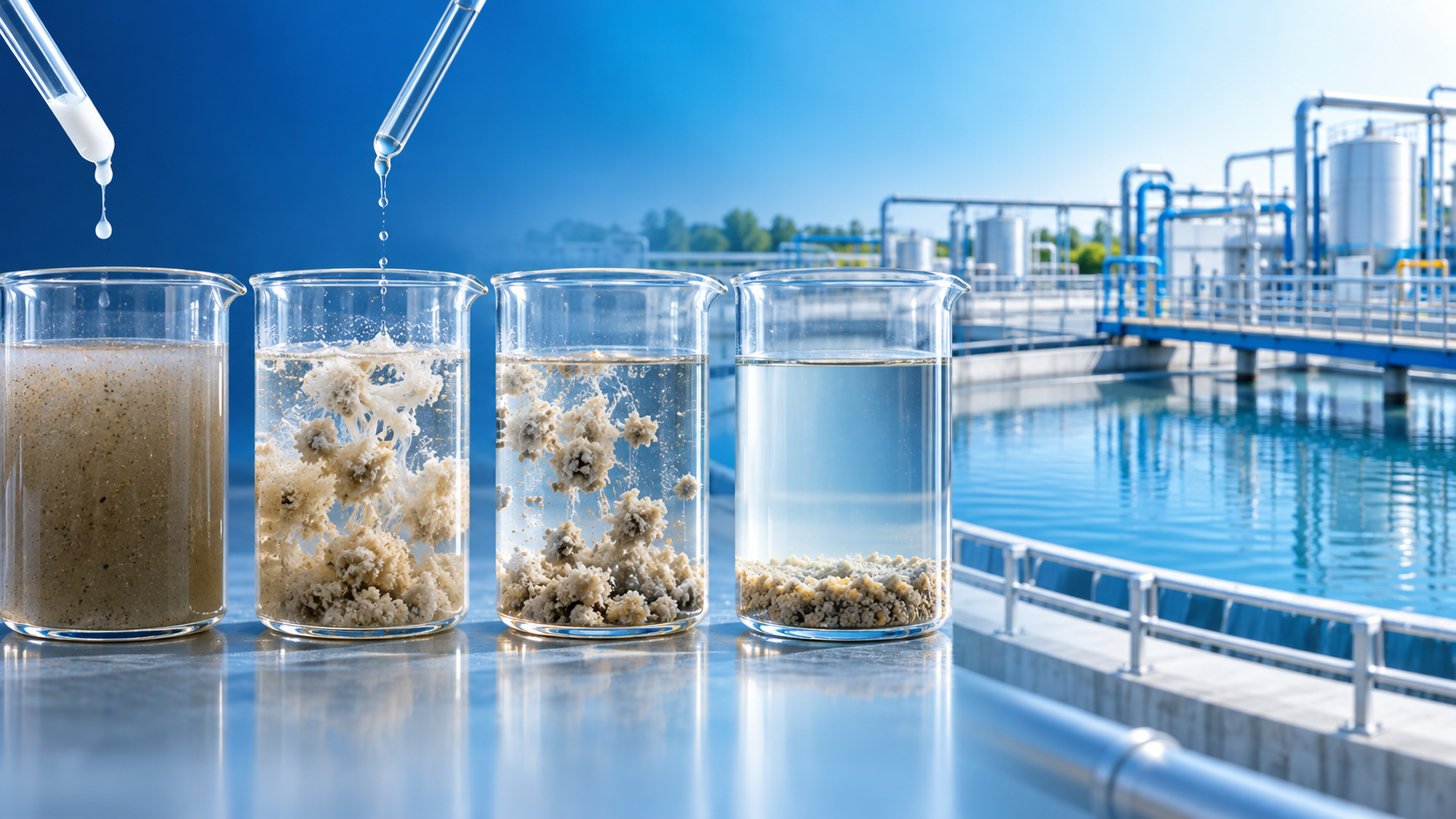
When Water Treatment Coagulants Need a Coagulant Aid
Water Treatment Coagulants are often the first chemical lever used to remove turbidity, color, colloidal matter, and selected organic contaminants. Aluminum- and iron-based salts, as well as pre-hydrolyzed inorganic coagulants, destabilize particles that would otherwise remain suspended for long periods. In many applications, that is enough. In others, the coagulant creates particles that are technically destabilized but still difficult to separate, settle, float, filter, or dewater.
That distinction matters. A clear supernatant in a jar test is not always proof that the full treatment train will operate reliably. Weak flocs can break under pumping, settle slowly in a clarifier, pass through filters, or form sludge that is difficult to thicken. When this happens, increasing the primary coagulant dose is a common response, but it is not always the right one. Excess inorganic coagulant can depress pH, increase dissolved metal residuals, raise sludge volume, and create an unstable operating window.
A coagulant aid is used when the primary coagulant can destabilize the water’s particles but needs support to build stronger, more separable floc or to maintain performance as raw-water quality shifts. For technical evaluators, the decision should rest on treatment evidence rather than a general preference for “more chemistry.”
What a coagulant aid changes in the separation process
Coagulation and flocculation are related but different functions. The coagulant neutralizes particle charges, compresses the electrical double layer, or forms precipitates that capture contaminants. The aid commonly improves collision efficiency, reinforces particle bridges, or creates flocs with a structure better suited to sedimentation, dissolved-air flotation, or filtration.
High-molecular-weight polymers are among the most familiar aids. Depending on charge type and water chemistry, they may bridge destabilized particles into larger flocs or support a charge-neutralization mechanism. Inorganic materials, activated silica systems, and selected pH-adjustment chemicals can also serve a supporting role in particular applications. The important point is that an aid is not simply an additional dose point: it changes the physical behavior of the floc.
The best result is usually a floc that forms quickly enough for the available retention time, survives transfer to the separator, settles or floats consistently, and produces manageable sludge. A large floc is not automatically a good floc. Some oversized structures are fragile, trap excessive water, or interfere with downstream filtration. The practical target is robust separation at the lowest overall treatment burden.
Operational signs that the primary coagulant is no longer sufficient
A coagulant aid should be considered when a plant repeatedly observes a gap between apparent coagulation and actual solids removal. That gap can show up in several ways:
- Flocs appear after rapid mixing but remain fine, slow-settling, or easily sheared.
- Clarified-water turbidity varies despite a stable coagulant dose and apparently normal pH.
- A clarifier requires more time than its available hydraulic retention time can provide.
- Filter run length falls because fine carryover reaches the filtration stage.
- Dissolved-air flotation produces a weak float blanket, poor solids capture, or excessive solids in the effluent.
- Sludge settles but remains difficult to thicken or dewater.
These symptoms do not prove that a polymer or other aid is needed. They can also result from poor mixing, a damaged flocculation basin, an incorrect feed point, unsuitable pH, inadequate alkalinity, or a sudden change in influent composition. Still, they are strong reasons to test whether a supporting chemical can widen the treatment process’s workable range.
Water characteristics that often justify an aid
Low-temperature water is a familiar challenge. As temperature decreases, floc formation and settling can become less favorable, while raw-water viscosity increases. A dosage program that performs well in warm conditions may leave fine, poorly compacted floc in winter. An aid can sometimes recover settling performance without forcing a large increase in metal-salt dosage, although this must be demonstrated under site-relevant conditions.
Low-turbidity water presents another difficult case. There may be too few particles available to form a dense, settleable floc, even though color or dissolved organic matter still requires treatment. In contrast, highly variable industrial wastewater may contain emulsified oils, surfactants, fine mineral solids, biological solids, or changing organic loads. Each can alter particle charge and floc structure from one shift to the next.
Alkalinity and pH deserve close attention. Many inorganic coagulants consume alkalinity and work best within a defined pH region. If pH control is unstable, the apparent benefit of an aid may disappear because the primary coagulant itself is no longer operating in its effective range. In these conditions, the first correction may be chemical conditioning rather than an additional flocculant.
Do not use a coagulant aid to hide a process fault
A frequent mistake is to treat the aid as a universal repair chemical. If the flash mixer is underperforming, the coagulant will not disperse properly. If the polymer injection point is too close to a high-shear pump, newly formed flocs may be destroyed immediately. If the clarification unit is hydraulically overloaded, better floc cannot fully compensate for insufficient settling area or short-circuiting.
The same caution applies to source-water changes. A raw-water shift from mineral turbidity to algae-rich water, for example, can demand a different coagulant chemistry and a different mixing regime. Industrial effluents should be checked for changes in cleaning chemicals, production additives, oil content, conductivity, and pH before a dosage increase is approved. Treatment programs fail when chemical adjustments are made without confirming what has changed upstream.
A useful evaluation sequence
Jar testing remains valuable, provided it reflects the actual treatment train. Start with the current primary coagulant and establish the working pH, dose range, rapid-mix intensity, slow-mix conditions, and settling time. Then compare candidate aids at low incremental doses. Record more than final turbidity: observe floc formation time, floc size, breakage during mixing, supernatant clarity at several settling intervals, and the visual compactness of settled solids.
A good test plan includes deliberately difficult water samples where possible: colder influent, higher color, lower turbidity, or representative industrial variability. A chemical program that only works on one clean sample is unlikely to provide operational confidence. For DAF systems, bench tests should consider whether the floc is compatible with flotation rather than judging settling alone. For downstream membranes or filters, assess residual turbidity and any risk of polymer overdosing, because excess polymer can contribute to fouling or interfere with filtration.
Pilot or plant-scale confirmation is still necessary where the consequence of underperformance is high. Hydraulics, shear, dosing equipment, and sludge systems cannot be reproduced perfectly in a beaker. Technical approval should therefore define a target operating range, not merely one “best” dose.
Choosing the chemistry and handling the supply question
Selection should begin with compatibility. An anionic, cationic, or nonionic polymer may behave very differently with a particular coagulant and contaminant profile. Molecular weight, charge density, product form, make-down water quality, aging time, and feed concentration all influence field performance. A technically suitable powder can still perform poorly if preparation equipment cannot hydrate it properly; an emulsion product introduces different storage and activation requirements.
Technical evaluators should also separate chemicals used in treatment from chemicals used in the production process. In food and beverage facilities, for example, ingredients and process chemicals may enter water streams indirectly through washdown, product loss, or cleaning operations. D-(+)-Glucono-1,5-lactone CAS#90-80-2 is a white to off-white, food-derived crystalline material used as an acidifier and sequestrant in applications such as dairy products, beverages, and instant drinks. It hydrolyzes gradually in water to form gluconic acid, so its pH effect depends on concentration, temperature, and initial water chemistry. It should not be treated as a standard coagulant aid; however, understanding such process ingredients can be relevant when assessing wastewater composition, pH trends, and the chemical segregation needed at a site.
Supply decisions increasingly belong in the technical review. Global chemical trade has raised expectations for consistent specification, traceable documentation, regulatory alignment, packaging suitability, and prompt response when a production schedule changes. A treatment chemical that performs well in a trial but has unreliable lead times, unclear product documentation, or inconsistent batches creates a different type of operating risk.
Shandong Huafeng Chemical Co., Ltd., based in Shandong Province, works with overseas customers through a broad chemical portfolio and comprehensive foreign-trade service capabilities. For buyers evaluating water-treatment inputs alongside wider process-chemical needs, the practical discussion should cover specification control, safety documentation, packing, storage conditions, shipment planning, and the destination market’s applicable requirements—not only unit price.
The decision is about stability, not chemical count
Water Treatment Coagulants need a coagulant aid when the existing program cannot consistently create floc that the downstream separation equipment can handle. The strongest signals are recurring fine solids carryover, slow settling, fragile floc, unstable flotation, shortened filter runs, or sludge behavior that worsens as coagulant dose rises. Yet an aid should follow a disciplined check of pH, alkalinity, mixing, hydraulics, and influent changes.
The next step is not to select a polymer by label alone. Define the water-quality problem, test realistic operating conditions, assess downstream effects, and confirm that the selected chemistry can be prepared, dosed, documented, and supplied reliably. That approach usually produces a treatment program with fewer surprises than simply adding more primary coagulant.
Send Us Your Inquiry Today
