









Product Quick Navigation
Get a Quote
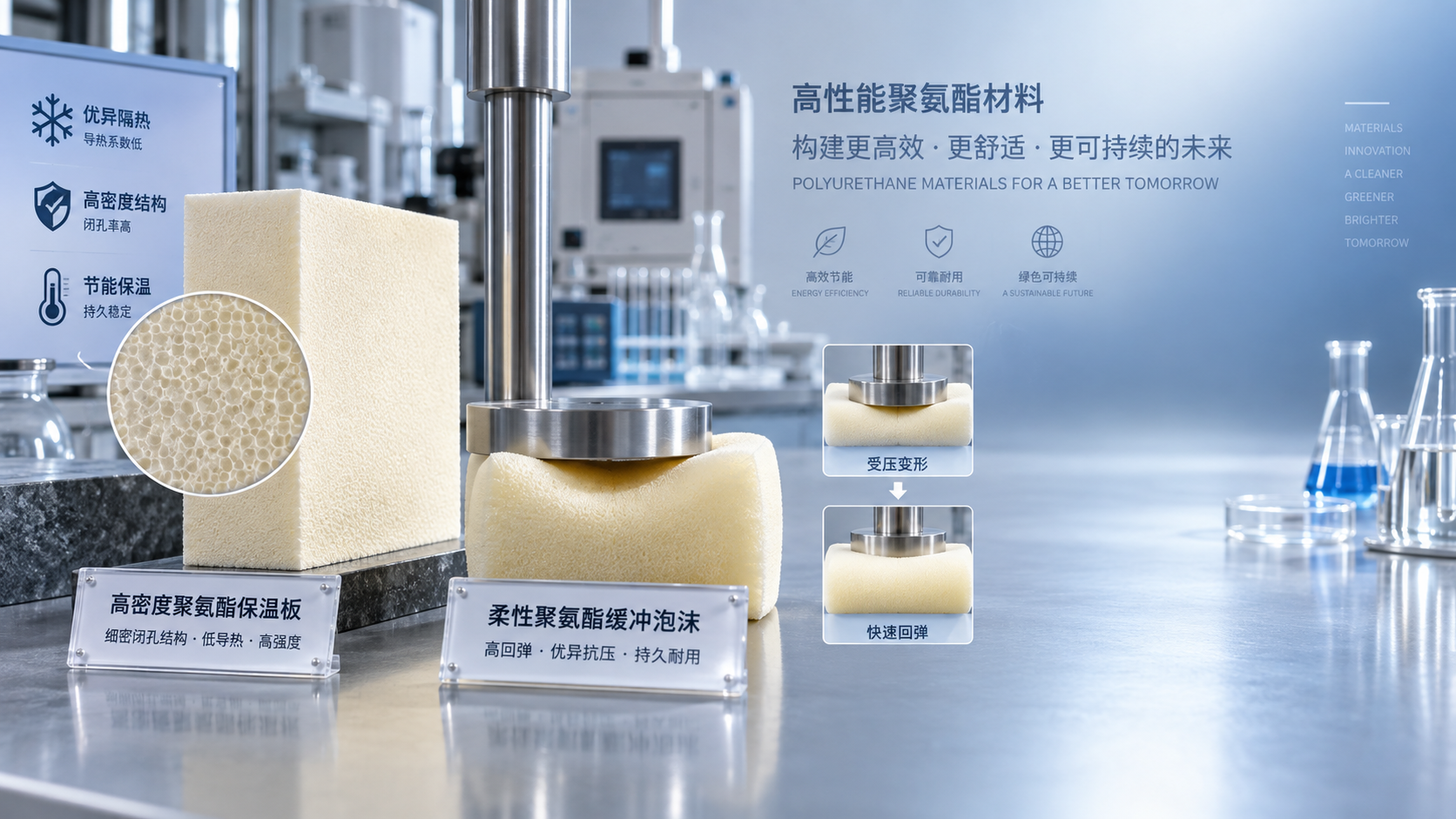
Polyurethane foam density is not a cosmetic specification or a simple indicator of “more material.” It changes how the foam carries load, resists repeated compression, controls heat flow, responds to moisture, and survives installation. A density value can help narrow a selection, but it cannot be read in isolation: the foam chemistry, cell structure, thickness, facing, compression conditions, and end-use environment all affect final performance.
For insulation and cushioning applications, the practical question is not “What density is best?” It is: what density and foam formulation will maintain the required performance throughout the product’s service life? Choosing a foam that is too light can create early deformation, weak edge support, inconsistent insulation, or damage during transport. Choosing one that is unnecessarily dense can add cost, weight, and stiffness without solving the actual requirement.
Density affects structure before it affects performance
Foam density describes the mass contained in a given volume of material. In polyurethane foam, it is closely related to how much polymer forms the cell walls and struts within the foam structure. A higher-density foam generally has more solid polymer supporting its cellular network. This often improves its ability to withstand handling and mechanical stress, but it does not automatically make the material suitable for every insulation or cushioning duty.
Two polyurethane foams can have similar density and still behave differently. One may be flexible and resilient, while another may be rigid and designed to limit heat transfer. Differences in raw materials, blowing agents, cell openness, crosslinking, additives, and curing conditions can all alter the result. Density is therefore a useful screening criterion, not a complete product specification.
This distinction matters when a purchasing or design team compares supplier data sheets. A decision based only on density may overlook whether the material is open-cell or closed-cell, whether it was tested under the relevant loading condition, or whether its properties remain stable after exposure to temperature cycling, humidity, oils, adhesives, or repeated use.
For insulation, density must be considered with thermal design
Rigid polyurethane foam is widely used where low thermal conductivity and a thin insulation profile are needed. Its insulating effect comes mainly from its fine, closed-cell structure, which limits heat movement through the material. Density contributes to the stability of that structure, but the relationship between density and insulation is not linear.
If density is too low for the formulation and manufacturing method, the foam may have fragile cell walls, poor dimensional stability, or uneven areas that affect installation quality. Gaps at joints, distorted panels, compressed sections, and damaged edges can reduce the effective insulation performance of the completed assembly, even when the nominal foam property looks acceptable.
At the other extreme, simply specifying a denser foam does not guarantee better thermal resistance. Adding more solid polymer can increase the solid path through which heat moves. A denser formulation may be selected because it needs greater compressive strength, better handling resistance, or improved compatibility with a structural assembly, not because density alone delivers the lowest heat flow.
The better selection method starts with the complete insulation system. Identify the required thermal target, available installation thickness, expected service temperature, moisture exposure, load conditions, facing material, and joint design. Then select a polyurethane foam system that can achieve those requirements together. A roof insulation board, refrigerated enclosure, insulated pipe section, and appliance panel may all need thermal control, yet their mechanical and environmental demands are substantially different.
Where insulation projects commonly go wrong
A frequent mistake is to treat the foam core as an independent component. In practice, insulation performance is also affected by seams, fasteners, adhesive coverage, vapor control layers, surface facings, and workmanship. A high-performing foam panel cannot compensate for poorly designed joints or persistent water exposure where the system was not intended to manage it.
Another problem is specifying compressive strength without defining how the load is applied. Short-term point loading, continuous distributed loading, and occasional maintenance traffic place very different demands on the same foam board. Density may rise as manufacturers design for greater load-bearing capability, but the relevant decision is whether the product meets the required strength and deformation limits in the actual assembly.
Cushioning performance depends on recovery, not just firmness
For protective packaging, seating, vibration pads, equipment inserts, and impact-control components, polyurethane foam density influences durability and support. Higher-density flexible foam often contains a more robust polymer network, allowing it to tolerate repeated compression better than a lighter foam of the same general type. This can be valuable where the foam must protect a heavy item, retain shape during frequent use, or resist damage during storage and transportation.
However, density and firmness are not interchangeable. Firmness is commonly associated with the force needed to compress foam by a specified amount. A dense foam can still be relatively soft if its formulation is designed for flexibility; a lower-density foam may feel firm because of its chemistry and cell structure. Selecting a cushioning foam only by touch or by density can therefore produce the wrong result.
For a packaging insert, the main concern is usually the compression behavior under the packaged item’s weight and likely impact conditions. Foam that is too soft may bottom out, transferring force directly to the product. Foam that is too firm may not absorb enough energy and can concentrate stress at contact points. For comfort cushioning, the same balance appears in another form: insufficient support leads to permanent set and sagging, while excessive firmness creates pressure concentration and an uncomfortable surface.
Open-cell and closed-cell construction changes the decision
Cell structure is one of the reasons density alone cannot guide selection. Open-cell polyurethane foam allows air to move through interconnected cells. It is commonly used where softness, acoustic absorption, air movement, or flexible cushioning is important. Its behavior under compression is influenced by both the polymer skeleton and the movement of air through the cells.
Closed-cell foam contains cells that are largely sealed from one another. This structure is generally more useful where thermal insulation, moisture resistance, buoyancy, or higher rigidity is required. Closed-cell systems are often more resistant to water uptake than open-cell materials, but the finished component still depends on cut surfaces, joints, facings, coatings, and exposure conditions.
Specifying a density target without naming the required foam family is an incomplete request. An open-cell cushioning foam and a closed-cell insulation foam may overlap in density ranges while serving entirely different functions. The procurement specification should state the end use and required functional properties first, then use density as a controlled supporting parameter.
Thickness can solve a problem that density cannot
When a foam part fails, it is tempting to request a denser grade. Sometimes the more effective change is thickness, geometry, or load distribution. A cushioning insert may need deeper material under a vulnerable corner rather than a denser foam throughout. An insulation system may benefit more from increased continuous thickness and better joint treatment than from a denser core.
This is especially relevant where cost and weight are constrained. A blanket instruction to “increase density” may raise material consumption across the whole part even though the failure occurs only at a few high-stress locations. Local reinforcement, layered construction, a different foam grade in critical zones, or redesigned contact surfaces may provide a better result.
Layering is often useful in cushioning design. A softer layer can conform to the item and spread contact pressure, while a firmer layer beneath it limits bottoming out. The correct combination depends on the protected product, expected drop orientation, packaging space, and whether the foam is intended for one shipment or repeated handling. Density remains relevant, but it is one element in a broader energy-management design.
Ask for the performance data that matches the failure risk
A reliable polyurethane foam specification should connect each property to a foreseeable risk. For insulation, focus on thermal performance at the intended service condition, compressive behavior where the foam is loaded, dimensional stability, and compatibility with the installation system. For cushioning, examine firmness or load-deflection behavior, resilience, compression set, tear strength where relevant, and performance after repeated loading.
Density should be stated with the relevant tolerance and sampling method, particularly for parts where weight, fit, or consistent mechanical response matters. A single density value without a defined tolerance can leave too much variation between production lots. This is important for molded components, laminated panels, and protective packaging where small dimensional or mechanical changes can affect assembly.
It is also useful to clarify whether the foam will be supplied as blocks, sheets, molded parts, sprayed insulation, or laminated composite panels. Processing can change the practical outcome. Cutting may expose cells; bonding can introduce stress or chemical compatibility issues; field spraying depends heavily on substrate condition, mixing, ambient conditions, and application control.
A practical selection sequence
- Define the primary function. Decide whether the foam’s main job is thermal control, impact protection, comfort, structural support, sound control, or a combination of these.
- Identify the failure consequence. Is the main risk heat loss, panel deformation, product breakage, permanent sagging, water exposure, or loss of fit?
- Describe actual loads and exposure. Include continuous loads, repeated compression, impact direction, temperature range, humidity, chemicals, and installation method.
- Select the foam category. Establish whether the application needs rigid or flexible polyurethane foam and whether open-cell or closed-cell structure is appropriate.
- Set density as a control parameter. Use density to support durability, handling, and consistency requirements, alongside the functional properties that directly determine success.
- Evaluate the finished assembly. Review the foam with its facing, adhesive, geometry, joints, protective layers, and real installation or transport conditions.
Do not turn density into a shortcut for quality
Higher density can be valuable when a polyurethane foam must resist crushing, retain its shape, support loads, or withstand repeated use. It can also be unnecessary when thermal design, thickness, or geometry is the real limiting factor. The correct choice is the lowest-risk option that meets the full functional requirement, not automatically the densest option available.
Before approving a grade, align the material request with the conditions that the finished product will actually face. This keeps insulation decisions focused on system-level thermal reliability and cushioning decisions focused on controlled deformation, recovery, and protection. That is where polyurethane foam density becomes useful: not as a stand-alone quality label, but as part of a specification built around how the foam must perform.
Send Us Your Inquiry Today
