









Product Quick Navigation
Get a Quote
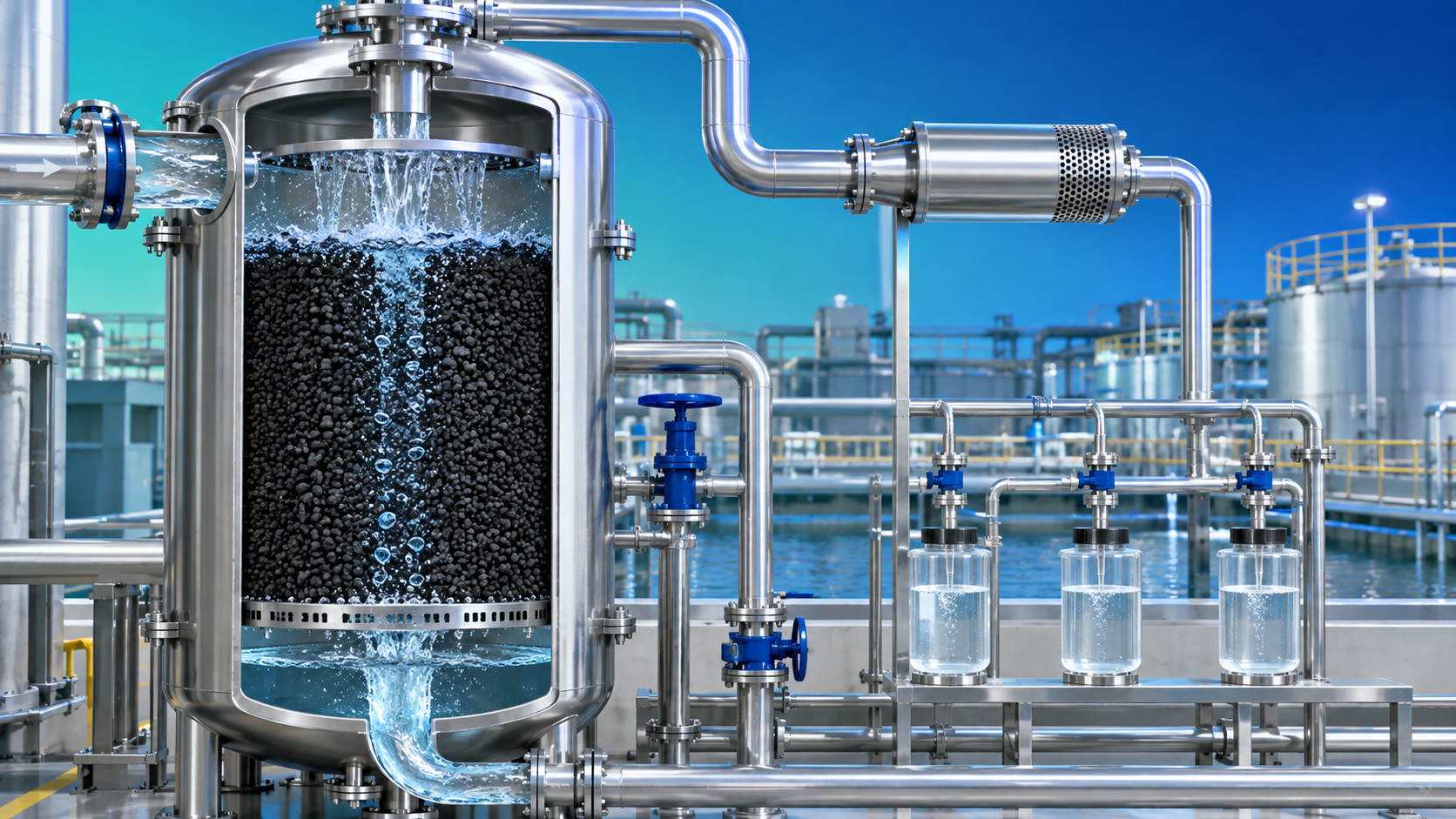
Selecting the right Activated Carbon is rarely a simple purchasing decision. For a project manager, the material sits at the intersection of process performance, operating budget, equipment design, compliance obligations, and delivery risk. A carbon grade that looks suitable on a datasheet may underperform once it meets real wastewater, humid air, fluctuating odor loads, or a liquid stream containing competing organics.
This matters most in odor control, decolorization, and water purification projects, where treatment failures are often gradual rather than dramatic. A nuisance odor returns before the expected media change-out date. Product color drifts outside specification. Effluent quality becomes unstable after seasonal changes in influent composition. These outcomes are not always caused by poor equipment; they are frequently signs that the carbon pore structure, particle size, activity level, or operating conditions were not matched closely enough to the duty.
For engineering teams, the practical question is not “Which Activated Carbon is best?” It is: Which grade provides dependable adsorption performance for this contaminant profile, in this system, at an acceptable total lifecycle cost?
Begin with the Molecule, Not the Carbon Grade
Activated carbon works through adsorption. Contaminant molecules are attracted to and retained within a network of pores. Because those pores vary in size, no single carbon is equally effective for every target compound.
Micropores are especially important for small molecules and many dissolved organic contaminants. Mesopores offer better access for larger organic molecules, color bodies, and certain complex compounds. Macropores act as transport routes, helping contaminants reach the smaller adsorption sites deeper inside the particle.
This is why a high iodine number alone should not be treated as a final selection criterion. Iodine number can be a useful indicator of micropore capacity, but it does not fully describe performance for large color molecules, humid mixed-gas streams, or wastewater containing oils, surfactants, suspended solids, and dissolved organics. A project designed around one attractive specification can become expensive if that specification is not relevant to the actual contaminant.
Before issuing an RFQ, define the following as clearly as possible:
- Target contaminants and their expected concentration range
- Whether the treatment objective is removal, polishing, emergency protection, or compliance backup
- Stream temperature, pressure, pH, moisture, and flow variation
- Presence of suspended solids, oils, biological growth, salts, oxidants, or competing organics
- Required outlet quality and the consequences of breakthrough
- Expected operating cycle, regeneration strategy, and disposal route for spent carbon
Even incomplete feed characterization is better than selecting solely by product name. When data are limited, a conservative pilot or laboratory adsorption test is usually less costly than redesigning a vessel after commissioning.
Odor Control: Humidity and Contact Time Change the Decision
Odor control applications often appear straightforward: air passes through a carbon bed, odor is reduced, and the media is replaced when breakthrough occurs. In practice, odor streams can contain a shifting mixture of sulfur compounds, amines, mercaptans, volatile organic compounds, acids, aldehydes, and moisture. The compound that causes the strongest perceived odor may be present at a low concentration, while other vapors quietly consume the carbon capacity.
For general VOC odor removal, coconut shell-based activated carbon is often considered because of its strong microporous structure and good adsorption of many low-molecular-weight organic vapors. Coal-based carbon can offer a broader pore distribution, which may be advantageous where a gas stream includes larger organic molecules or a complex mixture. Wood-based carbon is commonly valued in liquid decolorization due to its larger pore accessibility, though final choice should always be tied to test results rather than raw-material labels alone.
Humidity deserves particular attention. Water vapor can compete for adsorption sites and can affect the behavior of polar odor compounds. In very humid exhaust, standard carbon may lose practical working capacity earlier than expected. If hydrogen sulfide, ammonia, or other reactive odorants are central to the design basis, impregnated or chemically treated activated carbon may be appropriate. However, impregnated grades introduce additional issues: compatibility with the vessel material, handling requirements, potential heat generation, and spent-media classification all need to be reviewed.
Bed depth and empty-bed contact time should not be treated as afterthoughts. A carbon grade with excellent adsorption properties cannot compensate indefinitely for insufficient residence time or severe channeling. For project planning, the carbon supplier should be able to discuss particle size, pressure drop, bulk density, recommended service conditions, and expected performance limitations in relation to the proposed adsorber configuration.
Decolorization Requires a Different View of “Capacity”
In liquid processing, color is often caused by a family of compounds rather than one measurable molecule. Natural pigments, oxidation products, humic substances, caramelized residues, phenolics, and trace process impurities may all contribute to the final appearance. Their molecular size and polarity can differ widely, making decolorization one of the areas where carbon selection benefits most from direct trials.
Powdered activated carbon is frequently used for batch treatment because it provides rapid adsorption kinetics and can be dispersed through the liquid. It is then removed by filtration or centrifugation. Granular activated carbon is generally better suited to fixed-bed polishing, provided the liquid is sufficiently clarified and the risk of bed fouling is controlled.
A recurring mistake is to judge decolorization carbon only by how much color it removes. The more useful assessment includes selectivity. A grade may remove unwanted brown or red tones while also stripping valuable flavor compounds, active ingredients, or desired natural coloration. This is particularly relevant for food, nutraceutical, cosmetic, and pharmaceutical-related streams.
For example, when a project involves handling or refining botanical color systems, process teams should confirm whether carbon is intended to remove impurities, adjust shade, or fully decolorize an intermediate. Materials such as Gardenia Yellow CAS#94238-00-3 are used where yellow-to-orange natural coloration is desired in food, health product, cosmetic, or pharmaceutical applications. In such settings, activated carbon may be useful during upstream purification or correction steps, but uncontrolled dosage can reduce yield or alter the intended color profile. A small-scale trial using the actual formulation is far more informative than relying on generic decolorization claims.
For liquid decolorization, evaluate carbon against several measures at once: final color value, target compound recovery, filtration behavior, contact time, ash contribution, pH impact, and residual fines. If the liquid will be used in a regulated end market, the project specification should also identify acceptable impurity limits and applicable food, pharmaceutical, or potable-water requirements.
Water Purification: Match the Carbon to the Treatment Train
Activated carbon is widely used in municipal, industrial, commercial, and process-water treatment. Yet its role differs substantially between systems. In one plant, it may polish trace organics after biological treatment. In another, it may remove chlorine before membrane filtration. Elsewhere, it serves as a safeguard for taste, odor, pesticide residues, solvent traces, or intermittent contamination events.
Granular activated carbon is commonly selected for fixed-bed water treatment because it supports continuous operation and can be backwashed. Particle size affects both adsorption kinetics and hydraulic behavior. Smaller particles provide more surface accessibility but may create higher pressure drop and greater risk of media loss. Larger particles can improve hydraulics while reducing adsorption rate. The best balance depends on flow loading, vessel dimensions, backwash capacity, and the desired operating cycle.
Water pretreatment strongly affects carbon life. High turbidity, iron, manganese, oil, or biological solids can coat the media and block pores. Oxidants may damage certain contaminants differently or create by-products that change the adsorption burden. If the influent contains free chlorine, the carbon will remove it, but this duty consumes capacity that may otherwise have been available for organic contaminants. Project teams should therefore distinguish between the carbon’s nominal adsorption capacity and its working capacity in the complete treatment train.
For potable water or applications involving direct contact with sensitive products, procurement must include regulatory fit. Ask whether the grade is suitable for the intended jurisdiction and whether supporting documentation is available for relevant standards. Compliance is not merely a certificate-checking exercise: traceability, lot consistency, packaging integrity, and change-control communication can be just as important for a long-running project.
A Practical Selection Matrix for Project Reviews
When comparing suppliers or carbon grades, it helps to organize the review around decisions that affect installation and operation—not just laboratory specifications.
Do Not Confuse Laboratory Performance with Field Service Life
Bench testing is valuable, but it needs realistic conditions. A clean laboratory solution may show excellent color removal, while a real process stream contains suspended solids and competing compounds that shorten service life. Likewise, a dry-gas test does not predict carbon consumption in a damp industrial exhaust.
For major installations, consider staged validation. Start with feed analysis and a small adsorption screening test. Then move to a pilot column or side-stream trial where flow, contact time, and pressure drop resemble the planned system. Track breakthrough rather than only initial removal. This creates the data needed to estimate media replacement intervals, operating cost, and contingency inventory.
It is also wise to define breakthrough in commercial terms. A treatment system may technically still remove some contaminant, but it may no longer meet odor perception targets, product color requirements, discharge limits, or membrane-protection goals. The replacement trigger should reflect the true project requirement.
Procurement Is Part of the Treatment Design
For internationally sourced chemical materials, supply reliability is not separate from technical performance. A project may run for years, and a change in carbon source, mesh size, or activation process can affect results even when the product description appears unchanged. Procurement documents should specify critical parameters, permitted tolerances, test methods, packaging standards, inspection expectations, and a process for approving changes.
Huafeng Chemical supports overseas customers navigating these practical export requirements across a broad chemical portfolio. For project managers, the value of a responsive export partner lies in clearer documentation, communication around shipment timing, and the ability to coordinate specifications before a material reaches site. This is especially important where activated carbon is one component within a larger chemical treatment package rather than a standalone purchase.
Request a certificate of analysis for each lot, but also ask what the certificate does not reveal: typical variation ranges, particle-strength behavior, dust control measures, shelf-life considerations, and the recommended storage environment. Carbon should be protected from moisture, contamination, and exposure to vapors that could consume capacity before installation.
The Most Defensible Choice Is Usually a Documented One
Activated Carbon selection becomes more reliable when the decision is recorded as a chain of evidence: contaminant data, process conditions, candidate grades, test results, compliance needs, equipment constraints, and supply assumptions. That record helps teams defend the selection internally, compare alternatives fairly, and troubleshoot later if influent conditions change.
For odor control, focus on the gas composition, humidity, and contact time. For decolorization, prioritize pore accessibility and selectivity rather than color removal alone. For water purification, consider the full treatment train, hydraulic design, and regulatory requirements. Across all three applications, the right carbon is the one that performs predictably in the actual duty—not simply the one with the most impressive standalone number on a datasheet.
Send Us Your Inquiry Today
