









Product Quick Navigation
Get a Quote
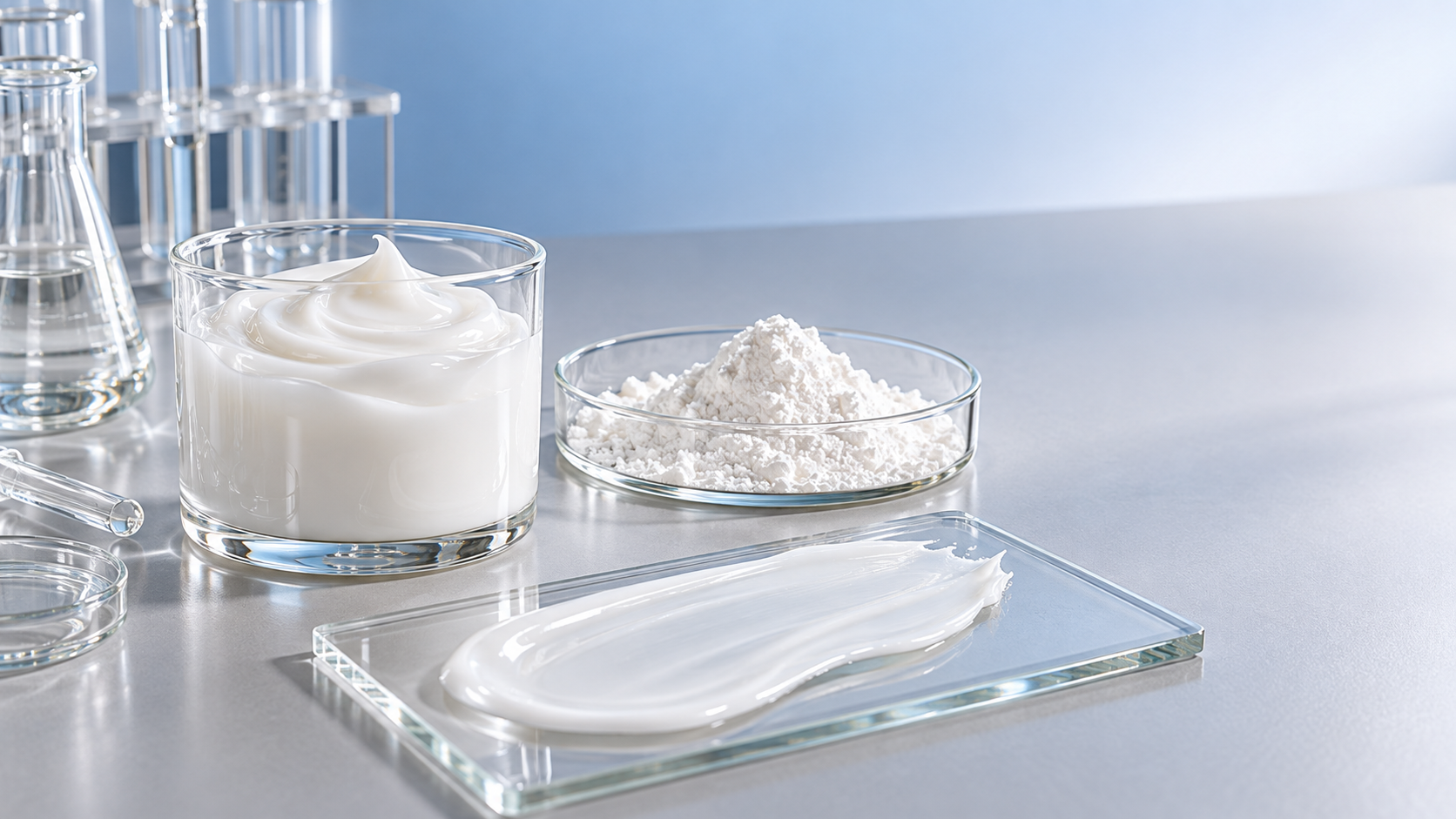
Yes—selected cosmetic-grade modified starches can reduce the perceived greasiness of skin care formulations by taking up some surface oil and changing how the residual film feels during and after application. The benefit is most useful when a cream or lotion has acceptable emulsion stability and moisturizing performance but leaves an excessively oily finish. It is less useful when the underlying problem is oil separation, an unsuitable emollient blend, or excessive deposition.
The important distinction is between a drier sensory finish and a lower oil content. Modified starch does not remove oil from a formulation, and a less greasy feel does not prove reduced sebum production or improved barrier performance. Success means achieving a measurable sensory improvement without introducing powderiness, drag, pilling, or changes in stability.
What modified starch changes in the skin film
After an emulsion is spread, water evaporation and ingredient redistribution leave a film containing emollients, emulsifiers, polymers, and other nonvolatile ingredients. Greasiness depends on that film’s composition, mobility, thickness, and interaction with skin—not simply the percentage of oil in the formula.
Suitable starch particles can take up oil at their surfaces and within their accessible structure. They can also interrupt the continuity of a lubricious surface film, changing contact between the skin and a finger. Particle shape, size distribution, and surface chemistry determine whether this produces a smooth, dry finish or an unpleasantly chalky residue.
Oil uptake alone is therefore an incomplete selection criterion. A powder with high uptake in a supplier’s test may perform differently in an emulsion containing esters, hydrocarbons, silicones, surfactants, and water. The test liquid, contact time, and endpoint all affect the reported result. Values obtained by different methods should not be treated as directly comparable.
Reduced shine is also distinct from reduced greasiness. Light scattering can make a surface look more matte without substantially changing its oily feel. Conversely, a formulation can feel less greasy while retaining some visible gloss. These endpoints need separate evaluation.
“Modified starch” does not describe one functional ingredient
Modification can alter water affinity, oil affinity, swelling, thermal behavior, and resistance to processing. Consequently, two ingredients carrying broadly similar descriptions can behave quite differently in the same base.
Aluminum Starch Octenylsuccinate is one established example of a cosmetic starch derivative used for absorbency and sensory modification. Other modified starch grades may primarily provide thickening, binding, or film-forming functions. Their presence in a cosmetic ingredient portfolio does not establish equivalent oil-control performance.
An ingredient that strongly hydrates or gelatinizes may reduce apparent greasiness indirectly by thickening the product, but that is a different mechanism from a dispersed powder modifying the deposited film. Substituting one type for the other can change spreadability, release from packaging, and emulsion behavior.
Identify the source of the greasy finish before adding powder
A stable oil-in-water cream with an overly rich after-feel is a reasonable candidate for starch screening. A cream showing oil droplets on its surface is not: powder may temporarily obscure the symptom while leaving the emulsion failure unresolved.
The timing of the undesirable sensation helps locate the problem. Greasiness during initial spreading may reflect emollient selection or excessive application thickness. Persistent slipperiness after dry-down may arise from the residual oil film. Tack can instead originate from humectants or film-forming polymers; treating it as oiliness can lead to unnecessary powder addition.
Where the emollient blend is intrinsically too persistent for the intended finish, adjusting that blend may deliver a cleaner result than increasing starch indefinitely. Powder is most effective as a controlled sensory adjustment, not as compensation for an unsuitable base.
The distinction matters in richer moisturizers. A dry-touch finish can coexist with substantial emollient deposition, but sensory improvement does not demonstrate unchanged occlusivity or hydration performance. If those properties support product claims, they require their own evidence.
Choose a use level through a controlled formulation screen
There is no universal addition level for modified starch for skin care. The useful range depends on the grade, oil phase, existing powder content, application dose, and target finish. Supplier guidance should define the initial screening window.
Within that window, compare several concentrations against an unchanged control. For a grade whose recommended range permits it, a preliminary screen might use 0.5%, 1.0%, and 2.0% by weight. These are illustrative trial points, not a general recommendation. Keep total batch weight constant and document which ingredient is displaced.
Increasing concentration can initially improve dryness, then reach a point where additional powder produces little benefit but increases drag or residue. The preferred level is the lowest concentration that meets the sensory target while preserving other critical properties.
Control the manufacturing variables as carefully as the composition. Powder addition order, dispersion medium, mixing intensity, temperature, and cooling profile can influence the result. A concentration comparison becomes difficult to interpret if one sample contains well-dispersed particles and another contains agglomerates.
Processing must preserve the intended particle behavior
Follow the grade-specific incorporation instructions rather than assuming every starch belongs in the heated water phase. Some sensory grades are intended for addition under conditions that preserve their particulate character. Other grades require hydration or a defined thermal process.
Pre-dispersion in a compatible liquid can help prevent agglomeration, but the liquid must wet the powder effectively and remain suitable for the formulation. A hydrophobic powder may resist direct wetting in water. Conversely, changing the oil-phase composition solely to facilitate dispersion can confound the sensory comparison.
Apply enough shear to distribute the ingredient uniformly, while respecting the supplier’s processing limits. Excessive processing may change particle structure or the emulsion itself; insufficient mixing leaves localized powder concentrations that can create drag, visible specks, or inconsistent viscosity.
Check the product after equilibration, not only immediately after manufacture. Continued wetting, hydration, and structural rearrangement can change viscosity and feel during storage. The actual production sequence should eventually be reproduced at pilot scale, because a successful laboratory dispersion does not automatically establish manufacturing robustness.
Evaluate the finish without overlooking new defects
A useful sensory protocol separates application from after-feel. Assess initial spread, slip during rub-out, tack during drying, residual greasiness, powderiness, and visible residue at defined intervals. Use the same application mass, skin area, preparation conditions, and assessment timing across samples.
Blind-coded, randomized comparisons against the control reduce expectation bias. Include the intended application dose: a cream that feels balanced in a very thin laboratory application may become chalky or pill when applied more generously.
Instrumental measurements can strengthen the comparison, provided their limits are recognized:
- Gloss measurement can quantify changes in reflected light, but does not independently establish reduced greasiness.
- Friction testing can reveal changes in slip and drag, although the substrate and test conditions must be relevant to use.
- Microscopy can help distinguish dispersed particles from agglomerates and reveal changes in emulsion structure.
- Rheology can identify changes in flow and structural recovery that a single viscosity reading may miss.
Oil-transfer or surface-lipid measurements need particular care. Deposited formulation oils and absorbent particles can influence the result; a lower reading should not automatically be described as reduced biological sebum production.
Layering tests are important for leave-on products used beneath sunscreen or makeup. Powder particles, dried polymers, and repeated rubbing can combine to form visible rolls. Pilling that does not appear when the moisturizer is used alone may emerge in the intended routine.
Stability and performance remain separate acceptance criteria
Adding starch changes the composition and potentially the microstructure of the product. It can alter viscosity, particle suspension, droplet interactions, and the distribution of liquid components. These effects are formulation-specific; neither “absorbent” nor “natural origin” establishes stability.
Compare the selected prototype with the control under storage conditions appropriate to the product and packaging. Track separation, creaming, sedimentation, viscosity, pH, odor, color, and sensory drift. Centrifugation can reveal weaknesses during screening, but it is not a substitute for a suitable stability program.
Preservation also needs attention. Raw-material microbiological quality, manufacturing hygiene, and changes to the formulation can affect preservation robustness. Confirm that the finished formula meets the applicable microbiological and preservative-efficacy requirements rather than assuming the original system remains adequate.
Where performance depends on a continuous film, sensory modification deserves additional scrutiny. In sunscreen-containing products, for example, a powder addition may affect spreading and film uniformity. SPF, UVA protection, and water resistance cannot be inferred from an unchanged filter concentration; relevant performance must be established for the final formulation.
Grade documentation should support the proposed use
Selection requires more than a generic starch specification. Obtain the exact INCI identity, recommended applications, processing limits, particle information, microbiological specifications, and relevant impurity controls. Confirm suitability for the intended market, product category, and exposure conditions. Food-grade or industrial-grade status is not a substitute for cosmetic-use assessment.
The distinction between a finished derivative and its manufacturing chemistry is important. Industrial reagents such as Epichlorohydrin CAS#106-89-8 are not interchangeable with cosmetic-grade modified starch and should not be added to a cream to create an absorbent ingredient. Where reactive chemicals are used in derivative manufacture, the relevant questions concern the finished material’s identity, purification, residual-impurity controls, and suitability for its intended use.
A modified starch earns its place when the final formula feels less greasy at a realistic dose, remains smooth during rubbing and layering, and retains the required stability and performance. If higher additions mainly increase drag, whitening, or pilling, the better next step is to reconsider the starch grade or the base formulation—not simply add more powder.
Send Us Your Inquiry Today
