









Product Quick Navigation
Get a Quote
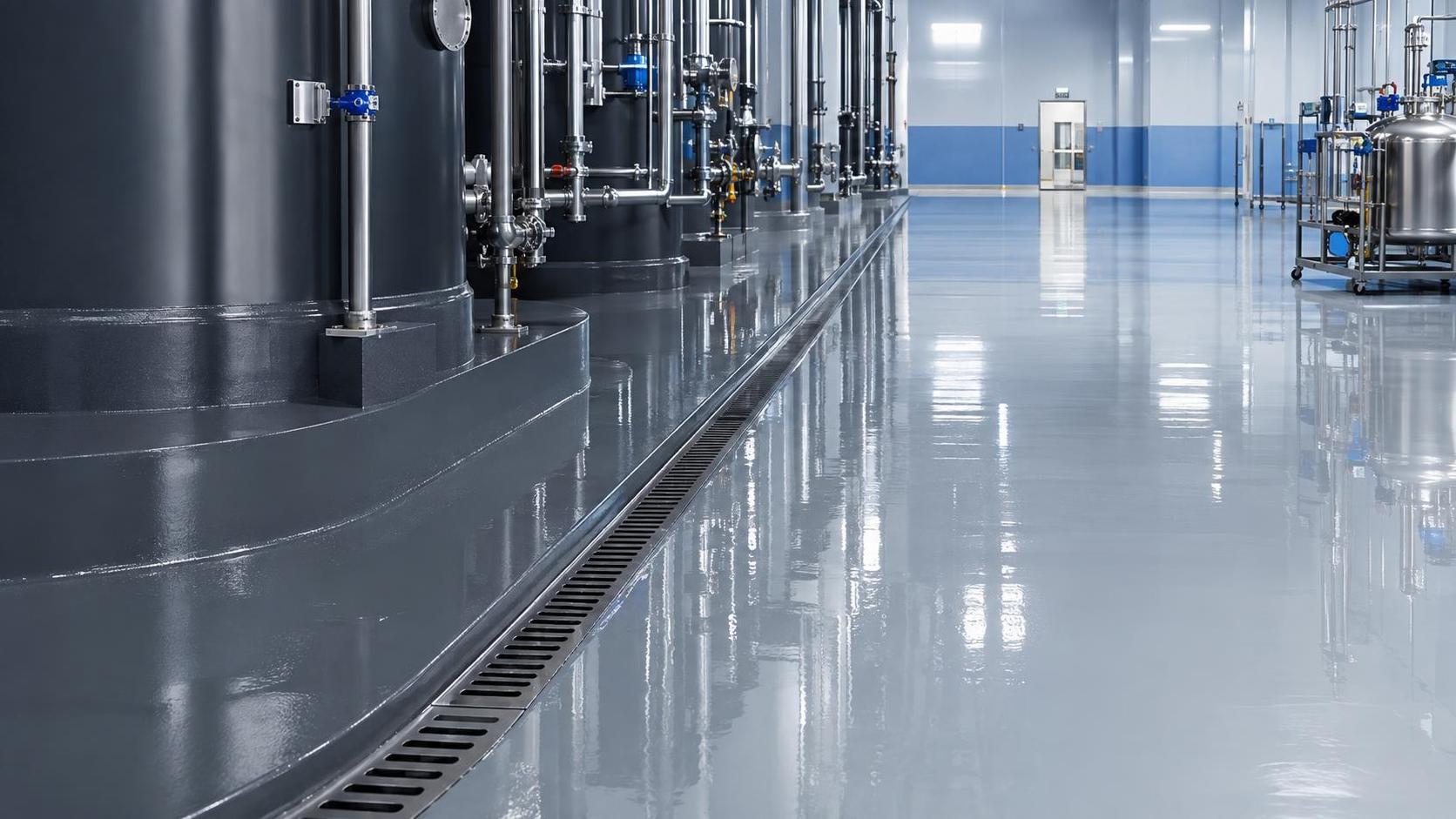
A chemical-resistant floor can fail long before the concrete beneath it looks damaged. A coating may appear sound after installation, then soften around drains, stain under repeated washdowns, lose bond at joints, or become brittle after thermal cycling. These failures often begin with an incomplete resin selection: the system was chosen for general durability rather than for the actual chemicals, temperatures, exposure duration, and substrate conditions on site.
The practical starting point is to choose an Epoxy Resin system based on the most severe credible exposure, not the average operating condition. Identify the chemicals that may contact the floor, whether exposure is intermittent or continuous, the highest service temperature, the required cleaning regime, and the condition of the concrete. Then select the resin chemistry, curing agent, build thickness, aggregate, and detailing as one flooring system. A high-performance resin cannot compensate for wet concrete, poorly prepared joints, or an unsuitable topcoat.
Start with the exposure map, not the resin datasheet
Before comparing resin grades, map the floor by exposure zone. Chemical-resistant flooring in a drum storage area does not face the same risk as flooring below a reactor, beside a wash station, or at a loading bay. A facility may need more than one system rather than a single specification applied everywhere.
Document the following for each zone:
- The chemical names, including acids, alkalis, solvents, salts, oils, oxidizers, detergents, and process intermediates.
- Concentration ranges rather than only the nominal formulation.
- Maximum liquid temperature at the point of contact.
- Exposure mode: splash, periodic spill, standing liquid, routine washdown, vapor, or continuous immersion.
- Expected contact time before cleanup and whether spills can collect at drains, curbs, or equipment bases.
- Mechanical loads from forklifts, wheeled equipment, impact, abrasion, pallets, or dropped containers.
- Cleaning chemicals and cleaning temperature, which are frequently omitted from the original process chemical list.
A resin that resists a dilute acid at room temperature may not remain suitable when the same acid is hot, concentrated, or allowed to stand under equipment. Likewise, a coating suitable for occasional splash may not be appropriate for full-time immersion. Chemical resistance information must be read for the actual exposure conditions, including the specified curing state and test duration. Do not treat a general “resistant” rating as approval for every concentration and temperature.
Match the resin family to the chemical duty
Epoxy flooring is not one material category. The backbone chemistry, functionality, curing agent, fillers, and topcoat all affect resistance. The right choice begins with understanding the boundaries of the main options.
Standard bisphenol-based epoxy systems
Conventional bisphenol A epoxy systems are widely used where the floor must tolerate many industrial chemicals, oils, moderate acids and alkalis, and normal service traffic. They can provide strong adhesion to properly prepared concrete and form the basis of coatings, mortar systems, and self-leveling floors. Their limits become more important where chemical concentrations are high, temperatures are elevated, aggressive solvents are present, or exposure is prolonged.
This type of system is often appropriate for controlled process areas where spills are addressed promptly and where the chemical profile is broad but not exceptionally severe. It should not be selected merely because epoxy is generally described as chemical resistant.
Bisphenol F epoxy systems
Bisphenol F resins are often considered when lower viscosity, improved wetting, or a higher-crosslinked formulation is useful. Lower viscosity can support higher filler loading, better penetration into prepared concrete, or the construction of thicker resin mortars. Depending on the complete formulation and hardener selection, these systems may offer improved resistance in demanding chemical environments compared with a basic general-purpose epoxy.
The comparison must remain system-specific. A bisphenol F resin alone does not guarantee superior flooring performance; cure chemistry, pigment package, aggregate, and film build still matter.
Novolac epoxy for more aggressive chemical exposure
Novolac epoxy resins have higher functionality than standard epoxy resins and can form a denser crosslinked network. They are frequently evaluated for stronger acids, selected solvents, elevated-temperature chemical contact, and severe processing environments. In a production area with hot acidic washdowns, concentrated chemical transfer, or repeated contact near sumps, a novolac-based system may be the more appropriate starting point.
That added chemical resistance can come with trade-offs. Highly crosslinked systems may be less forgiving of substrate movement, poor mixing, low-temperature application, or inadequate curing. They also require close attention to specified cure schedules before the floor is placed into chemical service. A floor opened to service too early may show reduced resistance even though it feels hard to the touch.
Specialized systems where epoxy reaches its limit
Some chemical duties exceed the practical resistance range of conventional epoxy flooring. Strong oxidizing agents, certain solvents, concentrated acids at elevated temperatures, and continuous immersion may require a specialized lining, vinyl ester-based system, or another chemistry designed for that exposure. Selecting a different chemistry is not a failure of epoxy; it is a recognition that resin compatibility has limits.
When the process includes chemicals that are unusually reactive, mixed, or proprietary, obtain compatibility confirmation based on the exact product composition and service conditions. This is especially important when contaminants, cleaning agents, or temperature excursions can change the exposure from the normal operating case.
Do not separate chemical resistance from floor construction
Resin selection answers only part of the question. The same resin can perform very differently as a thin coating, a broadcast system, or a troweled mortar. Build thickness and detailing determine how well the system tolerates impact, abrasion, pinholing, and local chemical accumulation.
A thin coating may resist the chemical on paper but fail mechanically when a pallet edge chips it or when traffic wears through high points. Conversely, a heavily textured surface can improve slip resistance but retain residues and complicate sanitation. In wet chemical areas, the floor profile should reflect the likely footwear, cleaning method, drainage slope, and contamination control needs—not simply a preference for the roughest possible finish.
Check the concrete before specifying the top layer
Flooring projects often lose time because the resin is selected before the substrate is evaluated. Concrete must be structurally sound, clean, sufficiently dry for the proposed system, and prepared to the surface profile required by the manufacturer. Residual curing compounds, densifiers, oil contamination, laitance, old coatings, and weak repair patches can all interfere with adhesion.
Moisture deserves particular attention. Moisture vapor transmission or hydrostatic pressure can lead to blistering, debonding, osmotic effects, or localized failure beneath an otherwise chemically resistant floor. A moisture-tolerant primer may expand installation options, but it does not solve active water ingress, failed vapor barriers, leaking drains, or vapor pressure beyond the system’s allowable range.
Assess cracks, joints, and transitions early. Moving joints should remain functional joints; coating rigid resin across them without an appropriate joint treatment can transfer movement into the floor system. Static cracks may be repaired within the coating design, but their cause should be understood. Cracking from slab movement, thermal stress, or ongoing settlement is not a simple cosmetic defect.
Use temperature and cure schedule as decision criteria
Project schedules can encourage a fast-cure product choice, especially during shutdown work. Fast return to foot traffic is useful, but it is not the same as readiness for chemical exposure. Many epoxy systems develop different properties at different stages: workable cure, traffic cure, full cure, and chemical-service cure. The specification should state the required cure period under the actual site temperature, not only under ideal laboratory conditions.
Low ambient temperature can slow cure, increase viscosity, reduce flow, and make mixing errors more consequential. High temperature can shorten working time and produce application defects if crews cannot place and back-roll material quickly enough. Large floor areas, complex drainage layouts, and cove detailing require a realistic installation sequence that fits the resin’s pot life.
Also consider service temperature after commissioning. Repeated hot-water washdowns, steam-adjacent zones, or thermal shock from alternating hot and cold liquids can stress a resin floor and its bond line. The relevant question is not simply, “What is the normal room temperature?” It is, “What temperature reaches the finished floor, how quickly does it change, and how often?”
A disciplined comparison process prevents unsuitable substitutions
When several epoxy proposals appear similar, compare them against the same written duty profile. Avoid accepting a substitution based only on solids content, nominal thickness, or a broad statement of chemical resistance. Ask each supplier or applicator to identify the complete proposed system: primer, body coat or mortar, aggregate where used, topcoat, cove material, joint treatment, and repair materials.
- Define the governing exposure. Use the harshest realistic combination of chemical, concentration, temperature, contact time, and cleaning cycle for each zone.
- Confirm compatibility of the complete system. A resistant base coat can still be undermined by a less resistant topcoat, seal coat, joint filler, or cove compound.
- Set performance priorities by location. Chemical containment areas may prioritize resistance and seamless detailing, while transport lanes may need greater impact and abrasion tolerance.
- Review substrate preparation requirements. Make sure the specified preparation method is practical around equipment, drains, walls, and operating constraints.
- Align application windows with site conditions. Confirm temperature, humidity, substrate moisture, ventilation, and curing protection before work begins.
- Define acceptance points. These can include surface preparation review, moisture assessment, batch control, wet-film or dry-film verification where appropriate, cure protection, and inspection of details around penetrations.
This process is particularly useful when procurement pressure favors a lower-cost material substitution. A lower initial material cost can be misleading if it reduces chemical tolerance, omits a needed moisture-control layer, or shortens the usable life of high-risk areas. The comparison should focus on whether each proposal meets the defined duty, not whether the products carry the same generic label.
Details around drains, curbs, and equipment bases often control service life
Chemicals do not remain evenly distributed across a floor. They collect at low points, travel along cracks, settle at wall-floor transitions, and remain trapped around base plates and pipe penetrations. These details should be addressed in the design rather than corrected after coating work has started.
Confirm that drains are compatible with the expected chemicals and that the floor slopes toward them without creating standing pools. Consider integral cove bases where washdown or spill containment makes a wall-floor seam vulnerable. At penetrations and equipment supports, the sealant or joint material needs chemical resistance and movement capability appropriate to the location. A rigid resin detail placed where movement is expected can crack and create a path for chemical ingress.
Where existing concrete is deeply contaminated or damaged, localized repair should be evaluated before the main epoxy installation. Coating over compromised concrete may conceal the problem temporarily but does not restore a reliable bond surface.
Questions that should trigger further technical review
Further confirmation is warranted when the floor will see continuous immersion, high-temperature chemical contact, strong oxidizers, mixed solvents, unknown waste streams, or frequent thermal shock. The same applies when the slab has persistent moisture issues, contamination cannot be fully removed, or the project requires rapid return to aggressive chemical service.
In these situations, provide the resin manufacturer or qualified technical reviewer with the chemical list, concentrations, temperatures, expected exposure duration, cleaning procedure, substrate condition, and system build. A useful recommendation should identify not only a suitable epoxy resin chemistry but also its limits, required cure, surface preparation, and the details that must be protected during installation.
Send Us Your Inquiry Today
