










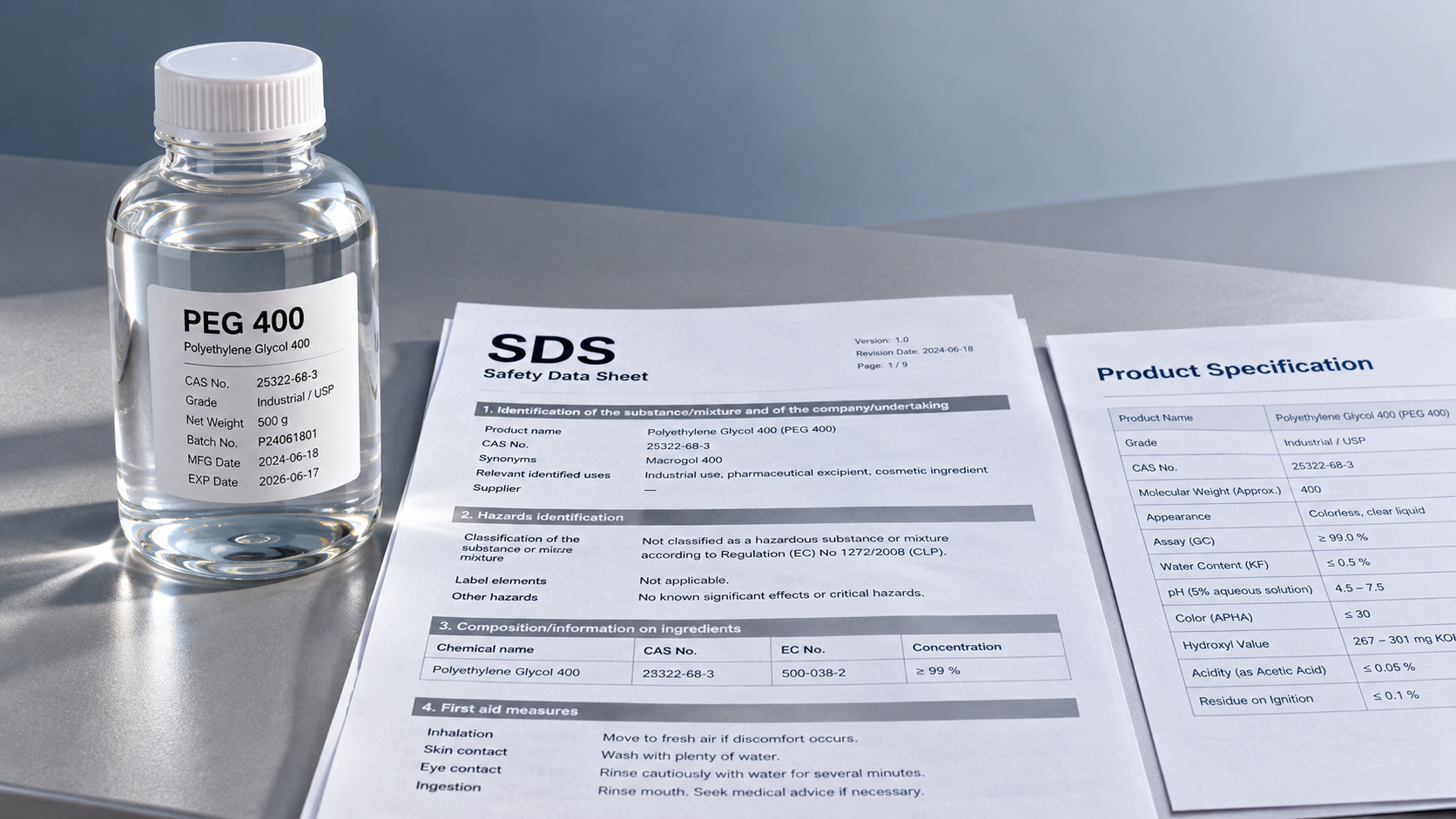
Will a Polyethylene Glycol SDS Meet Local Import Requirements?
A polyethylene glycol SDS is essential for many chemical imports, but possessing one does not automatically demonstrate compliance with the destination country’s import requirements.
Importers must check local rules for hazard classification, language, supplier identification, and document revisions, while separately confirming applicable registration, customs, labeling, and intended-use obligations.
Buyers asking, “Are small food colorants samples representative of production batches?” face a similar evidence problem: confirming that supplier documents accurately describe the goods shipped.
For polyethylene glycol, the practical starting point is matching the SDS to the actual grade, then checking its acceptability against the destination’s specific regulatory framework.
What Does an Acceptable SDS Actually Prove?
An SDS communicates chemical hazards, handling precautions, exposure controls, emergency measures, and related safety information. Its purpose differs from a customs declaration or product approval.
A document may satisfy local hazard communication requirements while the shipment still lacks necessary chemical registration, inventory coverage, importer authorization, or documentation for its intended application.
Conversely, some products may not require an SDS under a particular jurisdiction’s rules. A customer, warehouse, or carrier may nevertheless request safety information commercially.
The useful question is therefore broader than whether an SDS exists: does this document satisfy the applicable requirements for this product and destination market?
Start by establishing the importing country, responsible legal entity, expected annual quantity, product composition, and intended use. These details determine which checks deserve attention.
For purchasing teams, the business benefit is straightforward: resolving documentary gaps before shipment can prevent avoidable storage charges, relabeling costs, production delays, and rejected deliveries.
Does the SDS Describe the Exact PEG Grade You Ordered?
Polyethylene glycol describes a family of materials with different average molecular weights and physical properties. A generic family description may leave important product details unresolved.
Compare the purchase specification with the SDS product identifier, manufacturer’s grade designation, chemical identity, and stated composition. Investigate discrepancies before approving the document for use.
PEG 400 and PEG 6000, for example, typically differ in physical form and handling characteristics. An SDS should accurately describe the material being supplied.
A shared CAS number does not, by itself, establish that two commercial grades are interchangeable or that one safety document adequately covers both products.
Check whether the shipment contains neat PEG, an aqueous solution, or a formulated blend. Added ingredients can change classification, exposure precautions, labeling, and transport assessment.
Ask the supplier to explain any grade range covered by one SDS. The explanation should support consistent hazard information across the products included within its scope.
Use the certificate of analysis to confirm batch results against agreed specifications. Use the SDS for safety communication; neither document replaces the other’s function.
Which Destination Rules Should You Check First?
The Globally Harmonized System provides a common framework, but countries adopt different editions, hazard categories, implementation schedules, and supplementary requirements. Global formatting alone cannot establish compliance.
For EU imports, examine REACH safety data sheet requirements and CLP classification and labeling obligations. Determine separately whether registration or other substance-specific requirements apply.
An EU SDS generally needs the official language of the relevant Member State unless that state provides otherwise. Applicable exposure scenarios may also require attention.
For the United States, assess OSHA hazard communication requirements and applicable EPA TSCA obligations separately. Workplace safety documentation does not establish compliance with chemical import certification requirements.
For Great Britain, review GB CLP and UK REACH requirements. Northern Ireland can follow a different framework, making the precise delivery destination commercially significant.
For other markets, check the relevant national chemical authority’s requirements for SDS preparation, language, responsible supplier details, chemical inventory status, and any import controls.
A customs broker can clarify clearance procedures, while a qualified local regulatory specialist should address chemical compliance questions. Agree responsibilities before the supplier dispatches goods.
Which SDS Details Are Most Likely to Cause Problems?
Begin with Section 1: product identification, recommended uses, supplier details, and emergency contact information. These entries should reflect the applicable local requirements and supply arrangement.
A foreign manufacturer’s telephone number may not satisfy requirements for a local responsible party or emergency service. Verify availability, coverage, and required language support.
Review Section 2 for classification, label elements, and other hazards. Compare its conclusions with the container label and any destination-specific supplementary hazard statements required.
Check Section 3 for appropriate ingredient identification and disclosure. Confidentiality provisions differ between jurisdictions, so omissions acceptable in one market may require justification elsewhere.
Sections covering handling, exposure controls, physical properties, stability, toxicology, and ecology should be coherent. Unexplained contradictions can undermine confidence in the document’s underlying assessment.
Section 14 should address transport classification for the relevant modes. Section 15 may provide regulatory information, but cannot serve as a complete import compliance opinion.
The familiar sixteen-section structure is a useful screening tool. Its presence does not prove that the content, required detail, or legal basis is correct.
Is the Language Correct, and Is the Revision Still Valid?
English is common in international trade, but it is not universally sufficient. Confirm the required SDS language for each destination before accepting an English-only document.
A translation must preserve technical meaning, classification terminology, and precautionary instructions. Check that emergency details and regulatory references were localized where the destination requires it.
Use controlled document versions so the importer, warehouse, downstream customer, and supplier work from consistent information. Keep the original and translated versions linked and traceable.
There is no universal SDS expiry period. A document’s acceptability depends on applicable update rules, regulatory changes, and whether its safety information remains accurate.
A recent issue date does not guarantee compliance, while an older date does not automatically invalidate a document. Examine revision history and supporting regulatory references.
Request confirmation that relevant new hazard information, composition changes, and destination requirements have been considered. Where local law specifies review intervals, apply those intervals.
If the supplier updates an SDS after order approval, establish who reviews the change and whether labels, shipping arrangements, or workplace controls also require revision.
What Must You Verify Beyond the SDS?
Confirm whether the substance is covered by the destination’s chemical inventory or registration system. Requirements can depend on identity, quantity, importer arrangements, and available exemptions.
Where registration is relevant, ask how your legal entity, imported tonnage, and intended uses are covered. General statements about supplier registration may be insufficient.
Agree the customs classification using the product’s actual characteristics and applicable tariff rules. An SDS can support identification, but it does not conclusively establish classification.
Keep commercial invoices, packing lists, origin documents, specifications, and safety information consistent. Differences in product names or composition descriptions can prompt questions during clearance.
Food, pharmaceutical, cosmetic, and industrial applications may involve different requirements. A safety document does not establish suitability, permitted use, purity, or compliance for those sectors.
For sensitive applications, obtain the relevant specification, impurity information, and application-specific evidence. Evaluate any claimed standard against the exact grade and current purchasing requirements.
Also confirm transport status, packaging suitability, and carrier acceptance. A product assessed as non-dangerous for transport can still have workplace handling or storage requirements.
How Can You Review the Shipment Before Paying or Dispatching?
Build a short approval checklist around the purchase order. Record the destination, importer, grade, composition, quantity, intended use, and required language before reviewing supplier documents.
First, match the SDS against the specification and proposed label. Resolve inconsistent identifiers, physical descriptions, supplier names, and classification statements through documented supplier clarification.
Second, confirm destination obligations with the responsible importer or regulatory adviser. Record which registrations, inventory checks, notifications, or exemptions apply and who maintains the evidence.
Third, review the commercial and logistics documents with the broker and carrier. Confirm that product descriptions, packaging, transport assessment, and clearance information remain consistent.
Fourth, obtain the batch certificate of analysis when available. Check that its batch number and reported results correspond to the goods prepared for shipment.
Set an approval deadline before vessel booking or final payment. Assign unresolved issues to named owners so commercial urgency does not silently override compliance checks.
Hold dispatch when a material mismatch remains unresolved. Release the shipment once the responsible reviewers have accepted the corrected documents and any required supporting evidence.
Which Supplier Responses Should Make You Pause?
A supplier who says one universal SDS works everywhere may be overlooking national differences. Ask which destination requirements were considered and who prepared the document.
Be cautious when the grade on the quotation differs from the SDS without explanation. The mismatch may indicate outdated documents or unclear control of product information.
Blank mandatory fields, inconsistent company details, broken emergency contacts, and contradictory classifications deserve investigation. Request a corrected controlled version rather than relying on informal assurances.
Likewise, treat claims such as “customs approved” carefully unless they identify the authority, scope, and relevant shipment. Previous clearance does not guarantee future regulatory acceptance.
A supplier’s willingness to provide technical clarification, maintain revision records, and coordinate with the importer is more useful than broad promises that every document is compliant.
For Huafeng Chemical, the practical opportunity is to coordinate grade-specific documentation and destination review through its export service. Buyers should confirm these deliverables during quotation.
Agree response times for corrections and responsibility for document updates. Clear expectations help purchasing teams assess service quality alongside price, availability, and delivery commitments.
When Can You Confidently Approve a PEG Import?
A polyethylene glycol SDS supports import readiness when it matches the supplied grade, satisfies applicable local safety communication rules, and contains reliable, internally consistent information.
Approval also depends on separate checks for chemical regulatory coverage, customs documentation, labeling, transport, and intended-use requirements. Their relevance varies with the actual transaction.
Before committing to an overseas order, request the proposed SDS, product specification, label information, and applicable compliance evidence. Review them against a clearly identified destination.
The decisive standard is documented agreement between the product, its safety information, and local obligations. That gives buyers a defensible basis for releasing the shipment.