









Product Quick Navigation
Get a Quote
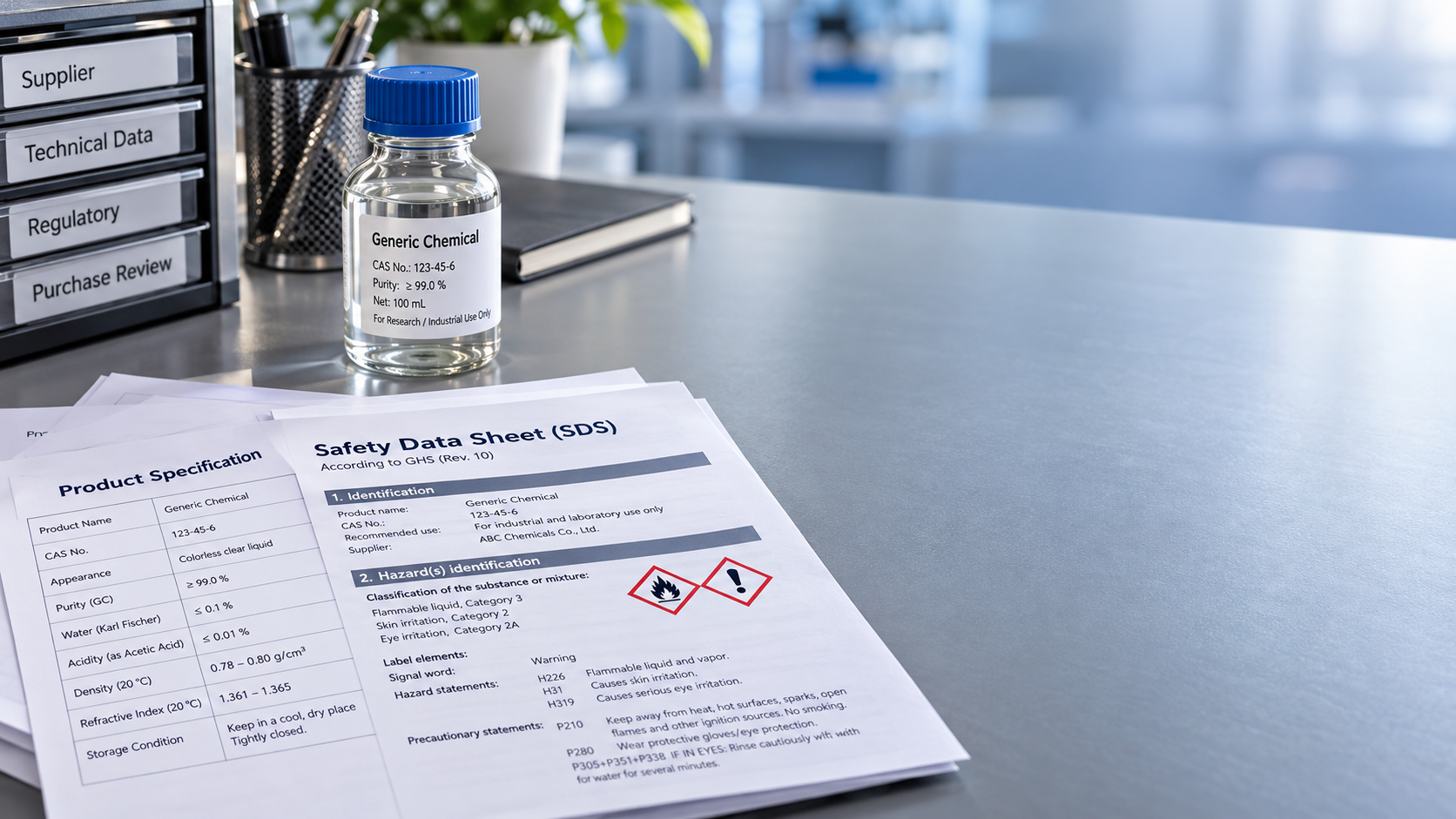
Buying industrial chemicals with SDS documentation is a sound starting point, but receiving a safety data sheet should not be the final approval step. Before placing an order, buyers need to establish that the document describes the material being quoted, that its hazard information is usable in the destination market, and that the proposed purchase can be stored, transported, and handled at the receiving site.
A competitive price can quickly lose its appeal if the shipment requires unexpected temperature control, arrives with the wrong documentation, or cannot be released for use. The most effective review connects the SDS to three other parts of the purchase: the product specification, the supplier’s offer, and the buyer’s intended use.
Start by matching the SDS to the material being offered
An SDS is useful only when it represents the product that will actually be supplied. Ask for the sheet before issuing the purchase order, and compare it with the quotation, technical specification, label information, and intended application. A familiar chemical name alone is not enough: products sold under similar names may differ in concentration, composition, physical form, or grade.
Section 1 normally identifies the product and supplier. Section 3 provides composition information, including relevant chemical identities and concentration ranges. For a single substance, a CAS number can help distinguish it from similarly named materials. For a mixture, pay particular attention to the stated concentration ranges and any components that affect hazards or compatibility.
Check the following points together:
- Product identifier: Does the name, CAS number where applicable, and product code correspond to the material on the quote and specification?
- Composition and concentration: Is the SDS for the concentration or mixture being ordered, rather than a related solution or a more concentrated substance?
- Physical form: Does it describe a powder, crystalline solid, liquid, or other form consistent with the offer?
- Supplier identity: Is the organization responsible for the SDS identifiable, and is its relationship to the seller clear?
- Revision date: Has the supplier provided its current applicable sheet, with a revision date that allows document control?
A discrepancy does not automatically mean the material is unsuitable. A distributor may issue documentation under its own name, for example, while the manufacturer appears elsewhere. It does mean the buyer should obtain an explanation and the correct documents before relying on the SDS. Avoid accepting an assurance that two grades are “essentially the same” when their composition, intended use, or handling requirements differ.
For recurring purchases, link the approved SDS to the product code and supplier in the purchasing system. When a supplier changes the formulation, source, or SDS revision, route the change to the people responsible for safety and quality rather than treating it as a routine file replacement.
Read the sections that can change the purchase decision
An SDS contains more information than most buyers need to interpret alone. Procurement does, however, need to identify requirements that affect sourcing, delivery, and total cost. The safety team, warehouse, transport provider, and end user can then assess the details within their responsibilities.
Hazards and exposure controls
Section 2 describes the hazard classification and label elements; Section 8 addresses exposure controls and personal protection. Look for information that could affect whether the material can be used at the intended site, including inhalation, skin contact, flammability, and chronic health hazards where classified. Also check whether the listed controls depend on ventilation or equipment the site does not have.
A hazard statement should prompt a practical question: can the receiving operation control the exposure in its actual process? A closed transfer system, small laboratory container, and manual opening of large powder sacks present different conditions. The SDS informs that assessment, but it does not replace a site-specific risk assessment or establish that a proposed process is safe.
Section 4 covers first aid, Section 5 firefighting, and Section 6 accidental release measures. These sections matter during purchasing because emergency equipment, spill response materials, and staff procedures may need to be in place before delivery. Ask the receiving site to review them early when the material is unfamiliar.
Storage, stability, and compatibility
Sections 7 and 10 address handling, storage, stability, and incompatible materials. Compare their requirements with the planned warehouse location and the time the material may spend in transit. A storage recommendation can affect refrigeration capacity, inventory placement, container choice, and delivery scheduling.
Do not assume that a warehouse can accommodate a chemical simply because it already stores other industrial products. Check segregation from incompatible substances, containment arrangements, temperature limits, and any restrictions on moisture or ignition sources. Where the SDS and technical specification appear to differ, ask the supplier to explain the intended conditions for the exact grade and packaging offered.
Transport and disposal
Section 14 provides transport information, while Section 13 addresses disposal considerations. If the material is regulated as dangerous goods for a proposed mode of transport, the classification can affect packaging, carrier acceptance, documentation, and freight cost. Requirements may differ by transport mode and jurisdiction; have the shipper and transport specialists confirm the classification and arrangements for the actual shipment.
Disposal also deserves attention before the order is placed. A low purchase price is less attractive if residues, contaminated packaging, or off-specification material require a disposal route the buyer has not arranged. The SDS is a starting point; local rules and the properties of the waste as generated still matter.
Check destination-market requirements before approving the document
Safety data sheet requirements are tied to the applicable jurisdiction and circumstances of supply. A document prepared for one market may not satisfy the language, format, classification, contact, or other requirements in another. Ask the supplier for an SDS intended for the destination market, then have the appropriate regulatory or safety specialist assess it against the requirements applicable to the transaction.
Do not use the presence of 16 section headings as proof of compliance. The content, classification, language, and responsible supplier details also matter. Where the buyer will import, relabel, repackage, or place the chemical on the market, additional obligations may apply beyond obtaining a supplier’s SDS.
Section 15 may provide useful regulatory information, but it should not be treated as a complete legal clearance for every destination or use. Establish who is responsible for checking import restrictions, registrations or notifications where applicable, and downstream communication. Put those responsibilities in the purchasing or supply agreement, especially when several parties are involved.
Emergency contact information is another practical check. Determine whether the number is appropriate for the destination, accessible when needed, and supported by arrangements suitable for the shipment. A contact that cannot assist the relevant parties during an incident offers little operational value.
Use the SDS alongside the specification, not in place of it
An SDS describes hazards and protective measures; it does not establish that a chemical meets the buyer’s quality requirements. A product may have a complete safety sheet and still be the wrong grade, contain unacceptable impurities, or fail a process requirement. Request a technical specification and, where appropriate, a certificate of analysis for the supplied lot. Agree on the relevant test methods, acceptance limits, and procedure for handling nonconforming material.
The distinction is especially important for pharmaceutical ingredients. Consider Metronidazole CAS#443-48-1, a substance associated with pharmaceutical applications. Matching the CAS number and reviewing an SDS are useful identity and safety checks, but they do not demonstrate suitability for use in a medicinal product. The buyer would also need to assess the applicable quality specification, impurity controls, manufacturing documentation, and regulatory requirements for the intended use and market.
Physical-property values should be interpreted with care as well. Reference data for a substance may include estimated values or conditions that do not represent a particular commercial grade. If a reported flash point, storage temperature, or other property affects warehouse or freight decisions, ask the supplier for the basis and the applicable information for the material being shipped. Do not resolve conflicting values by selecting whichever is cheaper to accommodate.
Compare offers on delivered and usable cost
The quoted price per kilogram is only one part of the decision. Once the SDS has been reviewed, ask each shortlisted supplier to quote on comparable terms: the same grade and concentration, package size, quantity, delivery destination, and transport responsibilities. Differences in those terms can make a lower unit price misleading.
Costs influenced by the safety and technical review can include:
- Special packaging, palletization, or dangerous-goods handling.
- Temperature-controlled storage or transport where required for the supplied material.
- Additional ventilation, protective equipment, spill controls, or staff training.
- Sampling, incoming inspection, and testing against the agreed specification.
- Disposal of residues, rejected material, and contaminated packaging.
- Delays or charges caused by incomplete shipment documents.
Not every cost belongs in the supplier’s quotation, but each can affect the buyer’s landed and usable cost. Assign likely costs to the responsible party and record any assumptions. When a supplier proposes a substitute grade or a different package to reduce price, repeat the relevant SDS and specification checks instead of assuming the earlier approval still applies.
What to settle before issuing the purchase order
At the final review, the buyer should be able to connect a specific supplier and product code to an applicable SDS, an agreed specification, and a delivery plan. The receiving site should know what will arrive, how it must be stored, and whether its handling and emergency arrangements are suitable.
Make unresolved requirements visible in the order or supply agreement: the documents to accompany shipment, labeling and packaging requirements, notification of material changes, and the process for reporting discrepancies. If a critical point remains open, agree on it before dispatch rather than relying on a document to be corrected after arrival.
The decision is then more useful than a simple “SDS received” checkbox. It shows whether the quoted material can be accepted, used, and managed at a cost and risk the buyer understands.
Send Us Your Inquiry Today
