









Product Quick Navigation
Get a Quote
Which African Countries Trigger Mandatory SPS Inspection Based on Export Documentation?
For chemical exporters shipping food additives into Africa, the question isn’t whether documentation matters—it’s which specific documents act as automatic “tripwires” for mandatory Sanitary and Phytosanitary (SPS) inspection at port. Unlike customs valuation or tariff classification—where discrepancies may lead to queries or minor delays—certain certification mismatches trigger immediate physical examination, detention, or rejection under national SPS frameworks. And crucially, this activation is not uniform across the continent: it depends less on the additive itself and more on how the supporting paperwork aligns with the importing country’s legally binding import control rules.
Three Certifications That Routinely Trigger Port-Side SPS Inspection
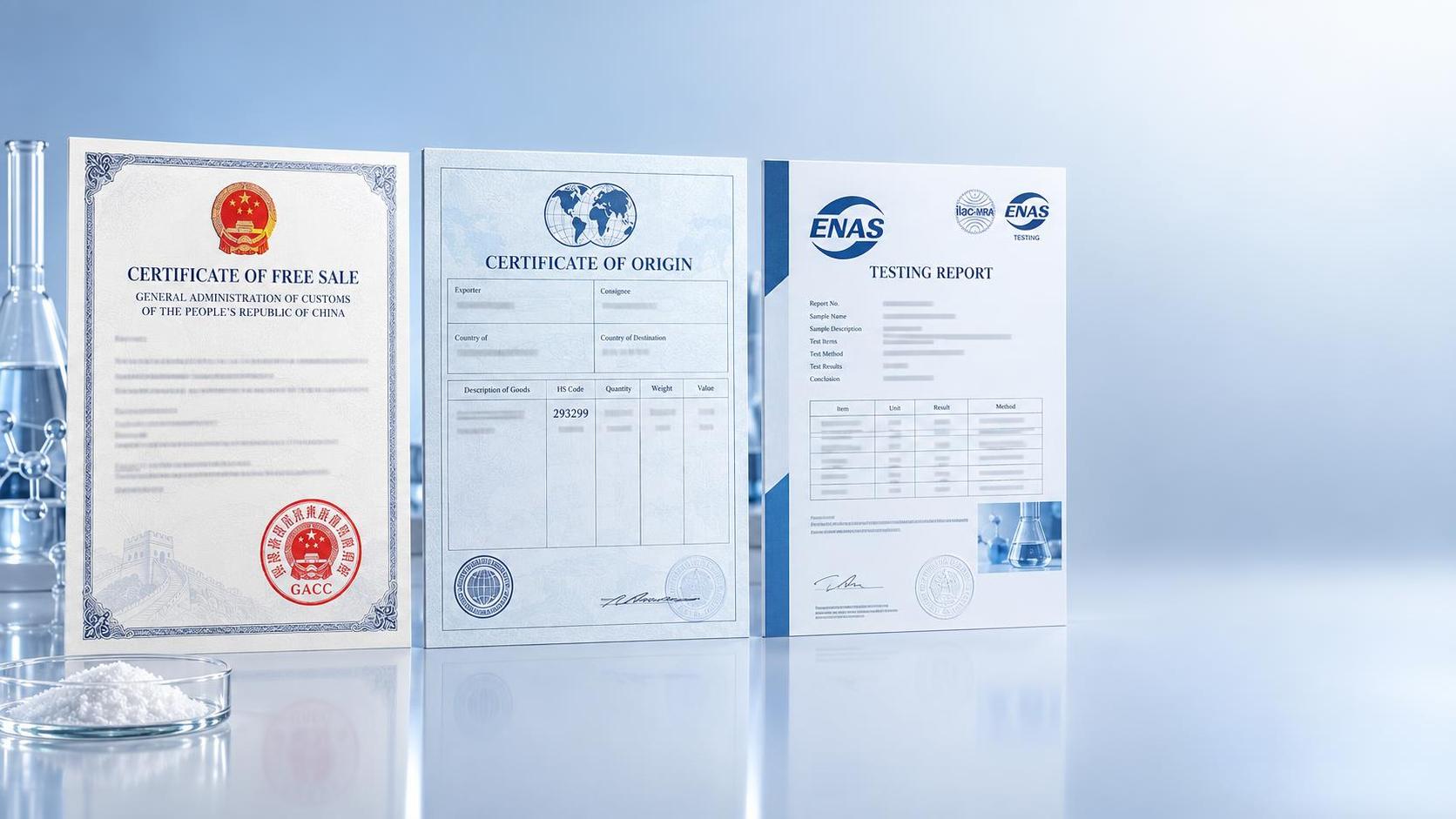
Based on recent clearance patterns across 12 major African ports—including Tema (Ghana), Dar es Salaam (Tanzania), Durban (South Africa), and Lagos (Nigeria)—three documentation elements consistently serve as formal triggers for mandatory SPS inspection:
- Non-recognized Certificate of Free Sale (CFS): A CFS issued by a Chinese provincial market supervision bureau—without explicit endorsement by China’s General Administration of Customs (GACC) or inclusion in the destination country’s approved list—is routinely flagged. For example, Kenya’s KEBS requires CFSs validated against its Approved List of Foreign Authorities; submissions from unlisted issuing bodies are treated as non-compliant, triggering full SPS verification.
- Missing or Non-Standardized Certificate of Origin (COO) with Preferential Treatment Claims: When exporters declare preferential tariff treatment under trade agreements (e.g., China–Africa FTA framework or ECOWAS protocols) but submit COOs lacking the required Annex II format—or omit the HS code at 6-digit level—the shipment enters SPS review. This is especially true in Senegal and Côte d’Ivoire, where customs and SPS authorities jointly audit preferential claims before release.
- Third-Party Laboratory Reports Without Accredited Signatory Recognition: Reports from ISO/IEC 17025-accredited labs are necessary—but insufficient—if the accrediting body (e.g., CNAS, UKAS, SAC) is not formally recognized by the importing authority. In Ethiopia, for instance, only test reports signed by labs accredited by the Ethiopian National Accreditation Service (ENAS) or its mutual recognition partners avoid mandatory retesting. Reports bearing CNAS accreditation alone do not exempt shipments from port-side analysis—even if technically valid.
Why “Compliant on Paper” Often Isn’t Enough
Many exporters assume that alignment with WTO-SPS principles—or even adherence to Codex Alimentarius standards—ensures smooth clearance. That assumption fails in practice. African SPS systems operate under national legislation, not international guidelines. What matters is whether the document satisfies the *exact* legal instrument cited in the importing country’s import decree.
Take Nigeria’s NAFDAC Regulation No. 8 of 2021: It explicitly states that “any food additive consignment accompanied by a Certificate of Analysis (CoA) not issued on the official letterhead of the manufacturer, bearing original wet-ink signature and stamp, shall undergo mandatory laboratory testing at Apapa Port.” This provision overrides general ISO or GMP references in the CoA. Similarly, South Africa’s DAFF Directive 14/2022 requires that all CoAs for preservatives (e.g., sodium benzoate, potassium sorbate) include batch-specific heavy metal limits aligned with SANS 1828—not just “complies with specification.” Omission of those values—even with full assay data—triggers SPS hold.
Country-Specific Thresholds: Where Documentation Becomes Operational Risk
The real operational risk lies not in obtaining documents, but in misjudging which ones carry legal weight *at the point of entry*. Below are three high-frequency scenarios where documentation choices directly determine inspection probability:
Note: These are not discretionary checks. They are codified in enforcement directives—and increasingly enforced through integrated customs-SPS digital platforms like Ghana’s GCNet and Kenya’s iTax-KEBS linkage.
What This Means for Commercial Evaluation
If you’re assessing an African market entry for food additives—or evaluating a supplier’s capacity to support it—documentation compliance must be assessed at the level of enforceable national requirements, not generic “export readiness.” Ask these questions before signing contracts or booking cargo:
- Does the target country maintain a publicly updated list of accepted foreign certifying authorities—and is your issuing body on it?
- Is the required Certificate of Analysis format prescribed in law (e.g., Kenya’s Legal Notice No. 212 of 2022), or left to administrative discretion?
- Are there mandatory pre-arrival electronic submissions—and what happens if the document upload window closes before vessel arrival?
- Does the importer hold active product registration? Because in 9 of the 12 countries reviewed, unregistered products—even with perfect documentation—cannot clear SPS regardless of certificate validity.
There is no continental harmonization of SPS documentation triggers. The East African Community (EAC) has made progress on mutual recognition, but implementation remains fragmented: a CFS accepted in Rwanda may still require revalidation in Uganda. Likewise, SADC’s model SPS protocol exists—but national regulations govern actual enforcement.
Forward-Looking Discipline, Not Just Checklist Compliance
Documentation that triggers SPS inspection isn’t inherently defective—it’s mismatched to the jurisdiction’s enforcement logic. The most resilient exporters treat documentation not as a final step, but as a live interface between technical specifications, regulatory timelines, and port-level operational reality. They map each document to its statutory basis in destination law, verify signatory recognition status quarterly—not annually—and build buffer time for pre-clearance steps that aren’t visible in shipping schedules.
That discipline separates predictable delivery from port-side uncertainty. And for food additive suppliers serving Africa’s expanding processed food sector—where shelf life, formulation stability, and regulatory predictability are interdependent—that distinction isn’t procedural. It’s commercial.
Send Us Your Inquiry Today
