









Product Quick Navigation
Get a Quote
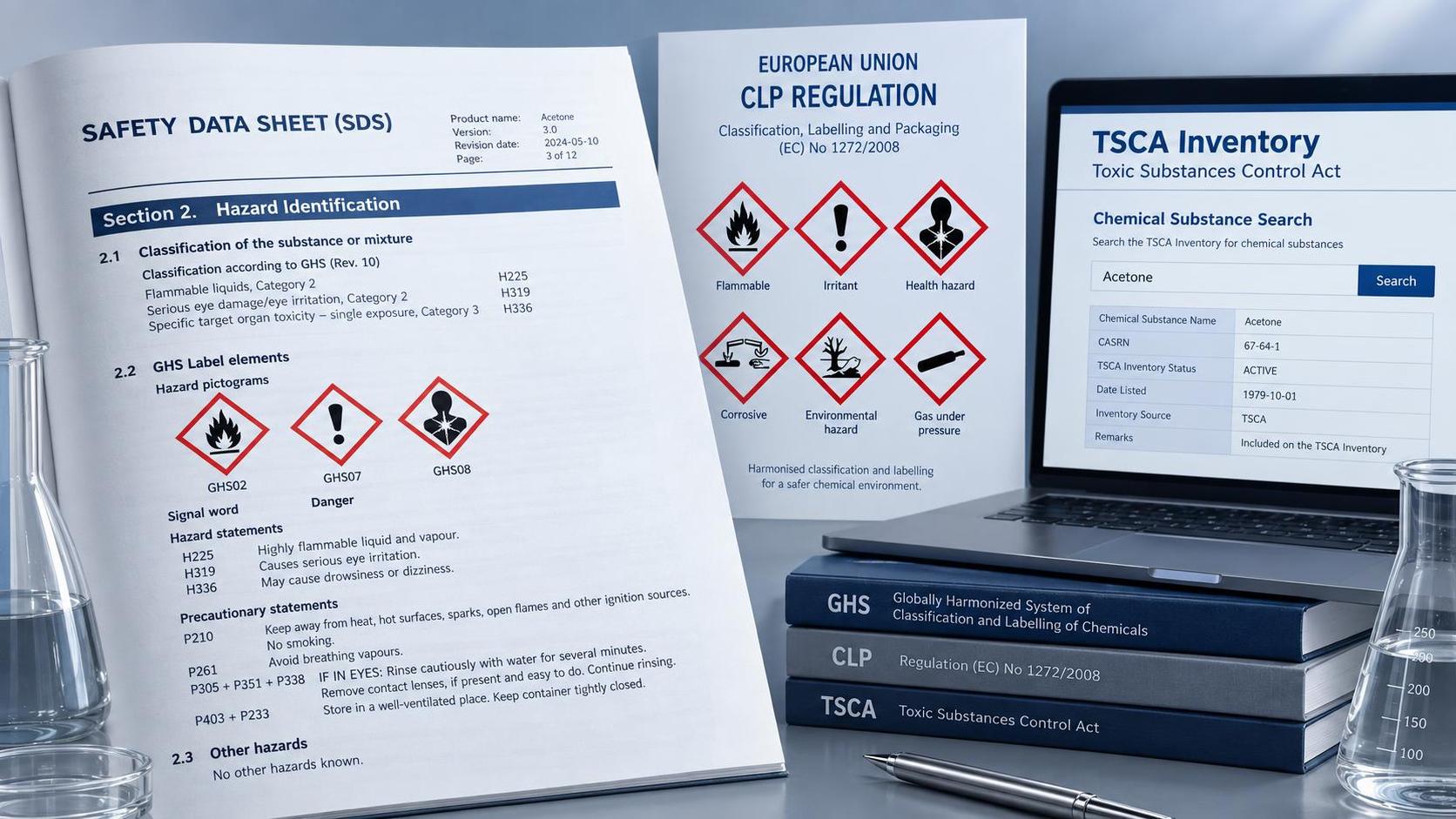
Facing a customs hold due to a chemical compliance issue is not a hypothetical risk—it’s a tangible disruption that can halt shipments at EU ports, trigger U.S. CBP red-flag reviews, or stall ASEAN clearance for weeks. For quality control and safety professionals managing global chemical exports, such holds mean more than delayed containers: they expose gaps in documentation accuracy, classification consistency, and regulatory alignment across jurisdictions. The immediate impact includes storage fees, missed delivery windows, contractual penalties, and erosion of buyer confidence—especially when the hold stems from preventable oversights like misapplied GHS hazard statements, outdated SDS versions, or mismatched HS codes tied to REACH or TSCA obligations.
The core resolution path is direct: identify the exact compliance deficiency flagged by customs, correct it with authoritative, jurisdiction-specific evidence, and resubmit under formal procedural channels. There is no universal “appeal” button—each hold requires precise diagnosis and jurisdiction-tailored remediation. At its foundation, this process hinges on three non-negotiable actions: verifying the official reason for detention (not assumptions), cross-checking your submission against the enforcing authority’s current regulatory baseline, and ensuring all supporting documents reflect real-time compliance—not historical or generic templates.
Step 1: Confirm the Exact Reason for Detention
Customs authorities rarely issue vague holds for chemical shipments. A detention notice—whether from U.S. CBP’s ACE system, EU’s CHIEF/NCTS portals, or Singapore’s TradeXchange—will specify the regulatory basis. Common triggers include:
- Mismatch between declared CAS number and actual substance composition (e.g., impurity thresholds exceeding TSCA exemption limits);
- SDS lacking required elements for the destination market (e.g., missing Section 2 hazard identification per CLP Regulation in the EU, or absence of U.S.-specific first-aid measures under OSHA HCS);
- Incorrect or missing import notification under REACH (for non-EU manufacturers using Only Representatives) or failure to file PMN pre-manufacture notices for new chemicals in the U.S.;
- Discrepancy between packaging labels and GHS pictograms/classifications stated in the SDS;
- Use of outdated harmonized classifications (e.g., referencing revoked Annex VI entries in CLP).
Do not proceed with corrections until you have the official detention reference number and verbatim reason. Relying on broker summaries or internal assumptions risks misalignment—and repeated rejection.
Step 2: Match Your Documentation to Jurisdiction-Specific Requirements
A single SDS or label cannot satisfy both U.S. and EU requirements simultaneously. Each jurisdiction enforces distinct rules on content, format, language, and update frequency. Below is a functional comparison for immediate verification:
Note: HS code assignment must reflect not just chemical identity but also physical state, purity, and formulation type. A 98% pure solvent may fall under one tariff heading; the same substance at 70% purity in aqueous solution often triggers a different classification—and different regulatory scrutiny.
Step 3: Correct and Resubmit With Evidence-Based Authority
Correction is not about reformatting documents—it’s about demonstrating traceable compliance. Submit only what customs explicitly requested, paired with source-backed justification:
- If the hold cites incorrect SDS classification, submit a revised SDS with tracked changes and a cover letter citing the specific regulation paragraph (e.g., “Per CLP Annex VI Table 3.1, Entry 01-0000001-00-0000, classification as Acute Toxicity Category 3 is mandatory”);
- If TSCA status is challenged, provide the EPA’s official TSCA Inventory search result showing active listing—or, if exempt, cite the applicable exemption (e.g., “This substance qualifies under 40 CFR 720.30(h)(1) as a polymer of low concern”);
- If labeling fails GHS alignment, submit corrected labels alongside the SDS Section 2 classification rationale and the relevant GHS Revision edition used (e.g., “GHS Rev. 7, Chapter 2.1.2”).
Do not submit generalized compliance statements. Customs officers act on codified references—not assurances.
Prevention: Build Compliance Into Your Export Workflow
Resolving a hold addresses the symptom. Preventing recurrence requires embedding verification checkpoints into routine operations:
- Pre-shipment SDS audit: Assign responsibility to verify SDS revision dates, jurisdiction-specific sections, and CAS number accuracy—not just formatting;
- Classification cross-walk review: Maintain an internal matrix mapping each product’s EU CLP, U.S. OSHA, and ASEAN GHS classifications side-by-side. Update it whenever a regulatory amendment is published;
- Broker communication protocol: Require brokers to share full detention notices—not summaries—and confirm receipt of your corrective submission with tracking numbers;
- Supplier data validation: For blended formulations, obtain full compositional data (including impurities >0.1%) from upstream suppliers—not just “<5%” ranges—to validate classification boundaries.
No external certification or third-party seal replaces rigorous, jurisdiction-grounded documentation discipline. When customs holds occur, the fastest resolution comes not from escalation—but from precision.
Send Us Your Inquiry Today
