









Product Quick Navigation
Get a Quote
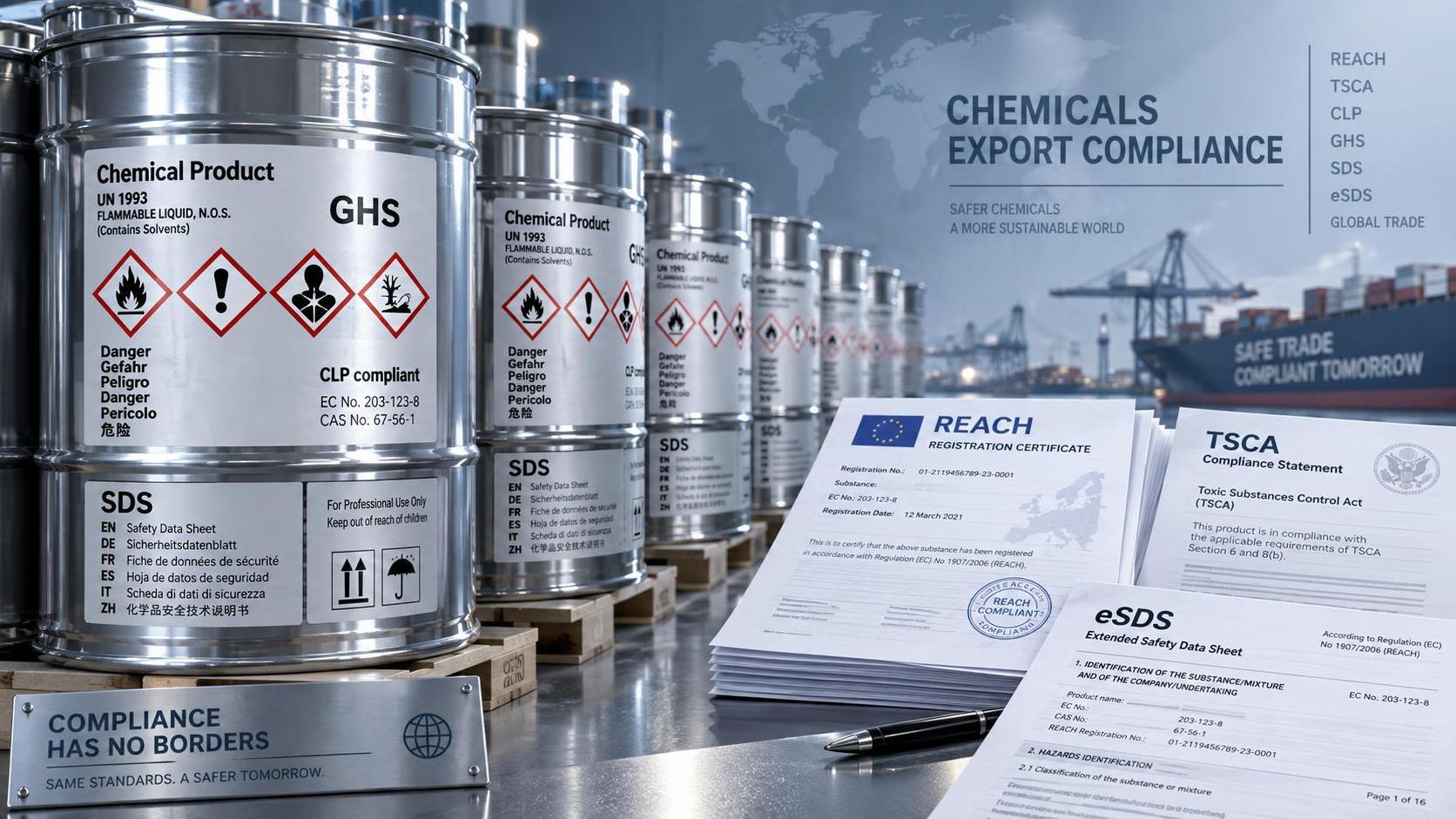
What happens if chemical regulatory compliance is overlooked during export?
It stops shipments. Not gradually—not with warnings or grace periods—but immediately, at the border.
When a consignment of industrial solvents, specialty additives, or agrochemical intermediates arrives at Rotterdam, Houston, or Yokohama port without valid SDS in the destination language, missing REACH pre-registration, or misclassified under CLP, customs authorities don’t request clarification. They detain. Then they notify the importer. Then they ask for documentation—or reject the cargo outright. There is no “second chance” built into most chemical import regimes. The consequence isn’t delay; it’s disruption—measured in weeks, not days—and cost—measured in tens of thousands, not hundreds.
Four consequences that compound—not just add up
Non-compliance rarely triggers a single penalty. It cascades:
- Customs rejection and forced re-export: In the EU, UK, and South Korea, shipments lacking correct classification, labeling, or prior notification (e.g., under REACH, K-REACH, or UK REACH) are routinely refused entry. Re-export requires new packaging, updated labels, revised documentation—and often, re-testing. One rejected 20-ft container of flame retardants bound for Germany incurred €47,000 in demurrage, repackaging, and air-freighted replacement samples to meet a production line deadline.
- Importers held liable—and they shift the burden: Under most jurisdictions, the legal responsibility for compliance rests with the importer of record. But in practice, overseas buyers enforce contractual clauses that make exporters financially responsible for non-compliant shipments. A U.S. polymer distributor recently invoked such a clause after a batch of UV stabilizers arrived without TSCA certification—charging the Chinese supplier for third-party verification, storage, and expedited reshipment. No appeal. No negotiation. Just an invoice.
- Loss of market access—not just for one product, but for your entire portfolio: Regulatory bodies track repeat violations. In Japan, two failed inspections under the Chemical Substances Control Law (CSCL) can trigger mandatory pre-import approval for all future shipments—even for unrelated products. In Canada, repeated failures to meet WHMIS requirements may result in being flagged in Health Canada’s internal exporter risk database, leading to 100% documentary checks on all subsequent consignments.
- Reputational erosion that outlasts any single shipment: Chemical buyers don’t evaluate suppliers on delivery timeliness alone—they assess reliability through regulatory discipline. A single incident where a customer’s production line halts due to unlabeled hazardous components doesn’t stay internal. It surfaces in procurement audits, shared supplier scorecards, and cross-industry forums. One Southeast Asian formulator stopped sourcing from three Chinese suppliers within six months of a joint audit revealing inconsistent SDS formats and unverified GHS classifications across their portfolios.
Why “we followed local rules” isn’t enough
Many exporters assume compliance means meeting China’s domestic standards—or satisfying the bare minimum required by their freight forwarder. That assumption fails because chemical regulation is jurisdictional, not universal.
Consider labeling: A drum marked “Flammable Liquid, Category 2” with pictograms compliant under China’s GB 30000.2-2013 may still violate EU CLP Annex I requirements—because CLP mandates specific signal words (“Danger”, not “Warning”), prescribed hazard statements (H225, not just “Highly flammable”), and supplemental information for certain substances. Similarly, an SDS prepared to GB/T 16483-2021 may omit the exposure scenarios required under REACH Article 31—or fail to include the extended safety data sheet (eSDS) needed for SVHC-containing mixtures above 0.1% w/w.
The gap isn’t oversight—it’s structural. Domestic compliance frameworks prioritize occupational safety and environmental protection *within* national borders. Export regulations focus on downstream use, supply chain transparency, and hazard communication *across* borders. They demand traceability (e.g., substance identity down to EC/ELINCS numbers), substantiation (e.g., test reports referenced in SDS Section 9), and procedural rigor (e.g., REACH registration dossiers validated by ECHA—not just filed).
Where the risk concentrates—and why it’s not evenly distributed
Compliance failure isn’t random. It clusters in three operational blind spots:
- Product formulation changes without regulatory reassessment: A minor tweak—substituting one solvent for another, adjusting pH with a different acid, or changing a catalyst—can shift classification, trigger new reporting obligations (e.g., under TSCA or Australia’s NICNAS), or invalidate existing SDS authorizations. Yet few export workflows require regulatory sign-off before formulation release.
- Reliance on outdated or generic SDS templates: Some exporters reuse SDS files across product lines, updating only concentration ranges. But GHS-compliant SDS aren’t templates—they’re substance-specific technical documents. A single incorrect LC50 value in Section 11, or omission of a known degradation product in Section 12, renders the entire document non-compliant—and exposes both exporter and importer to enforcement action.
- Assuming freight forwarders handle “regulatory” tasks: Forwarders manage logistics—not regulatory interpretation. They transmit documents but do not validate SDS content, verify CLP classification logic, or confirm whether a substance falls under PIC (Prior Informed Consent) procedures. When a shipment of organophosphate intermediates was detained in Chile, the forwarder confirmed the paperwork was “complete”—but had no authority to assess whether the notified substance met Decree No. 52’s definition of “highly hazardous.”
What shifts the calculation—from cost center to capability
For decision-makers weighing investment in compliance infrastructure, the question isn’t “Can we afford dedicated regulatory staff?” It’s “Can we afford *not* to?”
Companies treating compliance as a back-office task consistently face higher landed costs: emergency courier fees for corrected labels, third-party verification surcharges, penalties tied to Incoterms (especially DAP or DPU), and lost volume from delayed customer approvals. Those embedding regulatory assessment into R&D handover, sales quoting, and order fulfillment—using structured checklists, jurisdiction-specific rule engines, and cross-functional review gates—see fewer disruptions, faster time-to-market for new grades, and stronger leverage in commercial negotiations.
This isn’t theoretical. At Shandong Huafeng Chemical, export readiness begins at the lab bench: every new formulation undergoes parallel regulatory screening against target markets’ substance inventories, classification rules, and documentation mandates before sample dispatch. That upstream integration means their EU-bound surfactants ship with validated eSDS, CLP-compliant labels, and REACH registration numbers embedded in commercial invoices—not appended as last-minute corrections.
That level of alignment doesn’t eliminate complexity—but it converts regulatory risk from a stop-and-fix event into a predictable, managed input. And for chemical exporters operating across 15+ jurisdictions, predictability isn’t convenience. It’s the foundation of trusted supply.
Send Us Your Inquiry Today
