









Product Quick Navigation
Get a Quote
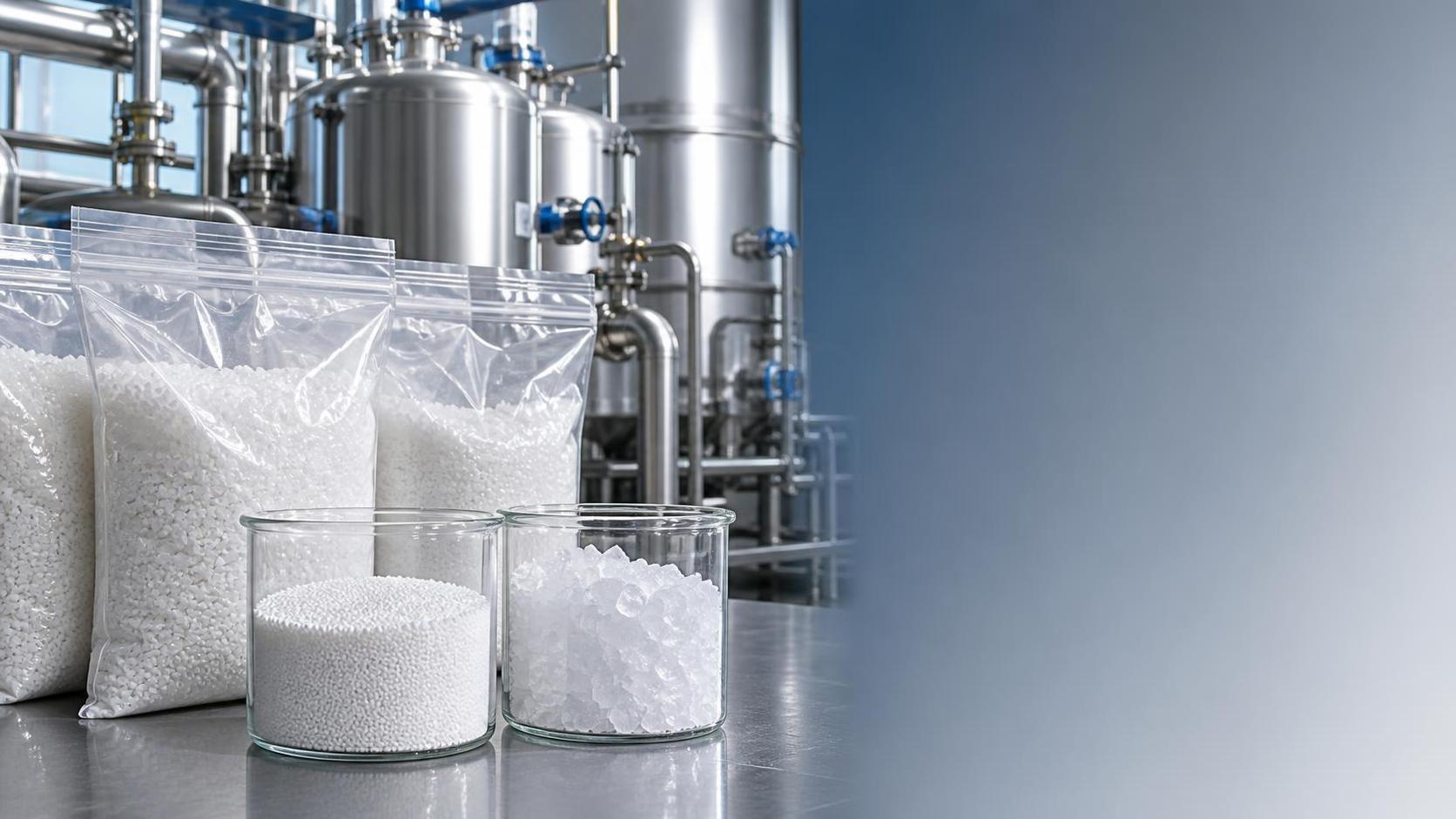
Anhydrous vs Hexahydrate Magnesium Chloride: Which Grade Fits Your Process?
Selecting the right Magnesium Chloride grade is a process decision, not merely a purchasing choice. The correct form affects active content, dosing accuracy, storage design, and operating cost.
For most technical evaluations, anhydrous magnesium chloride suits moisture-sensitive, high-temperature, or concentration-critical applications. Magnesium chloride hexahydrate generally suits aqueous processing where lower material cost and easier dissolution matter most.
The important distinction is not whether both materials contain magnesium and chloride. It is whether their physical form, water content, impurity profile, and logistics behavior fit your actual process window.
Start With the Chemical Difference That Drives Every Other Decision
Anhydrous Magnesium Chloride is commonly represented as MgCl2. It contains no intentionally bound water, making it the most concentrated commercial form of magnesium chloride on a mass basis.
Magnesium chloride hexahydrate is represented as MgCl2·6H2O. Its crystal structure includes six waters of hydration, which significantly changes its molecular weight, handling behavior, and effective magnesium chloride content.
The molecular weight of anhydrous magnesium chloride is approximately 95.21 g/mol. Magnesium chloride hexahydrate has a molecular weight of approximately 203.30 g/mol because of its bound water.
This difference means that one tonne of hexahydrate does not provide one tonne of active MgCl2. Technical teams must calculate dosage using active content rather than delivered product weight.
Pure magnesium chloride hexahydrate contains roughly 46.8% MgCl2 by weight. Pure anhydrous material is effectively 100% MgCl2, although commercial purity specifications always require separate review.
A plant replacing hexahydrate with anhydrous material without recalculating feed rates can substantially overdose magnesium chloride. The reverse substitution can create an underfeed and reduce process performance.
Water of hydration is chemically different from surface moisture, but both matter operationally. Hexahydrate may also carry free moisture depending on storage conditions, packaging integrity, and product form.
Therefore, a technical specification should identify the requested hydrate form, assay basis, moisture limit, particle size, insoluble matter, and relevant trace-ion restrictions before supplier comparison begins.
Compare Active Content Before Comparing the Quoted Price
The clearest cost comparison is cost per kilogram of active MgCl2 delivered into the process. A lower purchase price per tonne can be misleading when hydrate water represents a major portion.
For example, hexahydrate may appear less expensive per tonne while requiring more than twice the mass to supply an equivalent amount of anhydrous Magnesium Chloride.
Calculate the active-material cost by dividing the delivered tonne price by the guaranteed MgCl2 content. Include freight, losses, repackaging, storage, and preparation costs in the same calculation.
For dissolved-product applications, compare cost per kilogram of magnesium ion or chloride ion delivered. This approach is especially useful in water treatment, brine formulation, and mineral processing.
Anhydrous material can reduce inbound freight and warehouse throughput where active-content demand is high. However, its logistics advantage may disappear if moisture control requires specialized packaging or handling equipment.
Hexahydrate can be economically attractive where the process already uses water, dissolution tanks are available, and the additional hydration water has no negative effect on formulation balance.
Technical evaluators should avoid assuming that the concentrated grade is automatically cheaper. The best option depends on total installed cost, yearly consumption, transport distance, and process modification requirements.
A robust bid comparison should request assay on the same basis from every supplier. “Magnesium chloride content,” “MgCl2 dry basis,” and “MgCl2·6H2O content” are not interchangeable commercial statements.
How Moisture Sensitivity Changes Handling and Storage Requirements
Anhydrous Magnesium Chloride is strongly hygroscopic. It readily absorbs moisture from air and can form hydrates, cakes, or dissolve into concentrated liquid when exposed to humid conditions.
This behavior makes packaging quality central to performance. Moisture-barrier bags, sealed liners, covered transfer systems, dry receiving areas, and disciplined stock rotation are often necessary.
Open handling of anhydrous product may cause rapid weight gain and inconsistent flow. In automated dosing systems, this can affect feeder calibration, screw performance, and batch reproducibility.
Hexahydrate is also hygroscopic, but it is generally more forgiving in applications designed around aqueous materials. It may still cake, liquefy locally, or lose flowability during poor storage.
Flake, pellet, granular, and powder formats do not behave identically. Particle shape, particle-size distribution, fines content, and compaction resistance can determine whether a grade works in existing equipment.
For dry pneumatic conveying, both forms require evaluation for dust generation, transfer humidity, and corrosion potential. Hygroscopic dust can accumulate on surfaces and complicate housekeeping activities.
Storage design should also account for chloride-related corrosion. Contact with moisture can create corrosive brines that may attack unsuitable metals, fasteners, floors, and nearby process equipment.
Request supplier data on package construction, pallet wrapping, shelf life, recommended storage conditions, and typical flow properties. These operational details are often more useful than a basic chemical assay alone.
Choose the Grade That Matches Your Process Temperature and Water Balance
High-temperature processes often favor anhydrous material because added water can disrupt thermal balance, increase energy demand, or alter the chemistry of melting, roasting, drying, or fused-salt operations.
In metallurgical and refractory applications, hydrate water may require removal before the desired reaction can proceed. That dehydration step consumes energy and may generate handling or emissions concerns.
Anhydrous Magnesium Chloride is commonly considered where magnesium chloride acts as a concentrated precursor, flux component, feedstock, or reactant in temperature-sensitive production environments.
Even then, evaluators must consider hydrolysis risk. At elevated temperatures, magnesium chloride can react in the presence of water and produce acidic gases, including hydrogen chloride under certain conditions.
For aqueous solution preparation, hexahydrate often provides simpler operation. Its hydration state is already compatible with water-based systems, and controlled dissolution can produce consistent brines.
Water treatment facilities, dust-control operations, de-icing brine producers, and some textile processes may prefer hexahydrate when dry concentration is less important than convenient solution preparation.
The practical question is whether water entering with the raw material is useful, neutral, or harmful. This single question often narrows the grade selection faster than general product comparisons.
Where a final formulation has strict solids content, use anhydrous material only with an appropriate moisture-control plan. Where dilution is acceptable, hexahydrate may reduce unnecessary process complexity.
Purity Is Not One Number: Define the Impurities That Matter to Your Process
A high MgCl2 assay does not automatically mean a grade is suitable. The relevant impurity profile depends on whether the material enters food-related, pharmaceutical, technical, industrial, or metallurgical production.
Typical evaluation parameters include calcium, sodium, potassium, sulfate, bromide, insoluble matter, iron, heavy metals, moisture, pH, and water-insoluble residues.
For specialty formulations, trace metals can affect color, stability, catalytic behavior, or downstream product specifications. In electrochemical or metal-production uses, impurity control may be particularly critical.
Calcium chloride and sodium chloride may be tolerable in some de-icing products but unacceptable in applications requiring tightly controlled magnesium concentration, conductivity, crystallization, or reaction performance.
Insoluble matter deserves attention for liquid preparation systems. Fine insolubles can block filters, affect clarity, foul injection points, and produce sediment in storage tanks.
Request a recent certificate of analysis for the actual commercial grade, not only a generic technical data sheet. Confirm whether specification limits are guaranteed for every shipment.
When qualification risk is high, obtain a representative sample and test it under actual plant conditions. Bench chemistry alone may not reveal caking, dissolution residue, foaming, or filtration problems.
Technical teams should also ask whether the grade is produced from natural brine, seawater derivatives, recovered streams, or synthetic routes. Feedstock origin can influence consistency and trace impurities.
Dissolution Behavior and Dosing Accuracy Often Decide the Practical Winner
Both grades are highly soluble in water, but their dissolution behavior differs because hexahydrate already contains bound water and anhydrous material rapidly interacts with available moisture.
When preparing concentrated brines, heat release, mixing capacity, addition rate, and solution temperature should be evaluated. Poor charging practice can create local clumping or uneven concentration.
Anhydrous material may be advantageous where tank volume is limited and high active concentration is required. It can produce more active chemical per unit of warehouse and transport capacity.
Hexahydrate can simplify manual or semi-automated charging where operators need a stable, predictable solid form. Actual performance still depends on grade format and ambient humidity.
For continuous dosing, define the feed system around the purchased material. A gravimetric feeder calibrated for flakes may not perform reliably when supplied with fine powder or compacted granules.
Solution concentration should be verified with appropriate analytical controls, not inferred from nominal additions. Density, conductivity, titration, and chloride analysis may provide useful process confirmation.
Qualification trials should measure preparation time, solution temperature, undissolved residue, pumpability, final concentration, and batch-to-batch repeatability. These metrics reveal operating cost beyond raw-material price.
Do not overlook water quality. Hardness, alkalinity, suspended solids, and incompatible additives can affect solution appearance or downstream use, regardless of whether anhydrous or hexahydrate material is selected.
Application-Based Selection: Where Each Grade Usually Makes Sense
Anhydrous Magnesium Chloride is generally the stronger candidate for fused-salt systems, magnesium metal-related processing, catalyst preparation, specialized synthesis, and applications with strict water limitations.
It is also relevant when transportation efficiency is critical, provided the receiving site can preserve product integrity through dry storage and well-designed transfer procedures.
Magnesium chloride hexahydrate is commonly selected for brine preparation, road treatment products, dust suppression, wastewater treatment, construction-related uses, and other aqueous industrial applications.
Its practical value is strongest when hydration water does not impair performance and when the site benefits from an easier-to-handle solid with acceptable active-content economics.
In food, pharmaceutical, feed, and regulated consumer applications, grade selection cannot be based on hydrate form alone. Regulatory status, contaminant limits, traceability, and documentation are equally important.
Where a facility uses multiple reducing agents or process additives, procurement teams should separate chemical compatibility reviews by function. For example, Sodium Metabisulfite CAS#7681-57-4 requires its own moisture, acid-contact, and sulfur dioxide release controls.
That distinction matters because a supplier’s broad chemical portfolio does not establish interchangeability between products. Each chemical should be qualified against its own safety, storage, and reaction conditions.
Build a Supplier Qualification Process Around Consistency, Not Only Specification
For export procurement, consistency across shipments is often more valuable than an exceptional one-time assay. A technically acceptable grade must remain acceptable through routine production and international logistics.
Evaluate whether the supplier can provide stable product origin, batch traceability, certificates of analysis, safety data sheets, packaging photographs, and shipment-specific inspection records.
Confirm that export documentation aligns with destination-country requirements. This may include customs classification, labeling, transport declarations, chemical inventory status, and customer-specific compliance statements.
Packaging should be evaluated against route conditions, not just warehouse storage. Long sea transit, tropical humidity, port delays, and container condensation can materially change hygroscopic product quality.
Ask whether desiccants, liner bags, moisture barriers, and pallet protection are standard or optional. For anhydrous products, packaging design may be a decisive part of technical approval.
Supply-chain resilience also includes communication quality. Technical evaluators need prompt answers on batch deviations, loading dates, test methods, change notifications, and corrective-action procedures.
Shandong Huafeng Chemical can support overseas buyers with a broad chemical export portfolio and coordinated trade services. However, buyers should still define acceptance criteria before requesting commercial quotations.
A useful supplier questionnaire covers assay, test methods, impurity limits, physical form, annual capacity, lead time, packaging, origin, regulatory documentation, and procedures for handling nonconforming shipments.
A Practical Decision Framework for Technical Evaluators
Choose anhydrous Magnesium Chloride when your process is moisture-sensitive, requires high active concentration, operates at elevated temperature, or benefits materially from reduced shipping mass.
Choose magnesium chloride hexahydrate when your process is aqueous, dilution-tolerant, operationally simple, and able to use the hydrated product without adding energy or quality risk.
Before final approval, convert all candidate prices to active-MgCl2 cost. Then add freight, storage losses, dissolution time, energy demand, labor, equipment changes, and disposal requirements.
Next, compare the supplier’s guaranteed impurity limits with your process limits. Identify whether calcium, sulfate, sodium, insolubles, heavy metals, or moisture could create a measurable problem.
Finally, run a controlled trial using commercial packaging and expected handling conditions. The most credible selection is based on plant data, not assumptions derived from molecular formulas.
Document the approved grade with an unambiguous purchase specification. Include hydrate form, MgCl2 assay basis, maximum impurity limits, particle form, packaging, test certificates, and storage instructions.
Conclusion
Anhydrous and hexahydrate Magnesium Chloride are not interchangeable simply because they share the same base salt. Their water content changes delivered active material, handling risk, energy balance, and process suitability.
Anhydrous material is typically the technical choice for concentrated, moisture-controlled, or thermal applications. Hexahydrate is often the practical choice for water-based systems where handling convenience and lower initial cost are valuable.
The best grade is the one that meets your process specification after total cost, impurity control, packaging performance, regulatory documentation, and supplier reliability are evaluated together.
Send Us Your Inquiry Today
