









Product Quick Navigation
Get a Quote
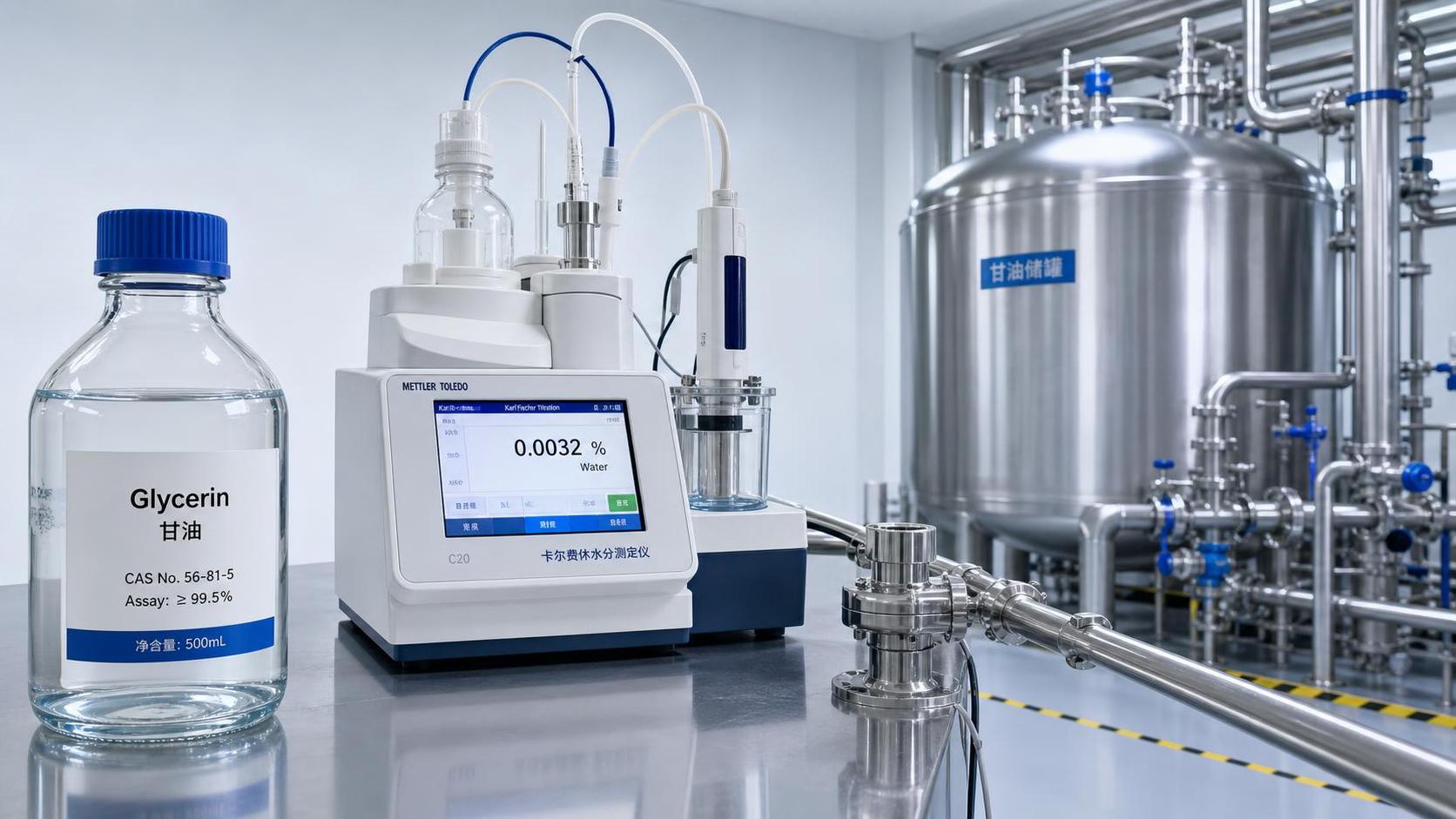
Glycerol purity and water content set the practical limits of many industrial formulations. A material that appears clear and meets a broad assay target may still create viscosity drift, inconsistent solids loading, unexpected microbial concerns, altered reaction rates, or documentation gaps. The relevant specification is therefore not a single purity number. It is a controlled set of chemical, physical, and trace-impurity parameters matched to the intended process and end-use requirements.
Glycerol is strongly hygroscopic, completely miscible with water, and commonly used as a humectant, solvent, viscosity modifier, plasticizer, heat-transfer component, intermediate, or processing aid. These properties make it useful across chemical, pharmaceutical, food, personal-care, coating, resin, and technical applications. They also make moisture control difficult: water can enter during manufacture, bulk storage, transfer, sampling, and repeated opening of smaller containers. A material may conform when released but differ materially by the time it reaches a blending vessel if the handling system does not limit moisture uptake.
Purity is a formulation specification, not merely an assay result
Assay normally expresses the mass fraction of glycerol in the delivered material. Higher assay generally indicates less water and fewer non-glycerol constituents, but it does not identify the nature of all remaining material. Two lots with a similar glycerol assay can behave differently when their residual water, salts, organic residues, ash, color bodies, odor-causing compounds, or trace process contaminants differ.
The correct purity grade depends on the formulation and on the applicable product standard. A technical mixture may tolerate a broader impurity profile when glycerol is used mainly for bulk rheology or freeze-point control. A sensitive formulation may require tighter limits for individual impurities because trace constituents can affect odor, appearance, reaction selectivity, color stability, conductivity, or downstream qualification. Food, pharmaceutical, cosmetic, and other regulated uses can impose separate identity, impurity, traceability, and documentation conditions. A general industrial grade should not be assumed interchangeable with a grade intended for a controlled application.
Purity should be assessed alongside identity testing. Density, refractive index, chromatographic assay, and infrared comparison can each contribute useful evidence, but no single method answers every question. Density and refractive index respond strongly to water content and temperature; they are efficient screening tools when the temperature correction and accepted range are defined. Chromatographic methods can quantify glycerol and certain organic impurities, while a dedicated water method is needed where water is a release-critical parameter.
Why water changes processing behavior
Water is the largest variable in most commercial glycerol systems. As water increases, viscosity declines substantially, density and refractive index change, and the effective concentration of every dissolved ingredient is reduced. The direction of those changes is predictable, but the operational consequence depends on the formulation.
In a viscosity-controlled blend, an unaccounted increase in water can cause the final product to fall outside its flow specification. Metering based on volume rather than mass may then introduce an additional error because the density has changed as well. In batching operations that charge glycerol by pump time, a lower-viscosity lot can move through the line faster than expected, while the actual glycerol mass delivered per unit volume is lower. Mass-flow measurement or weighed addition reduces this source of variation.
Water also affects dissolution and phase behavior. A solvent system formulated near a cloud point, crystallization boundary, or salt-solubility limit can become unstable after a modest moisture shift. Hydrophilic polymers may hydrate more rapidly or develop a different viscosity profile. Some resins, isocyanate-containing systems, acid chlorides, anhydrides, and moisture-sensitive reagents can react with water, produce gas, alter molecular weight, or consume active functional groups. In these cases, the allowable moisture level must be derived from reaction stoichiometry and process sensitivity rather than from a generic glycerol description.
Thermal operations deserve separate attention. Glycerol has a high boiling point, but an aqueous glycerol mixture will release water well before glycerol itself is exposed to high-temperature conditions. During vacuum concentration, heating, or distillation, the water fraction affects vapor load, condenser duty, foaming tendency, and residence time. If material is heated in a partly closed system, water vapor can increase pressure. Temperature limits, venting arrangements, and compatible seals should be defined for the actual composition, not for nominally anhydrous glycerol.
Water measurement needs a defined basis
Water content is often reported as a percentage, but the test basis matters. Karl Fischer titration is widely used because it directly measures water and can be suitable at low moisture levels when sampling and sample preparation are controlled. Volumetric or coulometric technique should be selected according to the expected water range and laboratory method capability. The result is only as reliable as the sample: a hygroscopic liquid can gain water quickly from humid air, and residual moisture in syringes, transfer lines, or sample bottles can distort the result.
Loss on drying is not always equivalent to water content. Heating may remove water, but it may also volatilize other components or initiate changes in a material containing unstable impurities. A loss-on-drying result can be useful where an applicable method permits it, yet it should not automatically replace Karl Fischer data. The certificate of analysis should state the method, unit, result, specification limit, and, where relevant, the release date.
Water is also a logistics variable. Drums, intermediate bulk containers, tank containers, valves, gaskets, vents, and hoses form part of the moisture-control system. Containers must be clean, dry, and compatible with the grade being handled. Opening a container repeatedly in a humid area can change a tightly controlled material before the container is exhausted. Nitrogen blanketing may be justified for moisture-sensitive formulations, although it should be evaluated against the relevant fire, pressure, contamination, and operating procedures rather than adopted as a universal measure.
Impurities that require more attention than the headline assay
Residual salts and inorganic ash can matter in electrically sensitive, catalytic, optical, or low-residue applications. They may increase conductivity, contribute to deposits during evaporation, or interfere with catalyst performance. Color and odor are similarly easy to dismiss as cosmetic attributes, yet they can indicate oxidation, thermal history, process residues, or contamination. A color limit should be evaluated using a stated method and comparison basis because visual inspection alone varies with vessel geometry, lighting, and sample depth.
Acidity or alkalinity can affect corrosion, pH adjustment, esterification, and compatibility with active ingredients. A low measured acidity does not establish compatibility with every formulation component, but it can identify changes from the agreed incoming-material profile. Chloride, sulfate, metals, aldehydes, and specific organic contaminants may also be relevant depending on feedstock route, purification method, intended market, and process chemistry. Testing should be risk-based: a long impurity list without acceptance rationale adds administrative work without necessarily improving control.
For formulations that are retained for extended periods, evaluate the total water balance rather than glycerol water alone. Water can arrive with surfactants, aqueous extracts, pigments, neutralizing solutions, recycled solvents, and wash residues. A compliant glycerol lot may still be associated with an out-of-range final mixture because another raw material or a cleaning step introduced the decisive moisture load.
Incoming control and release decisions
Incoming evaluation begins with material identity, container integrity, lot traceability, and document consistency. The purchase specification, certificate of analysis, safety documentation, transport information, and internal test results should describe the same material grade and lot. A certificate copied from a representative batch should not be treated as lot-specific evidence. Differences in product name, assay basis, water method, or unit of measure should be resolved before material is assigned to production.
- Confirm that the declared glycerol assay and water content are technically compatible. A reported assay plus water result may not add to exactly 100% because of other components and differing methods, but a large unexplained gap warrants investigation.
- Take a representative sample from a controlled point. Settling is generally less significant for a homogeneous liquid than for suspensions, but contamination can be concentrated near valves, hoses, and container openings.
- Record sample temperature when density or refractive index is used. Comparing values measured at different temperatures without correction can create a false out-of-specification result.
- Place material on hold when appearance, odor, documentation, or analytical results conflict with the approved specification. Blending a questionable lot into conforming stock removes the ability to isolate the cause.
Retain samples should be stored in tightly closed, compatible containers with clear lot identification. When a later complaint or process deviation occurs, a retained sample supports comparison with the original release result. The retention environment should limit moisture exchange and avoid unnecessary heat exposure. A sample kept in a partially filled bottle with repeated access may no longer represent the received lot.
Formulation interfaces and cross-material controls
Glycerol often enters blends containing powders, salts, polymers, acids, bases, surfactants, or reactive intermediates. Its water content can change powder wetting and dispersion time, especially where a powder is added under high shear. Water may reduce viscosity enough to improve initial wetting but later alter the target rheology after full hydration. Small-scale compatibility screening should use the intended glycerol grade, expected process temperature, addition order, and realistic hold time. Screening with a laboratory reagent grade can conceal problems that emerge with the commercial material.
In formulations that also contain inorganic powders, the liquid phase should be evaluated separately from powder properties. For example, Bismuth(III) Oxide CAS#1304-76-3 is practically insoluble in water and is supplied as a powder; glycerol moisture will not turn it into a dissolved component, but it can affect powder wetting, agglomerate breakup, slurry viscosity, and settling behavior. The relevant controls include particle dispersion, mixing energy, order of addition, and the water balance of the whole system. Treating insolubility as proof of formulation stability overlooks these physical interactions.
Compatibility must include contact materials. Glycerol-water mixtures can have different corrosion and extraction behavior from dry glycerol, particularly where acidic or alkaline impurities are present. Verify the suitability of storage tanks, pump seals, flexible hoses, valve seats, sampling devices, and coatings for the actual concentration range and temperature. Dead legs and low points should be drained or included in cleaning validation where cross-contamination is a concern.
Specifications that remain useful through transport and storage
A robust purchasing specification distinguishes release limits from process targets. The release limit defines what may be accepted; the process target is often narrower because it protects batch consistency. If a formulation requires a stable viscosity window, an internal target for water may be tighter than the external material specification. That distinction prevents a technically compliant lot from being incorrectly labeled defective while still protecting the manufacturing process.
Storage conditions should control contamination, moisture ingress, and temperature extremes. Glycerol becomes markedly more viscous at lower temperature, which can affect pumping and sampling. Warming may be used where permitted by site procedures and container guidance, but uncontrolled local heating can create uneven temperatures and misleading density or viscosity observations. Any heated transfer system should be assessed for temperature control, pressure relief where applicable, insulation condition, and the possibility of residual material degrading during prolonged residence.
Clear change control is needed when switching glycerol source, grade, packaging type, test method, or supply route. A nominally equivalent assay does not establish equivalence in a formulation. Compare water, density, color, acidity, ash or conductivity where relevant, odor, and critical trace impurities. Then confirm the effect in a representative blend under normal process conditions. This approach keeps purity and water content connected to the performance and safety limits that actually govern industrial use.
Send Us Your Inquiry Today
