









Product Quick Navigation
Get a Quote
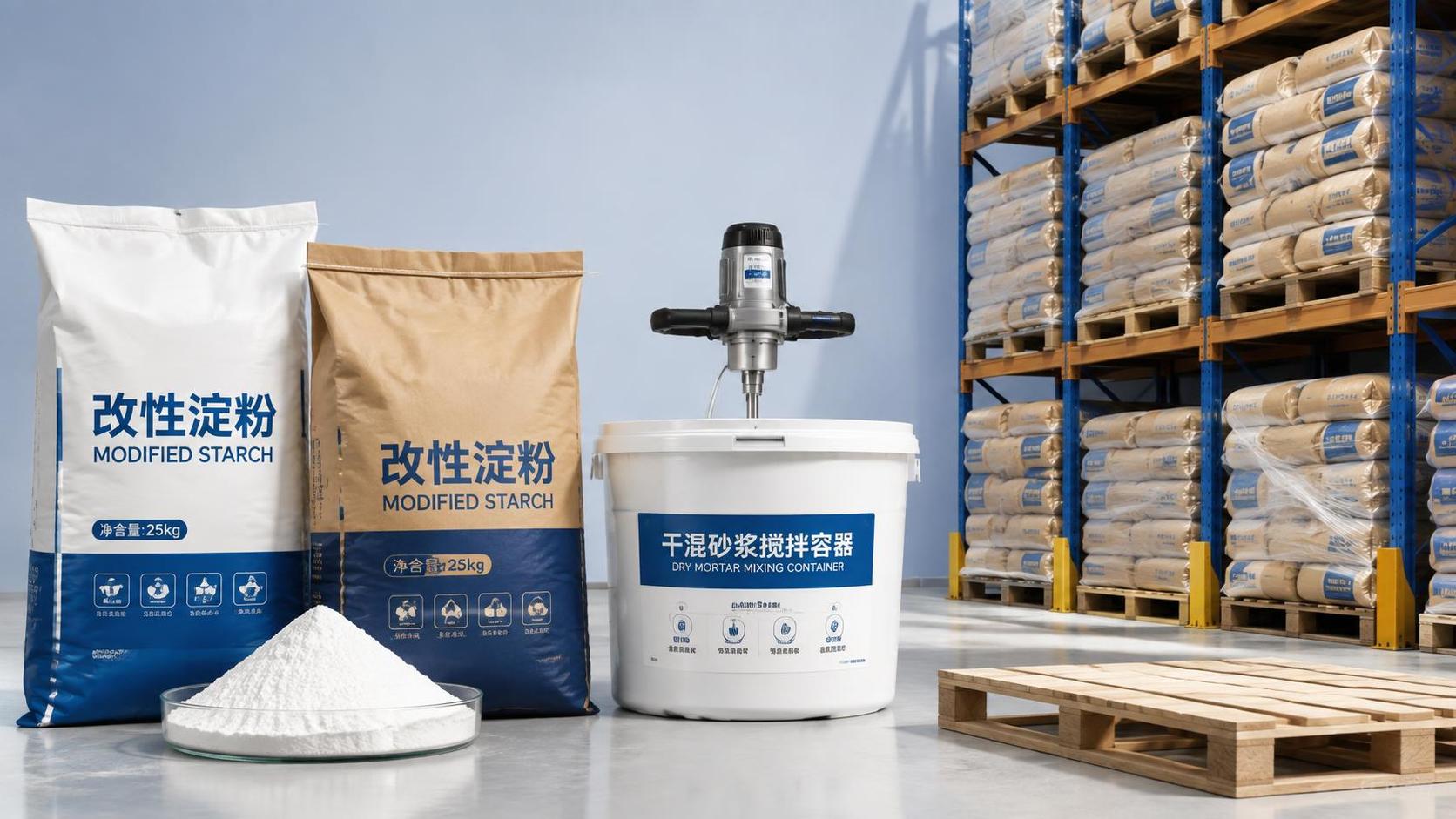
Yes. A small trial shipment of building material modified starch can usually be arranged before a commercial-scale order, but it should be treated as more than a laboratory sample. The purpose is not simply to confirm that a powder arrives at the destination. A useful trial shipment must allow the buyer to assess whether the starch performs consistently in the intended formulation, survives international transport in acceptable condition, clears import procedures with the required documents, and can be supplied under repeatable specifications.
For dry-mix mortar, tile adhesive, gypsum-based products, cementitious skim coats, wall putties, and related construction formulations, a trial quantity that is too small may answer only part of the question. A few hundred grams can support preliminary bench testing, but it cannot reliably reveal mixing behavior, batch-to-batch handling, packaging robustness, or the interaction between the starch and other additives at production-relevant conditions. The right trial shipment depends on the decision that needs to be made.
Define what the trial shipment must prove
“Modified starch” is not a single interchangeable material. In building material applications, its role may include thickening, water retention support, rheology adjustment, workability improvement, anti-sag behavior, open-time adjustment, or surface-feel modification. The outcome depends on the starch chemistry, degree of modification, particle characteristics, moisture content, dosage, and the rest of the dry-mix formula.
Before requesting a shipment, define the target application in functional terms. A supplier needs more than the phrase “construction-grade modified starch.” The most useful request identifies the product system and the performance question. For example:
- cement-based tile adhesive requiring better non-sag consistency without excessive viscosity;
- wall putty where spreading feel and water demand are critical;
- gypsum plaster requiring stable workability during the intended application window;
- skim coat where smoothness, trowel response, and resistance to cracking must be evaluated together;
- extruded or machine-applied material where powder flow and mixing dispersion matter as much as final rheology.
This definition determines the quantity, packaging, test documentation, and shipping method. It also avoids a common mistake: testing a starch at an arbitrary dosage, finding an unsatisfactory result, and concluding that the product is unsuitable when the real issue is formulation balance or an incorrect dosage range.
A trial request should state the existing formulation ingredients that may materially affect compatibility. Relevant information can include binder type, cellulose ether grade, redispersible polymer powder, retarders or accelerators, mineral fillers, hydrophobic agents, defoamers, and the normal mixing procedure. Full disclosure of a proprietary formula is not always necessary, but withholding all context makes technical matching less reliable.
Choose a quantity that matches the stage of evaluation
Small shipments commonly fall into three practical categories. The distinction is important because each serves a different purpose and has different logistics economics.
For an early formulation screen, the required amount should be calculated from the planned test matrix rather than selected as a symbolic sample size. If several dosage levels, competing additive systems, repeat tests, and retained reference samples are needed, the quantity can increase quickly. A single blend is rarely enough. Repeatability matters because modified starch performance can be affected by mixing energy, water temperature, resting time, and the sequence in which dry ingredients are combined.
A larger technical lot becomes necessary when the question is operational rather than purely chemical. Can the powder be fed consistently into the mixer? Does it disperse without agglomeration? Does the finished mortar maintain the expected handling characteristics after normal storage? These cannot be fully answered with a few lab beakers.
Ask for an identifiable production lot, not an anonymous sample
A trial shipment is only useful as a basis for later purchasing if its origin can be traced. The material should be linked to a defined production lot or batch, with a certificate of analysis or equivalent quality document that identifies the tested material. If the supplier later offers a commercial product with different specification limits, a different raw-material basis, or no batch relationship to the sample, the trial result has limited procurement value.
The documentation package should be proportionate to the destination market and the intended use, but several documents are normally worth requesting at the trial stage:
- technical data sheet describing the product, intended application, storage conditions, and relevant physical properties;
- certificate of analysis for the supplied lot, showing actual measured values rather than only target specifications;
- safety data sheet prepared in a format appropriate for transport and workplace handling;
- product composition or regulatory statement when required for import review, customer approval, or internal compliance assessment;
- commercial invoice and packing list with accurate product description, net weight, package count, country of origin, and shipment value;
- transport documents appropriate to the chosen freight mode.
Modified starch used in construction materials is often handled as a non-dangerous powder for transport, but that should never be assumed from the product category alone. Classification must be confirmed from the specific safety data sheet and the carrier’s acceptance rules. Fine organic powders may also require attention to dust control in handling, even where dangerous-goods transport classification does not apply.
For cross-border shipments, tariff classification should be checked early rather than copied from a previous invoice without review. The correct customs classification can depend on the nature and degree of chemical modification. Import duty, local tax treatment, labeling obligations, and documentary requirements are determined by the importing jurisdiction, not by a supplier’s general description of the product.
Packaging is part of the technical evaluation
Building material modified starch is hygroscopic to varying degrees, and moisture exposure can affect flowability, handling, and consistency. A small trial sent in an informal pouch may be adequate for a brief laboratory test, but it does not demonstrate whether the material can withstand the humidity, handling, stacking, and transit time associated with normal trade.
For a meaningful pre-commercial trial, request packaging that resembles the proposed commercial format as closely as practical. That may include moisture-barrier inner liners, multiwall paper sacks, plastic-lined bags, sealed cartons, palletization, stretch wrapping, and external markings. The appropriate format depends on shipment volume and transport mode, but the evaluation should consider whether the package arrives intact and whether it is practical for the receiving plant to open, store, and dose.
Inspect the trial delivery before testing. Record any tears, compression damage, wet spots, broken seals, unusual odor, visible clumping, or discrepancy between labeled and received quantities. Retain photographs and at least one unopened reference unit. If the material is tested after exposure to poor storage conditions, the resulting data may describe the damaged package rather than the starch itself.
Storage instructions also deserve attention. Temperature, humidity, direct sunlight, warehouse cleanliness, and shelf-life expectations should be clear before a larger purchase is discussed. A long stated shelf life does not eliminate the need for proper warehouse control; it merely defines the period during which the product should remain within specification when stored as instructed.
Build the test around application performance, not one headline property
A high viscosity reading or a favorable water-retention result alone does not establish suitability for a dry-mix formulation. Modified starches can alter several properties at once. An increase in body or consistency may improve anti-sag behavior while making application feel too heavy. Better water control can affect setting behavior or interact with cellulose ether. A formula that looks acceptable immediately after mixing may change after standing.
The test plan should reflect the actual product category. Depending on the formulation, useful observations may include:
- dry powder flow, dusting, and dispersion during mixing;
- water demand needed to reach the target consistency;
- mixing time and the presence of lumps or incomplete distribution;
- viscosity or consistency at fixed intervals after mixing;
- workability, trowelability, spreadability, and surface appearance;
- sag resistance or slip behavior where vertical application is relevant;
- open time, adjustment time, and changes during resting;
- setting behavior and interaction with other admixtures;
- bonding, cracking, shrinkage, or strength indicators required by the finished-product standard or internal specification.
Comparison against the current starch or rheology modifier is often more informative than testing in isolation. The comparison should use the same raw materials, mixing method, water ratio logic, curing conditions, and application method. If dosage is optimized for the incumbent additive but not adjusted for the trial material, the test is not a fair assessment of functional equivalence.
It is also sensible to retain a control sample from the trial lot. If a later shipment performs differently, the retained sample helps distinguish formulation drift, storage effects, and potential supply variation.
Do not confuse a sample shipment with confirmed supply capability
A supplier can send a satisfactory small parcel yet still be unable to support regular exports under the same conditions. Trial-shipment discussions should therefore include questions that are relevant to future orders: normal production lead time, minimum commercial order quantity, standard bag size, pallet configuration, lot traceability, quality-release process, export documentation capability, and the method used to manage specification changes.
These questions are not premature. They determine whether the trial material represents a scalable supply option or merely a one-time sample. For chemically modified materials, consistency in the agreed specification range is more important than a sample that happens to perform well at one point in time. A buyer should understand which properties are controlled for each lot, which are typical values only, and how deviations are communicated.
Commercial terms should also be clarified before the shipment is dispatched. A small order may be supplied free of charge, charged at material cost, or charged together with courier and export handling costs. None of these arrangements is inherently problematic. The key issue is transparency over what is included: sample preparation, packaging, inland transport, freight, customs clearance, import duty, local taxes, and destination delivery can sit with different parties depending on the agreed Incoterm or courier arrangement.
Courier transport is often convenient for laboratory quantities, but it may create a misleading impression of landed cost. Air freight and courier fees can exceed the product value by a wide margin. A pre-commercial sea, road, rail, or consolidated shipment may better reveal the logistics conditions of recurring trade, especially where the commercial volume will be palletized or containerized.
A clear request reduces delays and produces better data
An effective inquiry for a small trial shipment of building material modified starch should specify the application, intended test scale, required quantity, preferred packaging, destination country and postal code, desired delivery timing, and whether a commercial-format trial is needed. It should also ask for the current technical data sheet, lot-specific certificate of analysis, safety data sheet, storage guidance, and confirmation of whether the proposed sample comes from a normal production batch.
Where internal approval depends on regulatory review, request the compliance information before arranging freight. Sending material first and reviewing documents later can leave the shipment delayed at customs or unusable in the receiving facility. The same principle applies to labeling language: documents and package labels should satisfy the receiving organization’s operational requirements, not merely the exporter’s standard practice.
The most productive trial is one with a defined pass/fail basis. That basis may include a target workability range, acceptable water demand, no visible clumping, stable behavior during the required working period, intact packaging upon arrival, complete documents, and a commercially acceptable delivery path. Without agreed criteria, the discussion can become subjective even when the technical results are sound.
A small trial shipment is therefore a sensible and often necessary step before purchasing building material modified starch at volume. Its value lies in combining formulation testing with supply-chain verification. When the shipment is traceable, the test conditions are controlled, the documents are reviewed in advance, and the packaging reflects the intended trade route, the buyer gains evidence that is relevant not only to laboratory performance but also to a future commercial decision.
Send Us Your Inquiry Today
