










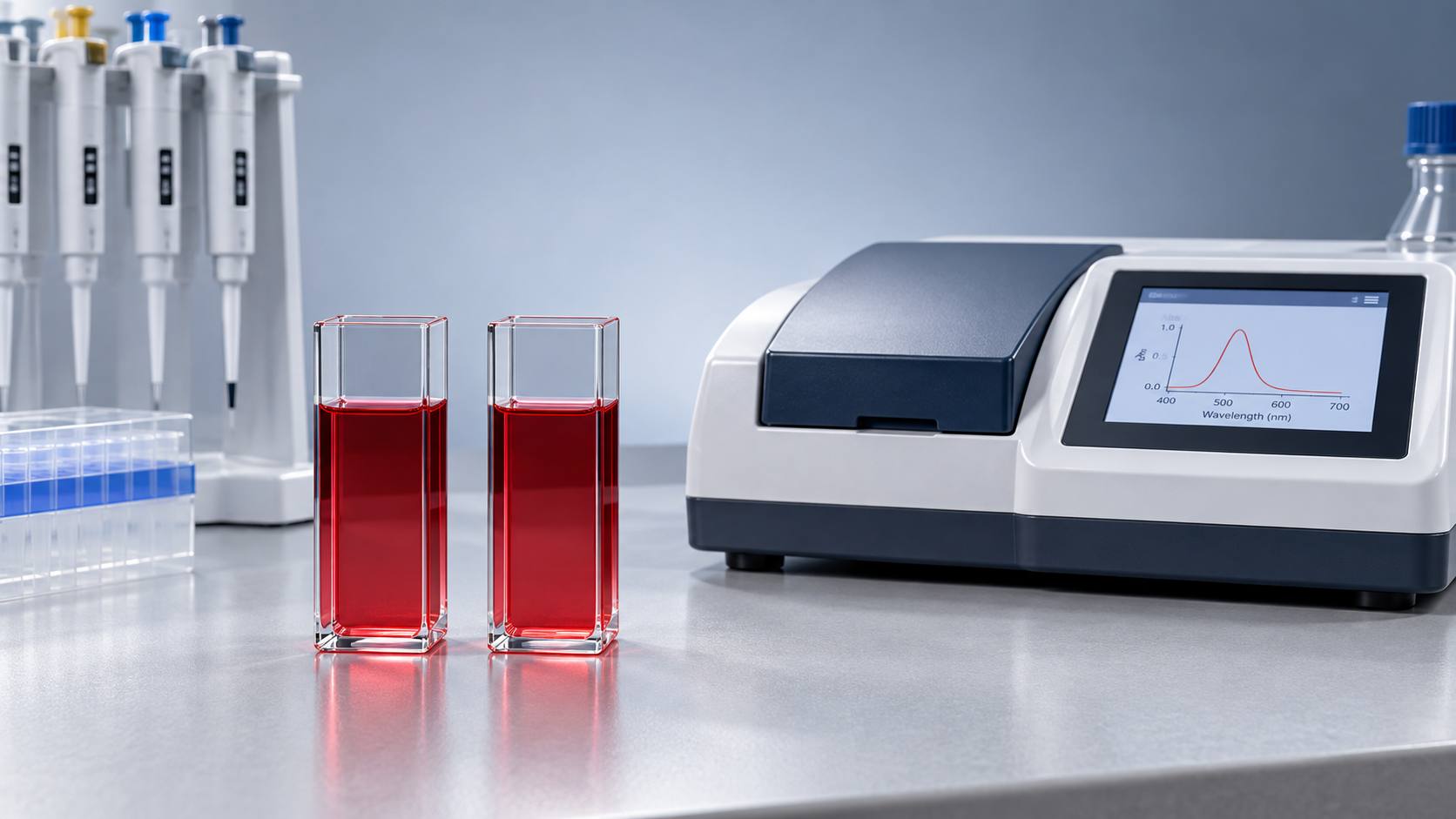
Can Testing Conditions Explain Food Colorant Batch Color Differences?
Yes. Food colorant batches can appear different because of testing conditions, even when their performance is consistent. Appearance alone cannot establish whether a batch is defective.
Lighting, pH, dilution, temperature, sample preparation, and measurement settings can change the comparison. Buyers should standardize these conditions before accepting, rejecting, or reformulating around a delivery.
For quality teams, formulators, and purchasing managers, the practical question is whether a difference persists under agreed testing conditions and affects the intended food application.
A controlled comparison helps separate testing variability from genuine product variation, giving international buyers stronger evidence for supplier discussions, purchasing decisions, and investigations into inconsistent results.
Does a Visible Difference Mean the Batch Is Out of Specification?
A visible difference is a reason to investigate, but it is not automatically evidence of nonconformity. The applicable specification and test method determine that judgment.
Two powders may look different because their particle sizes, packing densities, or moisture levels differ. Those differences do not necessarily predict color after dissolution or dispersion.
Conversely, powders that look similar may perform differently in a beverage, coating, or confectionery. Assessment should reflect the supplied product type and its intended use.
Start by identifying the reported difference: hue, lightness, saturation, color strength, clarity, or dispersibility. Each observation points toward different possible causes and suitable verification methods.
Also distinguish a contractual failure from an application concern. A compliant colorant may still require application validation when a recipe, process, or ingredient source changes.
The most useful first action is therefore a repeat comparison against an approved reference, using the same preparation procedure and a predefined basis for evaluation.
Which Testing Conditions Should You Standardize First?
Prioritize conditions most likely to influence your formulation: sample concentration, pH, solvent or food matrix, lighting, and measurement geometry. Control temperature and preparation timing alongside them.
Lighting and viewing conditions
Daylight, warehouse lamps, and office lighting can make the same samples appear different. Use a specified light source and consistent viewing conditions for visual comparisons.
Keep the background, container, fill depth, viewing angle, and observer procedure consistent. Colored surroundings and unequal sample depths can distort an otherwise straightforward side-by-side assessment.
If products must look acceptable under several retail lighting environments, assess those environments deliberately. Agreement under one light source does not guarantee agreement under another.
pH and the surrounding formulation
Some colorants, particularly certain natural pigments, change hue or stability with pH. Compare measured final sample pH, rather than assuming identical recipes produce identical conditions.
Water quality, buffers, salts, proteins, and other ingredients can influence appearance. For lake pigments or dispersions, matrix compatibility and dispersion quality may be especially important.
A water solution can support incoming quality control, but it may not predict performance in an acidic drink, dairy formulation, or fat-based coating without validation.
Concentration and sample depth
Small weighing, dilution, or transfer errors can create apparent differences in color strength. Use calibrated equipment, documented dilution steps, and an appropriate balance for the quantity.
Define whether samples are compared at equal supplied mass, equal active color content, or an application dosage. These comparisons answer different questions and are not interchangeable.
Keep optical path length or sample depth constant. A deeper liquid layer often appears more intense, even when the actual colorant concentration remains exactly unchanged.
Temperature and elapsed time
Compare samples at the same defined temperature after equivalent preparation and holding periods. Temperature can affect dissolution, dispersion, appearance, and the rate of pigment degradation.
Record exposure to heat, light, and air during preparation. An immediately measured sample should not be compared casually with one left overnight on a bench.
Could Sample Preparation Be Creating the Difference?
Sample preparation often introduces more variation than buyers expect. Incomplete dissolution, uneven mixing, sedimentation, foam, and contamination can all interfere with visual or instrumental assessment.
Use a documented mixing order, mixing time, and sampling procedure. For suspensions, establish how samples are homogenized and how quickly they are measured after mixing.
Confirm whether the material should dissolve or disperse. Treating an insoluble lake pigment as a soluble dye can produce misleading conclusions about strength or consistency.
Do not filter, centrifuge, or otherwise clarify samples unless the agreed method requires it. Such steps can remove pigment or change what the measurement represents.
Prepare independent replicates from each batch. Repeated readings of one prepared sample check instrument repeatability, but they cannot reveal variation introduced during weighing or dilution.
If replicate preparations disagree substantially, resolve the preparation problem first. Comparing batch averages is less informative when the underlying method itself produces inconsistent test results.
Which Measurement Actually Answers Your Purchasing Question?
No single measurement describes every aspect of food colorant performance. Choose an approach that matches the product, the agreed specification, and the suspected failure mode.
For suitable clear solutions, absorbance measurements can help assess color strength under a defined method. Wavelength, dilution, solvent, pH, and optical path length must match.
Absorbance alone does not establish complete visual equivalence. Samples can differ in spectral shape, clarity, or application behavior despite similar readings at one selected wavelength.
Colorimetric measurements such as CIELAB values can describe appearance and support numerical comparison. Their usefulness depends on consistent illumination, observer settings, geometry, and sample presentation.
For opaque foods, powders, and dispersions, reflection measurements may be appropriate. Instrument settings and sample presentation should reflect the material being evaluated and remain consistent.
Color difference values, including ΔE, require context. State the calculation formula and test conditions; different formulas and measurement arrangements can produce results that are not comparable.
There is no universal ΔE acceptance limit for all food colorants. Set tolerances using customer requirements, method capability, product appearance, and demonstrated application relevance together.
Confirm instrument calibration and suitability before interpreting small differences. A numerical result becomes useful evidence only when measurement uncertainty and repeatability are understood sufficiently well.
A Practical Workflow for Comparing Two Batches
A structured investigation helps teams reach a decision efficiently. Agree on the comparison procedure before exchanging results, especially when buyer and supplier laboratories use different equipment.
- Confirm product identity, grade, batch numbers, specification version, and intended application.
- Check packaging integrity, storage history, sampling records, and the reference sample’s condition.
- Prepare independent samples using the same documented materials, concentrations, and procedure.
- Measure under agreed conditions, then compare results with the applicable acceptance criteria.
- Run a controlled application trial if laboratory results do not resolve the concern.
- Document the decision, supporting evidence, and any corrective action required.
Use an approved reference with documented storage and validity. An aged or poorly stored retained sample can shift over time and mislead the entire investigation.
Record actual values wherever possible: measured pH, preparation temperature, dilution, holding time, and instrument configuration. Statements such as “tested normally” rarely support a reproducible comparison.
When results conflict between laboratories, exchange the complete methods and consider testing split samples. This helps separate laboratory differences from differences between the supplied materials.
If a repeat test eliminates the discrepancy, document the cause and update the procedure. If the difference persists, investigate product variation and application impact further.
When Should You Suspect Genuine Batch Variation?
Genuine variation becomes more plausible when a difference persists across independent preparations, controlled measurements, and a valid reference comparison, especially when application trials confirm it.
Possible causes include differences in color content, pigment composition, moisture, particle characteristics, carrier proportions, or degradation. The relevant causes depend on the specific colorant system.
For natural colorants, raw material variation and processing history may influence composition. Suppliers should manage relevant variation through product specifications, process controls, and suitable standardization.
Storage and transportation also deserve attention. Heat exposure, moisture ingress, damaged packaging, or prolonged storage can affect certain products even when manufacturing release results were acceptable.
A certificate of analysis supports the investigation, but it does not replace method alignment. Confirm that reported values address the disputed property and applicable specification.
If the batch fails an agreed requirement, follow the established nonconformance process. Avoid compensating through dosage changes until technical suitability, cost, labeling, and regulatory implications are reviewed.
What Evidence Should You Request from Your Supplier?
A useful supplier discussion starts with a precise observation and reproducible evidence. Send batch identifiers, preparation details, measured results, acceptance criteria, and the intended application.
Photographs can document the issue, but camera exposure, white balance, and screens affect appearance. Treat photographs as supporting records alongside controlled visual or instrumental comparisons.
Request the applicable specification, certificate of analysis, relevant test method, storage guidance, and investigation findings. Where appropriate, request comparison against the supplier’s retained batch sample.
Ask whether the supplier measures color strength, shade, or both, and how those properties are controlled. A general statement about “consistent quality” provides limited evidence.
For international sourcing, assign responsibility for technical coordination early. The exporter, manufacturer, and buyer should understand who supplies methods, reviews discrepancies, and approves the resolution.
For discussions with Shandong Huafeng Chemical Co., Ltd., buyers should request product-specific documentation and technical coordination appropriate to the actual material, manufacturer, and destination market.
Color consistency and regulatory suitability require separate checks. Confirm the specific colorant’s permitted uses and applicable limits in the destination market before approving commercial use.
Why the PEG Keyword Requires a Different Technical Comparison
“What is the difference between low and high molecular weight polyethylene glycol?” concerns another chemical family. It should not determine how food colorants are evaluated.
Broadly, PEG molecular weight influences viscosity, physical form, and formulation behavior. Food colorant comparisons instead require attention to pigment chemistry, strength, dispersion, stability, and application conditions.
The shared lesson is methodological: identify the property that matters, then compare materials under defined conditions. Similar-looking samples or broadly related chemical terms cannot establish equivalence.
Make the Decision on Controlled Evidence
Testing conditions can explain apparent food colorant batch differences, but they should be verified systematically. Standardize preparation and measurement before attributing a discrepancy to manufacturing.
If the difference disappears under controlled conditions, improve the test procedure. If it persists, evaluate the agreed specification, application performance, and supplier evidence before deciding.
The strongest purchasing decision connects three things: a reproducible method, a meaningful acceptance criterion, and performance in the intended food product. That connection makes disputes easier to resolve.