









Product Quick Navigation
Get a Quote
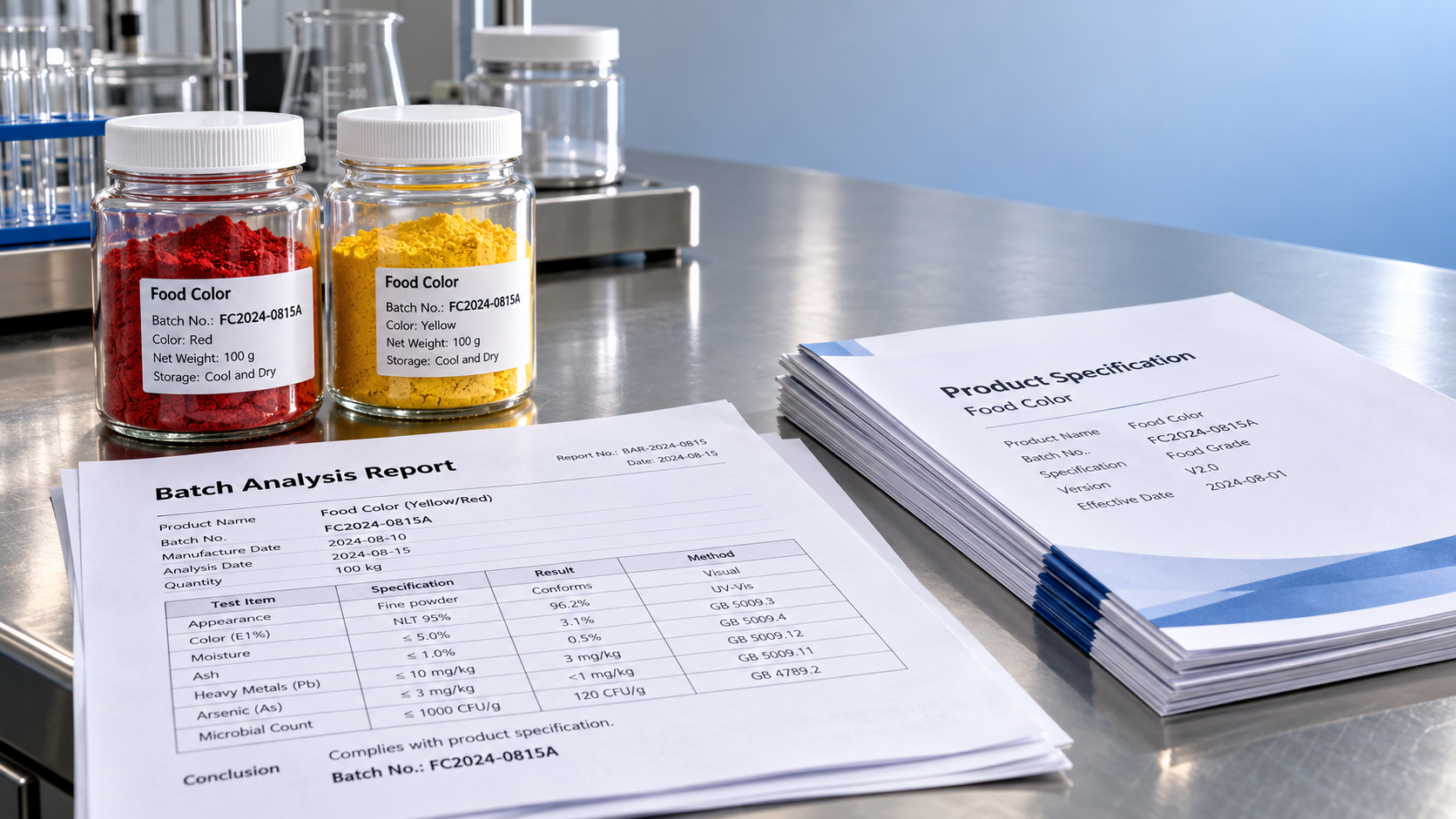
What should I do if imported food colorants fail incoming inspection? Place the affected lot on hold, preserve the inspection evidence, and compare the result with the agreed specification and supplier records before deciding whether to retest, reject, or return it. The documents supplied before shipment largely determine how quickly that investigation can move.
A food colorant supplier should provide an agreed product specification, a batch-specific certificate of analysis, composition and identity information, destination-market compliance documentation, and records linking the shipment to its manufacturer and production lot. Storage guidance and relevant safety information also belong in the documentation package. Additional evidence depends on the colorant, its intended food application, and the importing market.
The practical test is whether those documents establish what arrived, whether it meets the purchase requirements, and whether it is suitable for the intended use. A folder full of certificates can still leave those questions unanswered.
Start with an agreed specification before placing the order
The product specification establishes the acceptance criteria. Without it, a supplier may consider a batch acceptable while the receiving team rejects it using different limits or methods. Resolve that difference before shipment.
Identify the exact product, including its chemical or recognized additive identity where applicable, commercial grade, physical form, and formulation. A straight color, a lake pigment, and a formulated coloring preparation can behave differently even when their names suggest a similar shade.
The specification should address characteristics that affect safety, legality, and performance. Depending on the product, these may include color content or strength, moisture, solubility or dispersibility, relevant impurities, contaminants, and microbiological criteria. Apply requirements appropriate to the material; a botanical extract and a synthetic powder do not automatically need identical testing.
For a blend, define whether strength is expressed against the complete preparation, the coloring component, or a reference standard. Otherwise, two documents can report different values while describing the same material on different bases.
Include test methods or clearly identified method references, units, reporting basis, and the specification revision. Where visual shade matters, agree on preparation and comparison conditions. Concentration, pH, lighting, and the food matrix can change the apparent result.
What to request from the supplier
Read the certificate of analysis beyond the word “pass”
A certificate of analysis, or COA, should identify the supplier or manufacturer, product, batch, and applicable specification. Dates should make sense alongside the manufacturing and shelf-life information. The document also needs identifiable authorization so questions can be directed to its issuer.
For quantitative acceptance characteristics, numerical results are generally more useful than a blanket statement of conformity. “Pass” may be appropriate for some qualitative tests, but it does not show how close a measured result sits to an acceptance limit.
Check whether the reported value is an assay, a relative color-strength measurement, or another property. These terms are not interchangeable. A result reported on a dry basis cannot be compared directly with an as-received result without accounting for moisture.
Also establish which results come from testing the supplied batch and which rely on periodic testing or another control program. Not every parameter is necessarily tested on every lot. The arrangement should be explicit and acceptable under the purchasing quality agreement.
A representative COA can help assess a supplier before ordering, but the final shipment needs documentation tied to the delivered lot. If an independent laboratory report supports a disputed result, check its sample identification, methods, and relevant testing scope. A laboratory logo alone does not establish that the report covers your shipment.
“Food grade” does not establish permission for every application
A compliance statement should name the destination market and accurately identify the colorant or preparation. It should explain the basis on which the product meets applicable identity and purity requirements, with supporting records where needed.
Suitability also depends on the intended food category, use level, and labeling conditions. A colorant permitted in one application may face different restrictions in another. Authorization in the exporting country does not establish permission in the importing country.
Share the proposed application with the supplier before requesting compliance documentation. A request for “a red food color” leaves too much unresolved. A request identifying the food category, destination, formulation needs, and processing conditions gives the supplier a useful basis for responding.
Some colorants and markets involve additional certification or batch documentation. For example, certain color additives used in the United States require FDA batch certification. Where that applies, request the relevant certification evidence and ensure it connects to the material supplied; an ordinary supplier COA does not replace it.
Composition details matter here as well. Carriers, preservatives, and other components in a coloring preparation can affect labeling and suitability. For natural-source products, the source material and extraction or formulation information may also be relevant to the assessment.
Keep traceability intact through exporters and distributors
When the seller is an export service provider, the documentation must still connect the delivered goods to their production source. Establish who manufactured the material, who issued the COA, and whether anyone repacked, blended, or relabeled it before export.
Repacking can introduce a new lot reference. That reference needs a documented link to the original manufacturing lot. Otherwise, an apparently valid COA may describe material that cannot be connected reliably to the bags or drums in the warehouse.
Compare the lot identifiers on the COA, packaging labels, packing list, and receiving records. Commercial invoices and certificates of origin support trade processes, but they do not establish analytical conformity.
For purchases arranged through Shandong Huafeng Chemical Co., Ltd., or another chemical export service provider, document coordination should form part of the purchase requirements. Specify which records must come from the manufacturer and which the exporter will supply. This makes responsibility clear when a technical discrepancy requires a response from the production site.
Request supporting documents according to the actual risk
An allergen statement is useful when ingredients, carriers, or manufacturing conditions could affect allergen management. Statements concerning genetically modified sources, animal-derived ingredients, or particular dietary requirements may be needed for a formulation or customer commitment. Their value depends on their scope and relevance.
If halal, kosher, or food safety certification forms part of the purchasing requirement, check that it covers the appropriate product or site. A company-level certificate may not cover every material offered by a trading business.
Request a safety data sheet where applicable, together with handling information suitable for the product. An SDS supports workplace hazard communication; it does not demonstrate that a colorant is authorized for food use or meets the agreed purity specification.
Storage guidance should address conditions relevant to the material, such as moisture, heat, light, or freezing sensitivity. Obtain shelf-life information and instructions for opened containers where needed. A batch can leave the factory within specification and deteriorate during transport or storage, so receiving checks should consider packaging condition as well as paperwork.
How to investigate a failed incoming inspection
The immediate response should protect production while preserving evidence. A failed identity check, a damaged seal, and an unexpected shade result require different investigations, even though each may initially trigger a receiving hold.
- Quarantine the affected material. Record the lot, quantity, location, and hold reason. If any material has entered production, identify the affected work in progress or finished goods for assessment.
- Document the discrepancy. Retain photographs of labels and packaging, sampling records, raw results, preparation details, and relevant transport observations. Preserve suitable samples under controlled conditions.
- Check identity and acceptance criteria. Confirm that the inspected material matches the order and that the correct specification revision, units, and reporting basis were used.
- Compare the methods. Review sampling, sample preparation, equipment checks, and test conditions with the supplier. Differences in dilution, solvent, pH, or measurement conditions can affect some color measurements.
- Agree on the investigation and disposition. Obtain a written supplier response, define any justified confirmatory testing, and have the responsible quality function authorize release, rejection, return, or another permitted disposition.
Retesting should answer a defined technical question. Repeatedly testing until a passing value appears leaves the original failure unexplained. Where results conflict, an agreed independent laboratory and suitable method can help resolve the difference.
Shade complaints deserve particular care. A colorant can meet its chemical specification yet perform poorly in an acidic beverage or during heat processing. That may indicate an application mismatch, a formulation difference, or a performance requirement missing from the purchasing specification. Compare performance under the intended use conditions as well as the analytical results.
If the issue is a document error, request a controlled correction explaining what changed and why. A revised COA should remain connected to the original investigation. Replacing paperwork does not resolve a confirmed defect in the material.
Make document review a release gate before shipment
Set the documentation requirements in the purchase order or quality agreement. Identify the required records, approved specification, minimum remaining shelf life, and responsibility for responding to discrepancies. Require advance notice of changes to formulation, manufacturing site, source, or test methods when those changes could affect acceptance.
Review the final batch documents before authorizing shipment wherever practical. Check that product names and lot references agree across the records, and that the compliance evidence covers the destination and intended application.
Retain an approved reference sample when it meaningfully supports comparison, especially for shade-sensitive uses. Define how it will be stored and compared; an aged or poorly stored reference can create its own misleading result.
The next useful request to a prospective supplier is the proposed specification, a representative COA, composition details, and market-specific compliance information. Once those are acceptable, require the shipment’s own batch records. That sequence exposes gaps while they can still be resolved before the material reaches the receiving warehouse.
Send Us Your Inquiry Today
