









Product Quick Navigation
Get a Quote
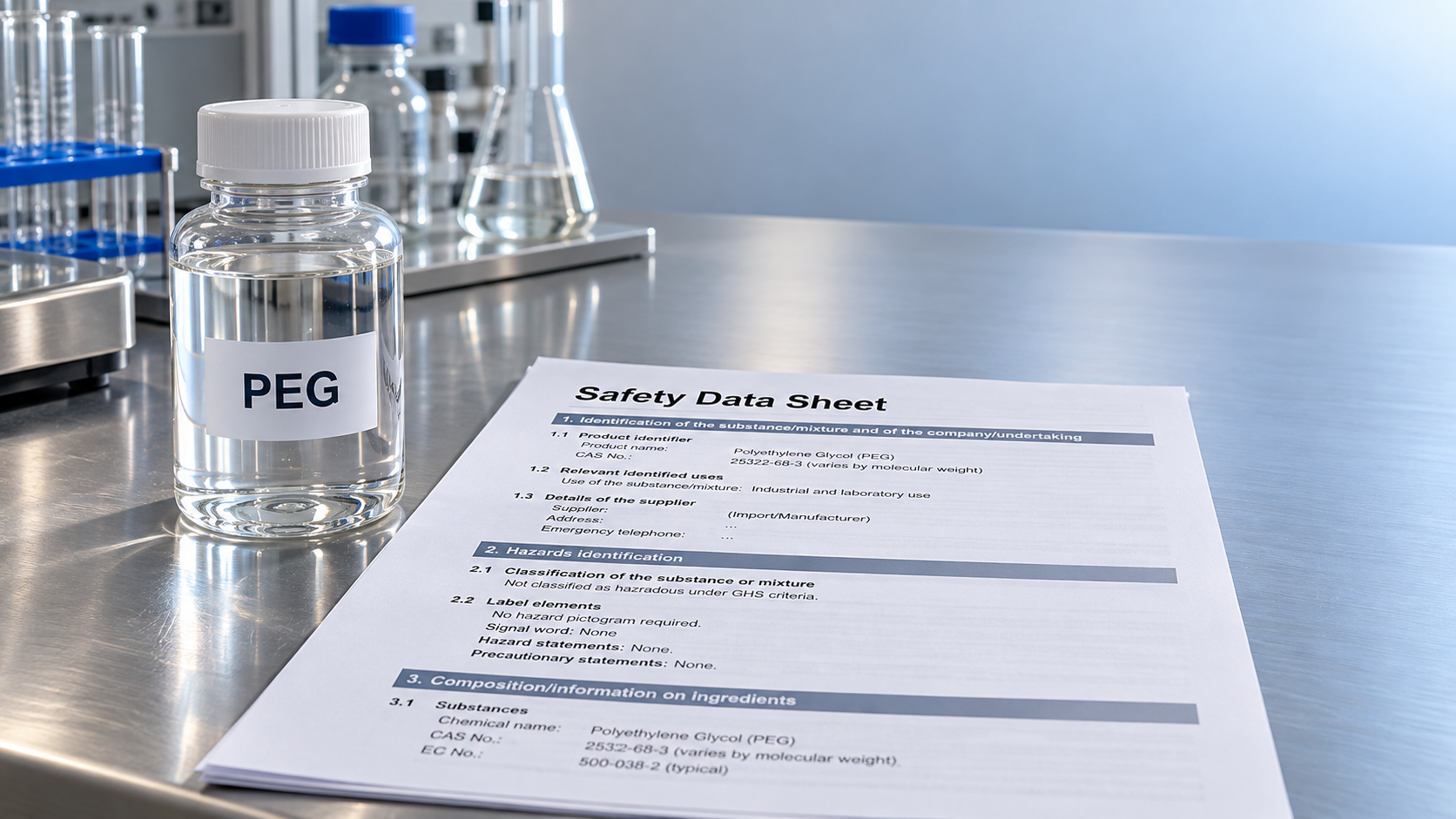
A polyethylene glycol shipment can be ready for dispatch while its documentation is still unsuitable for the importing market. The product name looks familiar, the specification matches the purchase order, and an English safety data sheet is attached. Yet the SDS may describe a different PEG grade, omit locally required supplier details, or use a regulatory format that does not fit the destination.
Chemical buyers handle many product-specific questions, from “What causes color variation between food colorant batches?” to whether a shipment has adequate safety documentation. For PEG imports, the priority is clear: obtain an SDS that accurately identifies the material, communicates its hazards, and meets the destination market’s applicable requirements.
The following checks help procurement, logistics, and compliance teams resolve gaps before shipment—not after a warehouse, carrier, or customer raises an objection.
Begin with the destination market, not the document template
There is no single “international SDS” that automatically satisfies every importing country. The Globally Harmonized System of Classification and Labelling of Chemicals provides a common framework, but jurisdictions adopt and implement it differently. A document prepared for export from China may therefore need adaptation before it is suitable for use in another market.
Before requesting revisions, tell the supplier the importing country, intended industrial use, exact PEG grade, and required language. Also clarify which legal entity will act as importer. This determines who must review local obligations and which contact information belongs in the documentation.
- European Union: Check the applicable REACH Annex II requirements, including the format introduced by Regulation (EU) 2020/878, and classification under CLP. Where an SDS is required, it generally needs to be supplied in the official language of the member state concerned, unless that state provides otherwise.
- United States: Review the document against the applicable OSHA Hazard Communication Standard requirements. OSHA requires the standardized SDS structure, although it does not enforce the content of Sections 12–15.
- Other destinations: Verify local GHS implementation, language rules, emergency-contact requirements, and any importer-specific duties rather than assuming an EU or US version will suffice.
Whether an SDS is legally mandatory also depends on the product’s classification and local rules. Commercial customers may still require one for a non-classified PEG grade as part of their purchasing and workplace-safety procedures.
Confirm that the SDS describes the PEG you actually ordered
“Polyethylene glycol” is a family description, not a complete purchasing identity. PEG grades differ in average molecular weight, physical form, viscosity, and handling characteristics. Lower-molecular-weight grades are commonly liquids, while higher-molecular-weight grades may be waxy solids, flakes, or powders.
A document for one grade should not be accepted for another simply because both carry the PEG name. A shared CAS number does not establish that their physical properties or handling instructions are interchangeable.
Cross-check the product identifier in Section 1 against the purchase order, specification, certificate of analysis, container label, and invoice. If the SDS covers a family of grades, its scope should be explicit, and the information must remain applicable to the supplied material.
Section 3 should identify the substance or mixture and provide the composition information required by the destination’s rules. Many polyethylene glycol products use CAS number 25322-68-3, but the supplier should confirm the identifier for the actual product. Solutions, formulated blends, or products with additives need composition information appropriate to that formulation.
A useful clarification request: “Please confirm that this SDS applies to the exact grade and formulation supplied under our purchase order, including any additives relevant to classification or safe handling.”
The 16-section SDS: what importers should verify
A complete-looking document can still contain generic or inconsistent information. Use the standard sections as a review framework, paying particular attention to details that affect receiving, storage, worker protection, and transport.
Read the sections together—not as isolated boxes
Hazard classification must match the material and the rules
Many conventional PEG grades are not classified as hazardous under commonly applied GHS-based systems. However, that conclusion must be established for the actual product and destination. It should not be copied from a different grade or treated as proof that no precautions are necessary.
“Not classified” does not mean “risk-free.” Spilled liquid PEG can create a slipping hazard. Heated product can cause thermal burns. Powder handling may require dust assessment and control, including consideration of combustible-dust hazards where relevant to the material and process.
Section 2 should therefore agree with the handling, exposure-control, and fire-fighting guidance elsewhere in the SDS. Unexplained contradictions deserve a supplier response.
Physical properties should support real receiving decisions
Section 9 is particularly valuable when a warehouse needs to decide how to unload and store the shipment. A liquid PEG grade should not be accompanied by an SDS that describes only a solid powder. Likewise, melting behavior and viscosity information should be relevant to the stated grade and, where necessary, include measurement conditions.
Consider a facility that warms PEG to make transfer easier. Its operators need suitable handling instructions, equipment controls, and protection against hot material. A generic “store in a cool place” statement does not answer those operational questions. Any recommended heating conditions should be confirmed through appropriate supplier technical guidance rather than inferred from an unrelated SDS.
Exposure controls should reflect the task
The absence of a listed occupational exposure limit does not remove the need to assess exposure. Ambient liquid transfer, heated processing, spraying, and powder charging can create different conditions.
Look for useful ventilation guidance and a defensible basis for protective equipment. Glove suitability depends on the material, temperature, contact duration, and task. Respiratory protection, where needed, should follow the workplace assessment and applicable local requirements—not a blanket instruction copied into every product document.
Check transport status without confusing it with import approval
Section 14 should address the transport regulations relevant to the route, such as the IMDG Code for sea freight, ICAO/IATA provisions for air freight, and applicable road transport rules. Where regulated, information may include the UN number, proper shipping name, hazard class, packing group, and environmental hazards.
Many standard PEG grades are not regulated as dangerous goods under common transport rules. Nevertheless, the determination must cover the actual formulation and shipping conditions. Additives or transport at elevated temperature can change the assessment.
If the SDS states “not regulated,” ask whether that statement applies to every planned transport mode. The freight forwarder should also receive a consistent product description and the current document version.
Importantly, non-dangerous-goods status is not chemical-market authorization. Inventory status, registration obligations, restrictions, customs classification, and intended-use requirements may need separate verification. An SDS supports these checks but does not replace them.
Keep safety documentation separate from quality and application approval
An SDS explains hazards and safe use; a certificate of analysis reports batch-specific results against an agreed specification. Neither document can substitute for the other.
For PEG purchasing, properties such as average molecular weight, water content, hydroxyl value, or color may be relevant depending on the grade and application. Buyers should define the required tests in the specification and verify them through the appropriate quality documents. The SDS may describe general appearance, but it is not normally the place to establish batch acceptance limits.
The same distinction matters for food, pharmaceutical, cosmetic, or other sensitive uses. A non-hazardous classification does not demonstrate suitability for those applications. Relevant purity requirements, impurity controls, compendial conformity, and use-specific regulatory status require separate evidence.
A practical pre-shipment review that prevents avoidable rework
The most useful review happens before freight is committed. Send the SDS to the people who will actually use it: the importer’s compliance contact, receiving site, and logistics provider. Their concerns often differ, and resolving them together avoids repeated revisions.
- Match the identity. Confirm the grade, formulation, product code, and document scope across the order and shipment documents.
- Check jurisdiction and language. Establish the applicable SDS rules, responsible-party details, and emergency-contact arrangements.
- Review internal consistency. Compare classification with composition, physical properties, handling advice, and transport information.
- Record outstanding questions. Request specific corrections or supporting explanations instead of asking vaguely for a “compliant SDS.”
- Control the released version. Keep the reviewed SDS accessible to the receiving site and agree how subsequent updates will be communicated.
A revision date alone is not a universal expiry date. What matters is whether the document reflects current product knowledge and applicable requirements. Conversely, a recently dated SDS is not automatically reliable if its content remains generic or incorrect.
What to request from your export supplier
For buyers working with Shandong Huafeng Chemical Co., Ltd., a Shandong-based chemical export service provider, the clearest approach is to make documentation requirements part of the initial inquiry. Provide the destination, intended use, exact PEG grade, required SDS language, and any customer-specific review criteria before shipment arrangements are finalized.
Request the current grade-specific SDS alongside the product specification and relevant quality documentation. Where local adaptation or specialist regulatory review is necessary, clarify who will arrange it and who will approve the final version. Supplier coordination supports the process, but it does not automatically transfer the importer’s legal responsibilities.
The acceptance test is straightforward: does the SDS accurately describe the PEG being shipped, meet the applicable destination requirements, and give the receiving team usable safety information? When those points are clear—and separate quality and import obligations have also been checked—the document becomes a working part of a reliable chemical supply chain rather than just another attachment.
Send Us Your Inquiry Today
