









Product Quick Navigation
Get a Quote
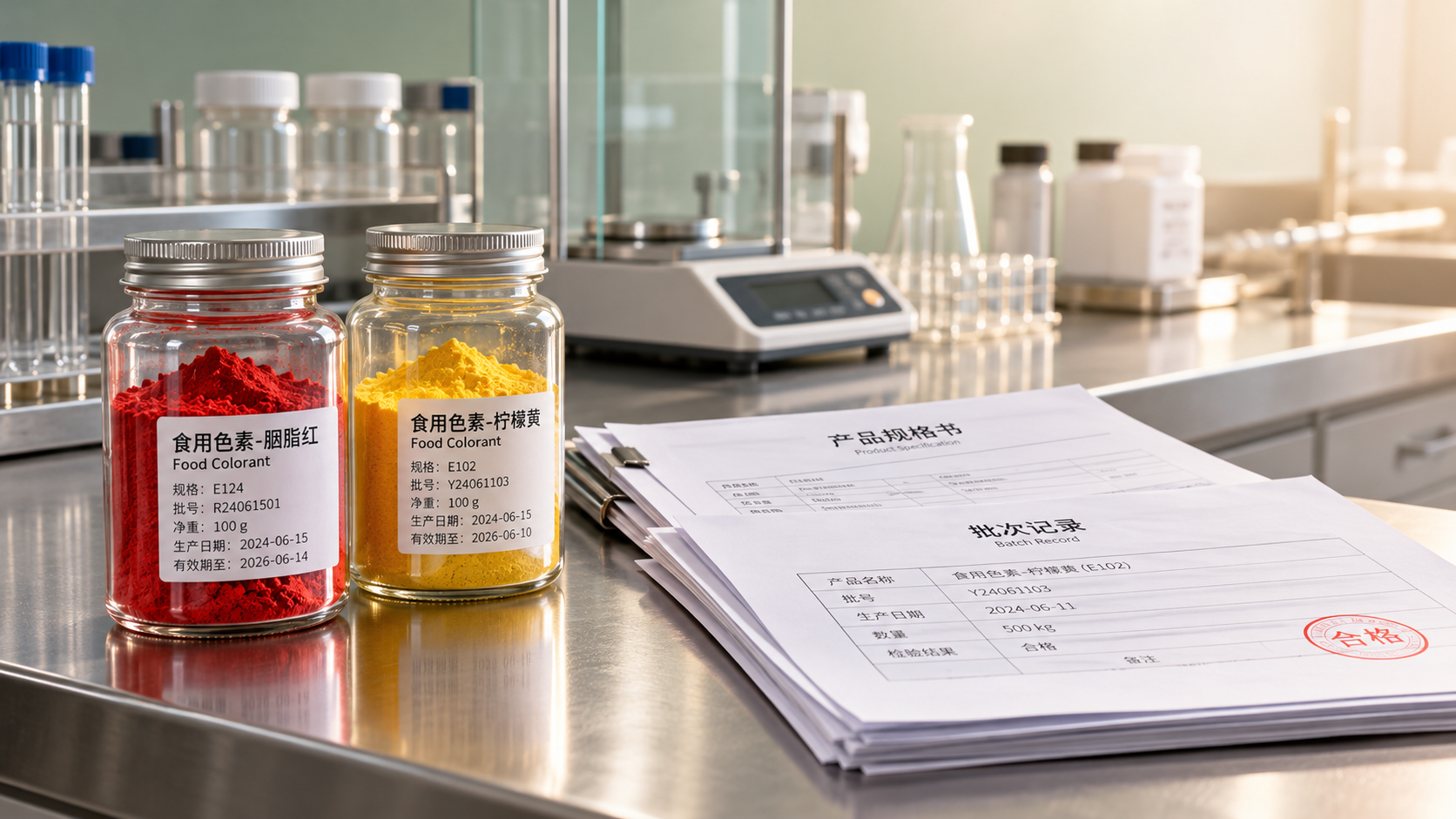
Food colorants do not face one uniform halal certification rule across Southeast Asia. Whether a certificate is legally required, commercially necessary, or relevant to a halal claim depends on the destination country, the product being sold, its place in the supply chain, and the applicable implementation rules.
A certificate alone is not enough to establish that a particular shipment is acceptable. The critical checks are whether the certificate covers the exact colorant and manufacturing site, whether the issuing body is accepted in the destination market, and whether the formulation and production controls match the certified scope. Halal status also does not replace food-additive authorization or conventional food safety controls.
Start with the destination market and the role of the colorant
A colorant may be imported as a food additive, sold as part of a premix, or incorporated into a finished food. Those are different compliance situations. The requirements applicable to a certified beverage manufacturer, for example, should not automatically be applied to every importer of the beverage’s ingredients.
The answer to “Do food colorants need halal certification for Southeast Asia?” therefore starts with three questions: Where will the material be placed on the market? Will it be used in a product making a halal claim? And which entity is responsible for demonstrating compliance—the ingredient manufacturer, the importer, or the finished-food producer?
Country-specific review matters:
- Indonesia: Mandatory halal certification is being implemented in stages for covered products under the national halal product assurance framework. BPJPH is the central authority. Check the applicable product category, business circumstances, transition period, and current rules for foreign certificates rather than assuming that one deadline applies to every colorant or importer.
- Malaysia: JAKIM administers the federal halal certification framework, and state Islamic religious authorities also have relevant roles. A halal claim or use of an accepted halal logo must meet the applicable requirements. For an imported ingredient, check whether the foreign halal certification body is recognized by JAKIM for the relevant scope; recognition of a body does not automatically validate every certificate it issues.
- Singapore: MUIS administers halal certification. Certification is generally voluntary, but a business seeking MUIS certification for a food product or establishment must satisfy the applicable scheme requirements, including those concerning ingredients and suppliers.
- Other Southeast Asian markets: Requirements and certification arrangements differ. Check local food law, halal-claim rules, import conditions, and the expectations of the finished-product certification body instead of treating a certificate accepted in one country as a regional approval.
For Indonesia and Malaysia in particular, an exporter should confirm the current official status of the issuing foreign body and the acceptance conditions for the specific certificate. Lists, recognition arrangements, and implementation rules can change; a supplier’s general statement that its certificate is “accepted worldwide” is not sufficient evidence.
Confirm the certificate covers the material being purchased
The most useful certificate review is a reconciliation exercise, not a visual check for a halal logo. Compare the document against the purchase specification, commercial invoice, product label, and manufacturing information.
Pay particular attention to:
- Product identity: The trade name, grade, product code, and formulation must match the item ordered. A certificate for a pure pigment does not necessarily cover a dispersion, blend, or customer-specific preparation containing that pigment.
- Certificate holder and manufacturer: Identify the company named on the certificate and the actual production site. A trader’s name on an invoice does not establish that the material it supplies comes from the certified manufacturer.
- Site and activity: Check whether manufacturing, blending, packing, or other relevant activities are within scope. A certificate for one factory should not be assumed to cover another plant operated by the same company.
- Validity and status: Check the validity dates, certificate number, and any available official verification record. Where status or scope is unclear, obtain confirmation from the issuing body and, where necessary, the destination authority or the finished-product certifier.
- Shipment traceability: Ensure the batch number, packaging label, and supplier records connect the delivered goods to the certified product and site.
A certificate valid on the date of an initial supplier approval can expire before shipment or before the finished product is assessed. The receiving procedure should therefore define when validity is checked and how an expired, suspended, replaced, or amended certificate affects stock release. Any treatment of goods manufactured during a certificate’s validity period should follow the applicable certifier’s rules rather than an internal assumption.
Assess the whole formulation, not just the named pigment
Food colorants are frequently sold as preparations. The coloring component may be acceptable while a carrier, solvent, coating, or processing aid introduces a separate halal question. A specification listing only the color name, color index, or additive number cannot establish the status of the complete commercial product.
Request a composition declaration that identifies the functions and sources of relevant ingredients. Depending on the formulation and the certifier’s requirements, the review may include:
- Carriers and diluents, such as maltodextrin or other substances used to standardize color strength.
- Emulsifiers, stabilizers, and fatty-acid derivatives whose raw materials may come from plant, animal, or synthetic sources.
- Gelatin or other animal-derived encapsulation and coating materials, including evidence of animal source and processing where applicable.
- Solvents used in extraction or formulation, particularly ethanol, its source, its role, and any residual amount subject to the applicable standard.
- Enzymes, fermentation media, microorganisms, and nutrients used to produce a colorant or an ingredient in its preparation.
- Antifoams, filter aids, release agents, and cleaning chemicals where their origin or use is relevant to the certifier’s assessment.
A statement such as “vegetable based” may describe the principal coloring source while saying nothing about the encapsulating material. Likewise, “synthetic” does not resolve questions about processing aids or shared equipment. For animal-derived materials, the species and, where applicable, slaughter and processing evidence matter; a generic animal-origin declaration does not establish compliance.
Proprietary formulations can make disclosure difficult. If a supplier cannot provide full details to the buyer, ask whether it can submit the information directly to the relevant halal certification body under confidentiality arrangements. The buyer still needs enough documentation to establish that the product supplied is the one assessed.
Natural origin is not a substitute for food-use approval
Halal assessment and food safety assessment answer different questions. A colorant must also be permitted for the intended food category in the destination market and meet applicable identity, purity, contaminant, labeling, and use-level requirements. An additive number or approval in one jurisdiction does not automatically establish permission in another.
It is especially important not to equate plant origin or visible color with suitability as a food additive. For example, Rotenone CAS#83-79-4 is a plant-derived pesticidal substance, not a food colorant to be selected on the basis of its origin or appearance. Its inclusion in a chemical catalogue does not establish food-use authorization or halal certification.
For an actual colorant, compare the full commercial grade with the applicable food-additive specification. Review relevant limits for contaminants, residual solvents, and other quality parameters, and confirm that the certificate of analysis corresponds to the delivered batch. Halal documentation cannot compensate for a failure to meet food-grade requirements.
Look beyond paper declarations to production controls
Manufacturing conditions affect whether the material continues to match its approved status. The appropriate level of evidence depends on the product, the facility, and the certification scheme, but the review should establish how the manufacturer controls the following:
- Raw-material approval: Are source declarations and supporting certificates maintained for ingredients and relevant processing aids? How are substitutions approved?
- Shared equipment: Are non-halal or unidentified materials processed on the same lines, tanks, filters, or packing equipment? What segregation and changeover controls apply?
- Cleaning: Are cleaning procedures documented and appropriate to the material and the applicable halal standard? Where a certifier prescribes a specific cleansing method, an ordinary sanitation record should not be assumed to satisfy it.
- Storage and handling: Are materials identified, protected from mix-ups, and traceable through internal transfers and repacking?
- Outsourced activities: Are toll blending, contract drying, repacking, and external warehousing identified, and are relevant activities included in the certification assessment?
A food safety management certificate can support confidence in general control of the site, but it is not a substitute for halal certification or evidence of halal-specific segregation. Conversely, a halal certificate does not prove that every food safety hazard has been adequately controlled.
Build a release decision around evidence and change control
A practical approval file should bring together the product specification, composition and source declarations, halal certificate and scope, manufacturer and site details, food-additive compliance information, and batch documentation. Record which destination market and intended use were assessed: approval for one customer’s certified product does not automatically establish suitability for every market or formulation.
Where evidence is incomplete, distinguish the reason for the hold. An unclear manufacturer address, an unlisted product code, and an unrecognized issuing body are different problems and require different responses. Ask for corrected documentation, confirmation from the certifier, or a destination-specific determination before treating the material as approved. A supplier declaration can explain a discrepancy, but it should not override the certificate’s stated scope without confirmation from the issuing body.
Changes also need a defined trigger for reassessment. A new carrier, alternative emulsifier source, revised solvent system, different manufacturing site, new subcontractor, or change in certification body can alter the basis on which the ingredient was accepted. Require advance notice of such changes and decide whether fresh certification evidence, a revised specification, or approval from the finished-product certifier is needed before the changed material is shipped.
The strongest control is a traceable link between the approved formulation, the certified site, and each delivered batch. When that link is supported by current destination-specific rules and separate food-additive compliance checks, a halal certificate becomes useful evidence rather than a logo taken at face value.
Send Us Your Inquiry Today
