









Product Quick Navigation
Get a Quote
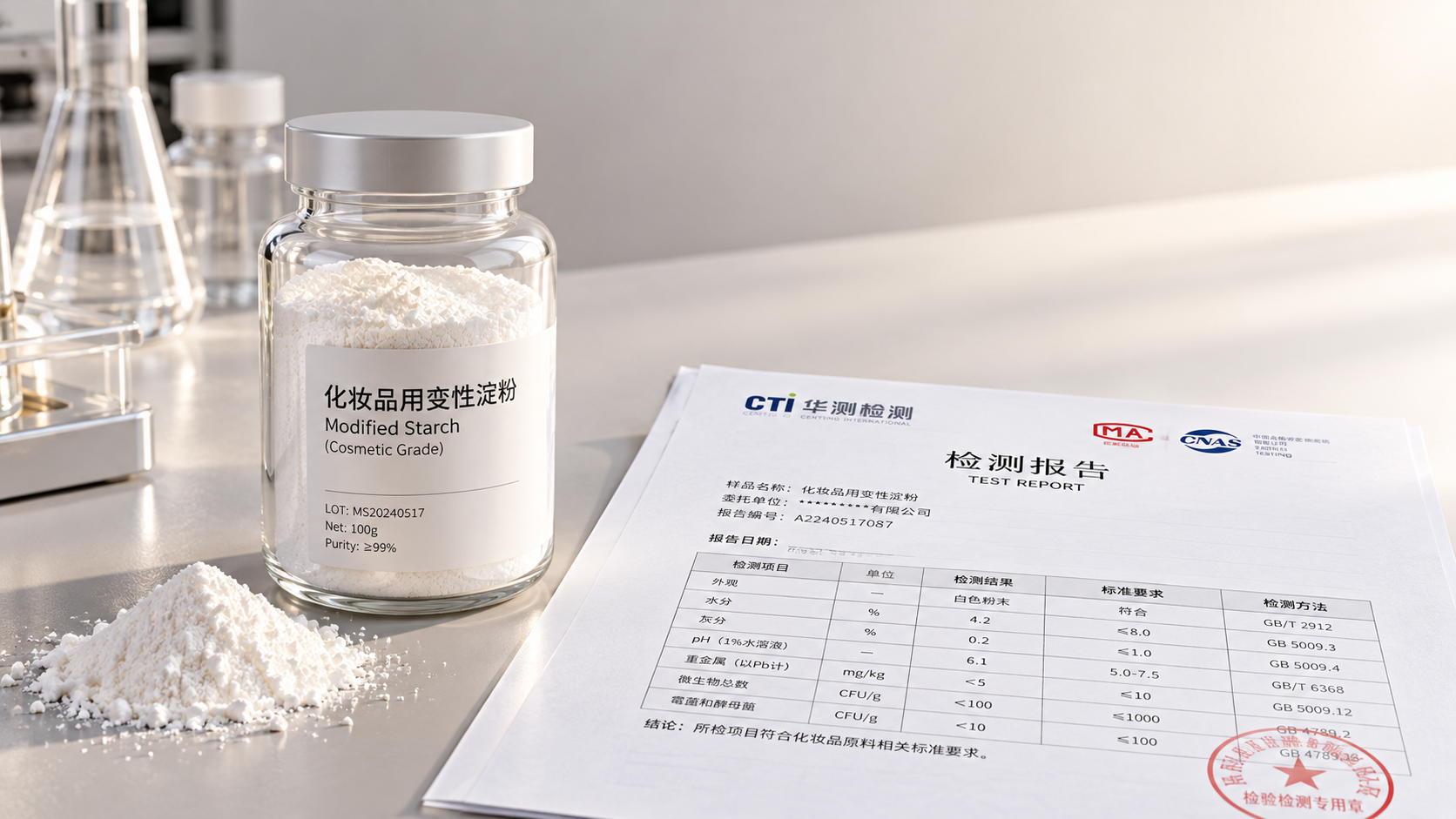
A non-GMO declaration can support a purchasing decision only when it applies to the exact modified starch grade, botanical source and supply chain being quoted. A lower price has little value if the documentation covers a different raw material, omits a subcontracted modification step or cannot support the intended cosmetic claim. Request the evidence package before approving a sample or agreeing to a long-term price.
The most useful package connects four things: the starch source, its identity through processing, the basis for the non-GMO statement and the specification of the material delivered. Each connection matters because a cosmetic starch is processed after the crop is harvested, and its finished appearance rarely reveals where its feedstock came from.
Start with the exact material being offered
Ask for the product’s commercial grade, INCI name, botanical origin and manufacturer’s specification. Modified starches can differ in feedstock and chemical or physical treatment even when they serve similar functions, such as improving powder feel, absorbing oil or changing emulsion texture. A declaration for “starch” or for an entire product range is weaker than a document naming the grade on the quotation.
Botanical origin is a starting point, not proof of non-GMO status. Corn, tapioca, potato and other sources have different agricultural supply chains. A statement that identifies a source without explaining the control method leaves open questions about seed selection, purchasing controls and segregation. Equally, a non-GMO statement for native starch does not establish that the modified grade remained identified through subsequent processing.
Match the grade name and manufacturer across the specification, quotation, sample label and non-GMO declaration. Differences do not automatically indicate a problem: a distributor may use an internal code. Request a written cross-reference that links that code to the manufacturer’s grade and the material to be shipped. Where the manufacturer is confidential, the documents still need enough identifiers to establish that they concern the same product.
Evidence that supports the claim
Origin and segregation records
Request a current, signed non-GMO statement that identifies the product, botanical source, issuing party and scope of the claim. It should explain whether the conclusion rests on controlled sourcing, identity preservation, testing, certification or a combination of these. Ask whether the statement covers only the principal starch feedstock or also other agricultural ingredients in the supplied product.
Traceability should extend from the finished lot back through modification and starch production to the relevant feedstock records. Commercial confidentiality can limit access to individual farm records, but the supplier should be able to describe the traceability chain and provide a documented response for a specific lot. A process description that stops at the distributor’s warehouse does not establish upstream origin.
Where non-GMO and other feedstocks share storage, transport or production equipment, ask how they are separated and how changeovers are managed. Useful evidence includes documented cleaning or flushing procedures, lot identification and investigation procedures for mix-ups. The appropriate detail depends on the claim being made; a general quality policy alone does not show how a particular lot was controlled.
Also ask about subcontractors. Starch extraction, modification, drying, blending and packing do not necessarily occur at the same facility. A declaration issued before an outsourced step should be supported by controls that preserve material identity through that step. If a processing aid or carrier remains in the delivered ingredient, its identity and contribution to the claim need to be understood as well.
Test reports and their limits
A laboratory report can add evidence, but its value depends on the sample, method and question being tested. Polymerase chain reaction testing looks for specific DNA sequences; it does not independently prove every aspect of the supply chain. Highly processed starch may contain little usable DNA, so an inconclusive result or a result below a method’s detection limit should not be presented as proof that the original crop was non-GMO.
When testing is offered, ask for the sample identity, sampling point, method, analytical scope, detection or reporting limit and laboratory report date. A test on incoming grain supports a different conclusion from a test on finished powder. A report for one lot also does not automatically cover later deliveries. Test scope matters: a negative result applies to the sequences examined and the method’s stated limitations.
If a third-party certificate is supplied, review its scope and validity. Confirm that it covers the relevant site, product or activity and that any certification standard’s rules are appropriate for the claim intended on the finished cosmetic. A certificate associated with a company name alone is not necessarily evidence for the quoted grade.
Separate non-GMO evidence from cosmetic suitability
A non-GMO claim does not establish that a starch is suitable for a particular formulation or market. Request a technical specification and a representative certificate of analysis, then compare the listed attributes with the product’s intended function. Relevant characteristics can include appearance, moisture, particle size, pH, viscosity and microbiological limits, where specified for the grade. The certificate of analysis should identify the manufactured lot and report results or conformity against the agreed specification.
Interpret a viscosity figure alongside its test method: concentration, temperature, preparation and measurement conditions affect the result. A value obtained under one set of conditions is not directly interchangeable with a value from another method. Similarly, a particle-size result is meaningful only when the measurement technique and the reported fraction or distribution are clear.
In a pressed powder, particle size and flow can affect processing and skin feel. In an emulsion, the order of addition, hydration conditions and compatibility with other ingredients can change the outcome. Request a sample from the quoted grade and evaluate it in the intended formula and process. A positive laboratory trial does not replace a production-scale assessment when mixing equipment or batch conditions differ substantially.
Ask for the safety data sheet, composition information appropriate to the application, and available statements on impurities and microbiological quality. Review the ingredient’s permitted status, labeling and any applicable restrictions in each destination market against the actual composition and use. The supplier’s regulatory statement is useful supporting evidence; it should identify its scope and date rather than offer an unqualified worldwide compliance claim.
Keep ingredient files separate when a formulation contains several botanical materials. For example, Asiaticoside CAS#16830-15-2 is a compound associated with Centella asiatica, not a modified starch. Documentation for that ingredient does not establish the origin or non-GMO status of the starch, and each material requires its own identity and suitability assessment.
Compare quotations on a consistent basis
Request prices against the same grade, quantity, packaging, delivery terms and destination. A quote for an unmodified starch or a different botanical source is not a like-for-like alternative, even if the unit price is attractive. Include the cost of sampling, qualification, testing, freight, import charges where applicable, storage and any minimum order commitment in the comparison.
Documentation can also affect the effective cost. A product with a low quoted price may require additional origin verification, formulation work or repeated testing if the evidence supplied does not cover the intended claim. Conversely, paying for certification or lot testing that the claim does not require may add expense without resolving the actual evidence gap. Identify which documents are included in the price and which are supplied only on request or for an additional charge.
Pack size and shelf life affect purchasing economics. A large pack can lower the price per kilogram while increasing unused inventory or handling demands. Ask for the unopened shelf life, storage conditions and packaging configuration, then compare them with expected consumption. Confirm whether the quoted shelf life is measured from manufacture or delivery and what minimum remaining life will be accepted at receipt.
Put continuity and change control into the order
Supply continuity depends on more than an initial declaration. Ask whether the quoted grade has an established feedstock source, where modification and packing occur, and how changes are communicated. A change of botanical origin, production site, subcontractor, process or formulation can affect both performance and the evidence supporting a non-GMO claim, even when the commercial name remains unchanged.
Define notification requirements in the purchasing agreement or quality agreement. The notice should arrive before a change is introduced into supplied material, with enough information to determine whether documentation review, a new sample or reformulation testing is needed. Specify how substitutions are handled; an alternative source should not be shipped under the same approval merely because it meets a similar physical specification.
For each delivery, retain the purchase order, lot identification, certificate of analysis and applicable claim documentation together. Agree on the response expected if a lot cannot be traced, a document expires or a result falls outside the specification. A clear hold-and-investigate procedure prevents material with unresolved identity from entering production while the evidence is being reconciled.
Send Us Your Inquiry Today
