









Product Quick Navigation
Get a Quote
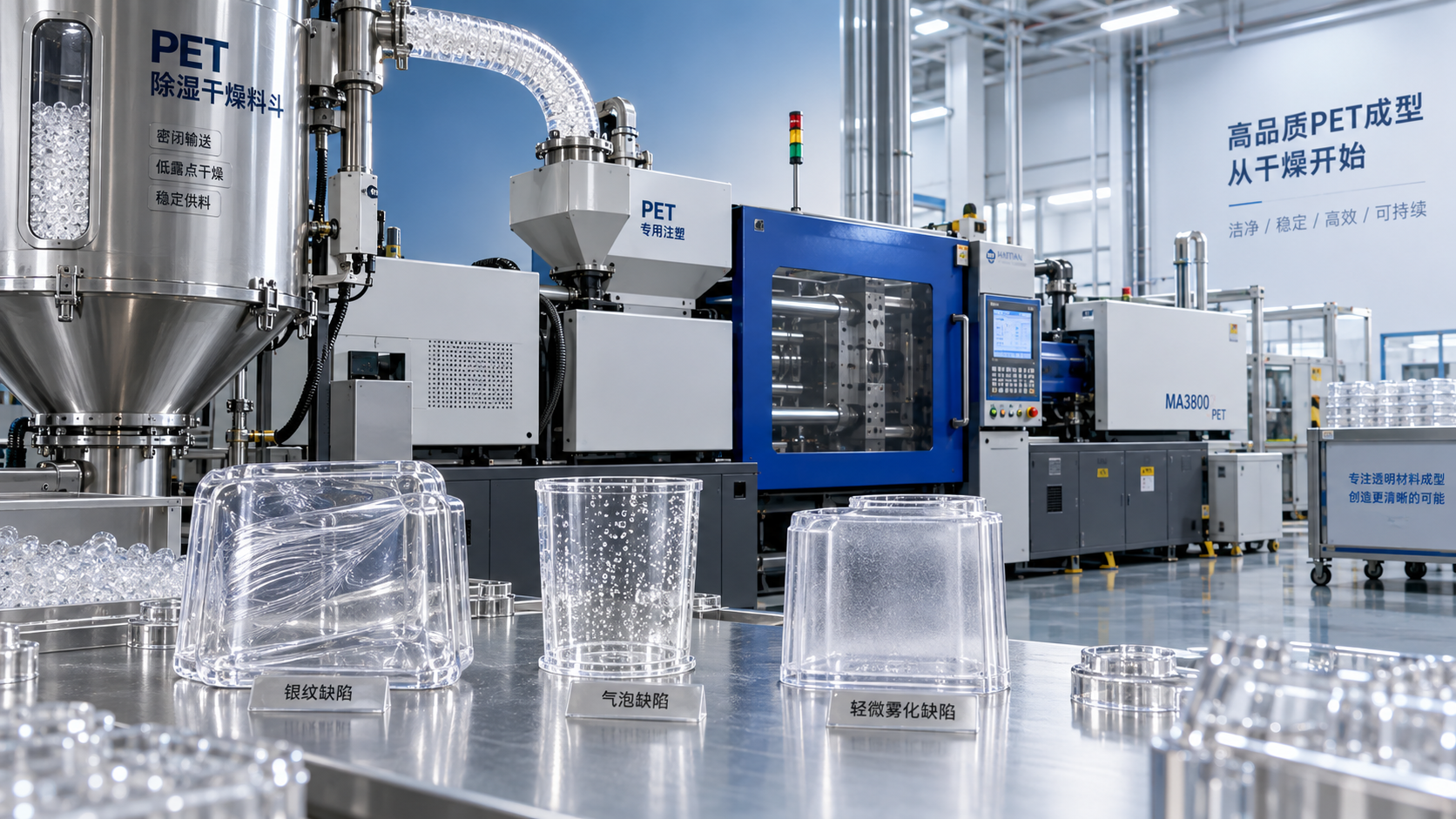
How Moisture in PET Resin Causes Defects During Injection Molding
Moisture in PET Resin can quickly turn a stable injection molding process into a source of costly defects for operators and production teams.
Understanding how improper drying affects melt viscosity, surface quality, dimensions, and part strength is essential for maintaining consistent output and preventing avoidable scrap.
Why Moisture Is a Critical PET Resin Processing Problem
PET Resin is hygroscopic, meaning its pellets absorb water from surrounding air during storage, transport, conveying, and exposure at the molding machine.
Unlike some moisture-sensitive materials, PET may appear normal before processing even when its internal moisture content is already too high for molding.
Once wet PET Resin enters the heated barrel, absorbed water reacts with polymer chains through hydrolysis, permanently reducing molecular weight during melting.
This is not simply a cosmetic problem. Hydrolysis changes the resin itself, so increasing packing pressure or changing mold temperature cannot fully restore performance.
Operators often first notice unstable production rather than a single obvious defect. Shot weight, cushion position, fill behavior, and part appearance may change together.
A useful operating principle is simple: if PET parts suddenly show cosmetic defects and mechanical weakness, verify drying conditions before adjusting molding parameters.
What Happens to PET Resin When It Is Not Properly Dried
PET polymer chains provide the melt strength needed for controlled filling, packing, and solidification. Water breaks those chains at elevated processing temperatures.
As chain length decreases, melt viscosity falls. The material may flow more easily, but that apparent improvement usually indicates degradation rather than better processing.
Low-viscosity PET can fill thin areas quickly, yet it may produce inconsistent packing, excessive flash, poor dimensional stability, and reduced resistance to stress.
Hydrolysis also reduces intrinsic viscosity, commonly called IV. Since IV relates to molecular weight, a measurable IV drop confirms that thermal processing caused polymer degradation.
The degradation becomes more severe when resin stays wet for longer periods in a hot hopper, feed throat, barrel, or stagnant screw zone.
High barrel temperatures can accelerate the reaction, but temperature alone is not the root cause. Properly dried PET Resin can tolerate normal processing temperatures.
For this reason, lowering barrel settings may hide symptoms temporarily while creating other problems, including incomplete filling, poor weld lines, and inadequate surface replication.
Common Injection Molding Defects Caused by Moisture
Splay, Silver Streaks, and Surface Streaking
Splay marks are among the most recognizable moisture-related PET defects. They appear as silvery, whitish, or streak-like patterns extending from the melt flow direction.
Water turns into vapor inside the hot melt. As the melt enters the cavity, trapped vapor creates visible streaks near gates, thin sections, or flow fronts.
Similar marks can also result from contamination, poor venting, or excessive shear. However, moisture should be checked first when PET drying records are uncertain.
Bubbles, Voids, and Blisters
Moisture-generated vapor can form internal bubbles or surface blisters. These defects may be visible immediately or appear later after parts cool and stabilize.
Clear PET components make bubbles especially unacceptable because even small voids reduce transparency, create optical distortion, and weaken the finished molded product.
Parts with thick walls are particularly vulnerable because the outer skin can freeze before internal gases escape, leaving voids beneath an apparently acceptable surface.
Reduced Strength and Brittleness
Hydrolyzed PET may look acceptable while failing in service. Reduced molecular weight lowers impact resistance, tensile performance, fatigue life, and resistance to cracking.
This risk matters for containers, electrical components, automotive parts, appliance elements, and any molded product exposed to repeated loading or temperature changes.
Operators should not accept a visually clean sample as proof that drying is adequate. Mechanical testing or IV monitoring may be necessary for critical applications.
Discoloration and Haze
Excess moisture can contribute to yellowing, haze, and reduced clarity, particularly when long residence time allows hydrolysis and secondary thermal degradation to continue.
Discoloration may become worse when regrind, color concentrates, or incompatible additives are present, making disciplined material segregation and drying even more important.
Flash, Dimensional Drift, and Variable Part Weight
When moisture lowers melt viscosity, the polymer can enter gaps more readily. Flash may increase even though clamp force and molding settings remain unchanged.
Reduced viscosity can also alter packing behavior. Operators may see inconsistent part weight, changing shrinkage, unstable dimensions, or warpage after cooling.
These symptoms are often misdiagnosed as mold wear or pressure-control problems. Reviewing the material history can prevent unnecessary changes to tooling or equipment.
How to Distinguish Moisture Defects from Other Process Problems
Many injection molding defects have multiple causes, so diagnosis should rely on evidence rather than appearance alone. Start with moisture measurement and drying verification.
Use a moisture analyzer appropriate for PET and measure pellets at the machine, not only material taken from unopened warehouse packaging.
For many PET injection molding grades, processors commonly target a moisture content below 50 ppm before molding. Always follow the resin supplier's technical data sheet.
If measured moisture is high, correct the drying process first and mold controlled comparison samples before changing pressure, speed, temperature, or mold settings.
Record the date, lot number, moisture result, dryer temperature, dew point, residence time, hopper loading method, and observed defect pattern for each investigation.
This structured approach helps distinguish wet resin from poor venting, contamination, excessive shear, degraded regrind, worn check rings, or improper mold temperature control.
A fast diagnostic trial is to mold parts using confirmed dry virgin PET under unchanged conditions. Improved clarity and stability strongly indicate moisture involvement.
Drying PET Resin Correctly Before Injection Molding
PET Resin should be dried using desiccant drying equipment capable of delivering consistently low-dew-point air, rather than a basic hot-air hopper alone.
Hot air removes surface moisture slowly but may not lower internal moisture sufficiently. Desiccant dryers provide dry air that supports effective moisture removal.
Typical PET drying conditions often fall around 150 to 180 degrees Celsius for four to six hours, depending on grade, pellet size, equipment, and initial moisture.
These values are operating references, not universal instructions. Excessive temperature or excessive residence time can cause pellet sticking, yellowing, or degradation before molding begins.
Dryer airflow must be sufficient for the hopper size and throughput. A correctly set temperature cannot compensate for poor airflow or overloaded drying equipment.
Dew point is equally important. Many PET drying operations aim for desiccant air with a dew point of minus 40 degrees Celsius or lower.
Monitor actual dew point at the dryer, not only the controller setpoint. Saturated desiccant, air leaks, or poor regeneration can cause hidden drying failures.
Drying time begins only after pellets reach the target material temperature. Loading cold material into a hopper does not mean it is ready immediately.
Maintain a first-in, first-out system when possible. Mixed residence times can result in one portion of the hopper being dry while newly added material remains wet.
Material Handling Practices That Prevent Moisture Pickup
Correct drying can be wasted quickly when hot, dry pellets are exposed to humid plant air. Protect the resin from dryer discharge through molding.
Use sealed or properly designed closed-loop conveying systems where practical. Open transfer containers and uncovered hopper loading introduce unnecessary moisture exposure.
Keep hopper lids closed and inspect seals around loader connections, sight glasses, vacuum lines, and material hoses. Small leaks can affect long production runs.
Do not leave dried PET Resin in open bins beside the press. The resin can begin absorbing moisture again before the next shift or production change.
When changing material lots, label containers clearly with resin grade, color, supplier lot, drying start time, and confirmed moisture-test status.
Regrind requires separate control because it may carry moisture, dust, fines, contamination, or previous thermal history. Do not assume regrind is dry because it was once molded.
Limit regrind percentage according to product requirements and supplier guidance. High regrind levels can magnify viscosity variation and obscure the cause of defects.
Storage discipline applies across chemical materials. For example, hygroscopic products such as Sodium Sulfide CAS#1313-82-2 require tightly controlled handling because moisture exposure can create serious safety and quality risks.
Machine Conditions That Can Intensify Moisture Damage
Even adequately dried PET can degrade when machine conditions create excessive thermal exposure. The barrel should be matched to the actual shot size and cycle time.
Very small shots in a large barrel increase residence time. Material remains molten longer, increasing the chance of thermal degradation and acetaldehyde formation.
Avoid extended idle periods with PET in the barrel. Follow an established purge or shutdown procedure when production stops, especially at elevated processing temperatures.
High back pressure, excessive screw speed, restricted nozzles, and narrow gates can add shear heat. These conditions may worsen defects already initiated by moisture.
Check for dead spots around the feed throat, screw tip, non-return valve, nozzle, and hot runner system. Stagnant PET degrades and contaminates fresh melt.
Mold venting still matters. Good venting does not correct wet resin, but poor venting can intensify gas marks and make moisture-related splay more visible.
Use stable melt temperature profiles rather than chasing short-term defects with large temperature changes. Frequent adjustments make root-cause analysis less reliable.
A Practical Troubleshooting Sequence for Operators
When splay, bubbles, haze, brittle parts, or unstable weight appear, begin with a controlled troubleshooting sequence instead of adjusting every machine setting at once.
First, inspect the raw material. Confirm the PET grade, lot identity, packaging condition, storage exposure, regrind percentage, and whether pellets were left uncovered.
Second, measure resin moisture at the machine inlet. Compare the result with the supplier requirement and retain the reading with the job record.
Third, verify dryer performance. Check actual air temperature, dew point, airflow, regeneration cycle, hopper residence time, filter condition, and loading practice.
Fourth, mold a limited sample after confirmed drying. Keep the main injection settings stable so part quality changes can be attributed to material condition.
Fifth, evaluate both appearance and function. Inspect clarity, streaks, bubbles, flash, dimensions, part weight, gate quality, and break behavior where applicable.
Sixth, inspect process conditions only after the moisture issue is controlled. Review residence time, barrel profile, screw recovery, back pressure, and mold venting.
This order reduces wasted production trials. It also protects operators from being blamed for defects caused upstream by storage, drying, or material-handling failures.
Building a Reliable PET Resin Quality-Control Routine
Reliable PET molding depends on repeatable controls, not operator memory. Written drying standards should define each resin grade, acceptable moisture range, and verification frequency.
Train operators to recognize early defect signals, especially faint streaking, changing transparency, fluctuating cushion position, unusual odor, and altered screw recovery behavior.
Establish alarms or documented response actions for dew point excursions, dryer maintenance failures, conveyor leaks, and unplanned exposure of dried material to humid air.
Coordinate with purchasing and suppliers when moisture problems repeat. Packaging quality, transit conditions, warehouse humidity, and lot consistency can affect molding results before production begins.
For export-oriented chemical supply chains, documentation and responsive communication matter because processors need traceable material information to maintain stable, compliant operations across sites.
Routine moisture testing costs far less than sorting defective parts, reworking molds, investigating field failures, or losing production time after a quality complaint.
Conclusion
Moisture in PET Resin causes defects because water hydrolyzes the polymer during melting, reducing molecular weight, melt strength, part appearance, and mechanical performance.
For injection molding operators, the most effective response is to measure moisture, verify desiccant drying, protect dried pellets from humid air, and document process conditions.
When PET defects occur, do not immediately compensate with pressure or temperature changes. Confirm resin condition first, then make controlled machine adjustments based on evidence.
A disciplined drying and handling routine produces clearer parts, more stable dimensions, stronger molded products, lower scrap rates, and a more predictable injection molding process.
Send Us Your Inquiry Today
