









Product Quick Navigation
Get a Quote
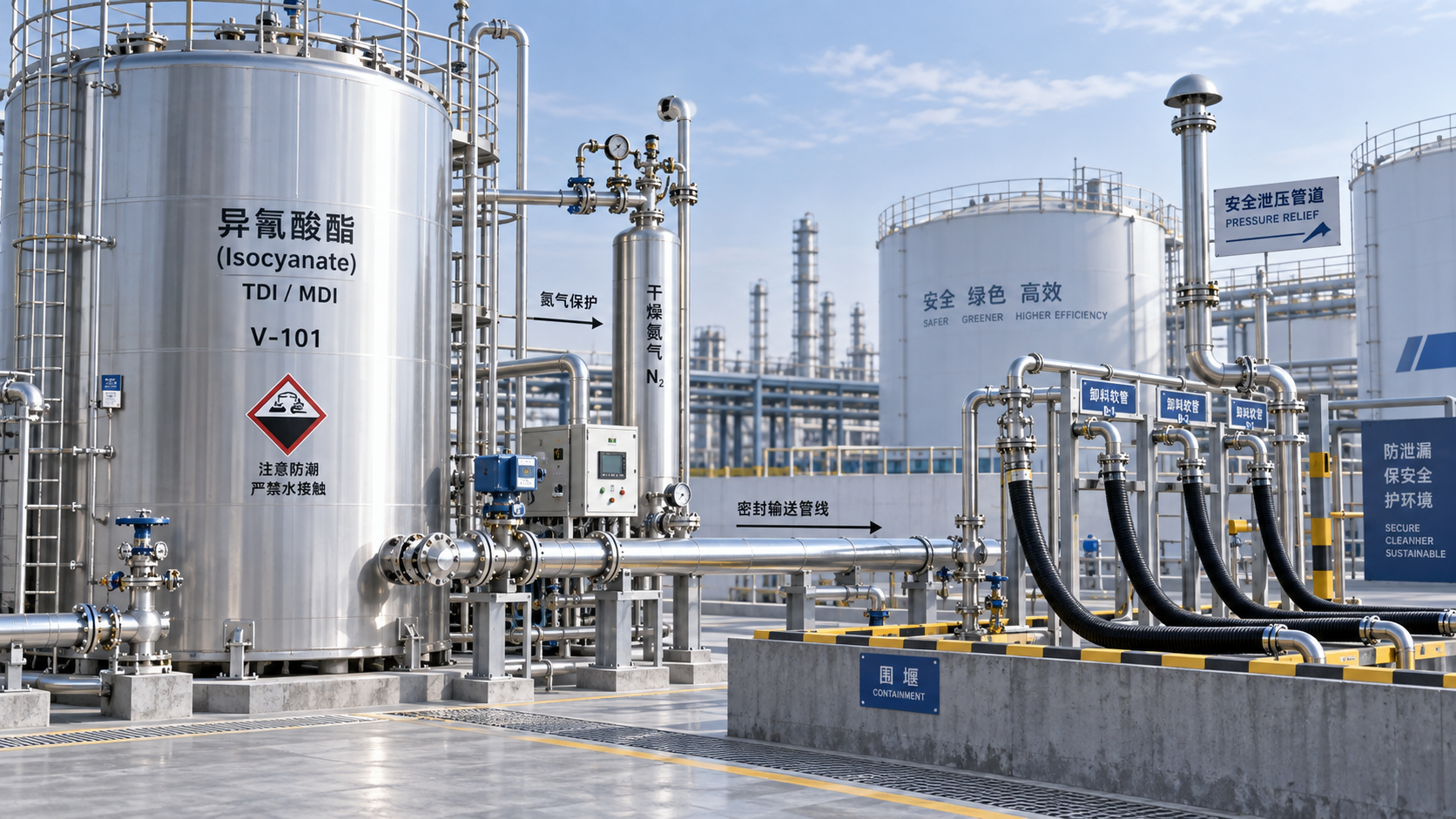
Bulk storage of isocyanates should not begin when the delivery vehicle arrives. It should begin only after the receiving tank, transfer route, utilities, documentation, and emergency arrangements have been checked as one system. A tank can appear clean and mechanically sound yet still be unsuitable if it contains residual moisture, has an uncontrolled vent path, uses incompatible hose seals, or cannot maintain the product temperature required for reliable pumping.
The central storage risk is moisture. Isocyanates react with water to form urea-type solids and carbon dioxide. In a bulk tank, this can cause off-spec material, sediment, plugged lines, pressure development, and difficult cleanup. The reaction is not limited to visible water in the vessel: wet nitrogen, humid air entering through an open connection, water trapped behind a valve, or an inadequately dried hose can be enough to create a quality and safety problem.
Before accepting a bulk shipment, treat the following checks as release conditions, not as general good practice.
Confirm the exact product and its storage envelope
“Isocyanate” is a chemical family, not a single storage condition. Aromatic and aliphatic grades, monomeric and polymeric products, and different commercial formulations can have different temperature ranges, viscosity behavior, freezing tendencies, and handling instructions. The tank operating limits must therefore come from the current product safety data sheet, technical data sheet, and agreed purchase specification for the exact grade being received.
Start by matching the delivery documents to the tank allocation: product name, grade, batch identification, quantity, and any required inhibitor or stabilizer information. Confirm that the tank has not previously held another material unless the cleaning and release process explicitly covers the product change. “Same chemical family” is not an adequate justification for using a tank without a documented compatibility review.
Temperature limits require particular care. Some materials become too viscous to pump or can partially crystallize when stored too cold. Others can discolor, degrade, or generate pressure concerns if exposed to excessive heat. A heat-traced tank is not automatically a controlled tank; the heat source, temperature sensor, alarm setting, controller response, and actual bulk temperature must all be checked. A temperature indication at the tank wall may not represent the temperature in the product mass, especially after a long period of inactivity.
Verify tank material, internal condition, and dry status
The receiving tank and every wetted component need to be compatible with the specific isocyanate grade. This review includes the shell, internal coating where present, nozzle lining, valve bodies, gaskets, sight glasses, sample valves, pump internals, hose linings, and flexible connectors. Compatibility is more than corrosion resistance. A material that sheds particles, swells, leaches additives, or retains moisture can compromise product quality even if it does not visibly fail.
Inspect the tank’s internal condition through the established inspection method before first use, after maintenance, after cleaning, and after any suspected contamination event. Look for residue, rust particles, damaged linings, loose scale, old hardened deposits, or standing liquid in low points. Hard deposits around nozzles or valve seats can signal prior reaction with moisture and may later break loose into the product stream.
Dryness needs evidence. A drained tank is not necessarily dry, and a recent water wash is not sufficient proof that water has been removed. The release procedure should define how drying is completed and how the result is accepted. This may involve controlled drying, dry inert-gas purging, inspection of drain points, or moisture verification suited to the site procedure. Do not overlook dead legs, pump casings, sample loops, filter housings, and hose ends. These are common places for small amounts of trapped water to remain after cleaning.
Do not confuse clean with suitable
A line may look clean after flushing but still be unacceptable for isocyanate service. A solvent flush can leave residual solvent or moisture; air blowing can introduce humid air; and an opened line can absorb atmospheric humidity before it is reconnected. The receiving system should be kept closed after drying, with unused openings properly blanked or sealed until transfer begins.
Protect the tank from air and water during storage
For bulk isocyanates, sealing strategy is a quality control measure. The tank should have a defined means of preventing uncontrolled air ingress while also managing normal pressure changes. Where inert gas blanketing is used, confirm the gas quality, dryness, pressure-control arrangement, supply availability, and alarm response. Wet or poorly controlled inert gas does not solve the moisture problem.
The vent system also deserves a functional check. Verify that the vent path is connected as designed, that it is not blocked, and that it does not permit rainwater, condensed moisture, or process vapors to enter an unsuitable area. Relief devices, vent treatment equipment, and drain arrangements must be maintained in a condition that supports the operating scenario, including thermal expansion and a possible reaction caused by contamination.
Open venting, loosely fitted caps, and routine manual opening of manways are poor controls for a moisture-sensitive bulk material. They may seem harmless when the tank is nearly empty or when work is being completed quickly, but each opening changes the exposure conditions. If inspection or sampling requires an opening, the procedure should specify how exposure is minimized and how the system is restored afterward.
Check the full transfer path, not just the storage vessel
Many receiving incidents start in the hose or unloading connection rather than in the tank. Before transfer, trace the route from the transport connection to the tank inlet. Confirm the correct line-up, valve positions, line identification, hose rating, hose cleanliness, grounding provisions where required by the site, and availability of containment around connection points.
Hoses and transfer arms should be dedicated where practical or subject to a documented cleaning, drying, and release process between products. Check couplings, seals, and locking devices for wear. A small leak is not only an exposure issue; it can draw moisture into the system during cooldown or pressure changes, and the residue can cure on fittings, making future connections unreliable.
Dead-headed lines and inaccessible low points should be identified before storage is authorized. If the system cannot be drained or isolated properly, it may retain material that later reacts, thickens, or blocks the line. This is especially important for infrequently used transfer routes and standby pumps. A tank may remain in good condition while its outlet route becomes unusable because material left in a small bypass or filter housing has hardened.
Assess temperature control as an operating function
Check whether the tank needs heating, cooling, insulation, recirculation, or simply protection from outdoor temperature swings. The answer depends on the grade and the local climate. The important point is to assess the entire storage cycle: receipt temperature, expected holding time, pumping temperature, seasonal conditions, and recovery after an alarm or utility interruption.
For a heated system, verify that the heating medium cannot create localized hot spots and that the temperature control is measured at a meaningful location. Overheating a small area near a coil or jacket can affect material before a bulk sensor recognizes the change. For systems that require warming to restore flow, establish an approved, gradual approach rather than applying uncontrolled heat to a cold or partially solidified tank.
Also consider power loss and instrument failure. A temperature control plan is incomplete if operators cannot tell whether the displayed value is current, whether the heat trace is actually energized, and what action is required when product temperature moves outside the approved range.
Set acceptance checks before unloading
Bulk receiving should have defined acceptance criteria for both identity and condition. Review the certificate of analysis, shipping documents, seal status where used, and package or transport condition before connecting. If the product is sampled, use a dry, closed or low-exposure method that does not introduce moisture or leave a contaminated sample point behind.
Product tests should reflect the risks that matter for the grade and intended use. Appearance may reveal gross contamination or unexpected solids, but it is not enough on its own. A material can remain visually clear while moisture-related changes or incorrect identity create downstream performance problems. The receiving plan should state which quality results are required before release, which can be reviewed after transfer, and what happens to the product if results do not meet specification.
Tank inventory measurement must be dependable before unloading starts. Confirm available working volume, high-level alarm operation, independent level indication where provided, and the intended stopping point. Avoid filling to a level that leaves no operating margin for thermal expansion, measurement error, or the practical need to maintain a vapor space.
Make emergency readiness specific to isocyanate handling
Emergency readiness should be checked at the same time as equipment readiness. Personnel involved in the transfer need suitable protective equipment, defined access to washing and decontamination facilities, communication arrangements, and an understood stop-work authority. Spill containment must be compatible with the response procedure and must not direct contaminated liquid into drains or uncontrolled areas.
The plan should distinguish between a minor external leak, a hose or coupling failure, a suspected water ingress event, and abnormal tank pressure or temperature. These situations do not call for the same response. In particular, a suspected reaction inside a closed system should not be treated as a routine maintenance issue. Isolate the system according to the established emergency procedure and prevent actions that could increase exposure or pressure.
Written procedures matter most when they are usable under time pressure. Check that valve tags match the procedure, emergency contacts are current, and the people performing unloading understand the sequence for stopping transfer, isolating the line, and reporting an abnormal condition.
Keep records that show the storage decision was controlled
For compliance and traceability, retain more than a delivery note. The pre-storage record should show tank identity, previous contents, cleaning and drying release, inspection status, product identification, transfer-line verification, temperature status, vent or blanketing status, available volume, and any deviations resolved before receipt. Linking the incoming batch to the destination tank and later transfer history makes contamination investigations far more manageable.
This discipline is especially useful in export supply chains, where product documentation, packaging integrity, transit time, and receiving conditions can cross several organizations. Chemical suppliers such as Huafeng Chemical can support continuity through broad product availability and trade coordination, but the receiving site still needs a product-specific release process before material enters bulk storage.
A different storage review is needed for products that may be shipped alongside isocyanates but have unrelated handling characteristics. For example, 1-ETHYL-3-METHYLIMIDAZOLIUM BIS(TRIFLUOROMETHYLSULFONYL)IMIDE CAS#174899-82-2 is a room-temperature ionic liquid used in non-aqueous synthesis and electrochemical work; its stated storage condition below 30°C does not make its tank controls interchangeable with those for moisture-reactive isocyanates.
A practical release sequence
- Match the incoming material to the approved tank allocation and current product documents.
- Confirm available capacity, level protection, temperature condition, and operating utilities.
- Verify the tank, lines, hoses, valves, and sample points are compatible, clean, dry, and sealed.
- Check venting, inerting or blanketing arrangements, and pressure-management equipment.
- Walk down the actual unloading route, including drains, containment, isolation points, and emergency equipment.
- Review acceptance testing and define the hold status of the received material.
- Record the completed checks before the first transfer connection is opened.
The most effective bulk-storage control is not a single tank specification. It is a verified chain of conditions that keeps the correct product in a dry, compatible, temperature-controlled, traceable system from unloading through final use.
Send Us Your Inquiry Today
