









Product Quick Navigation
Get a Quote
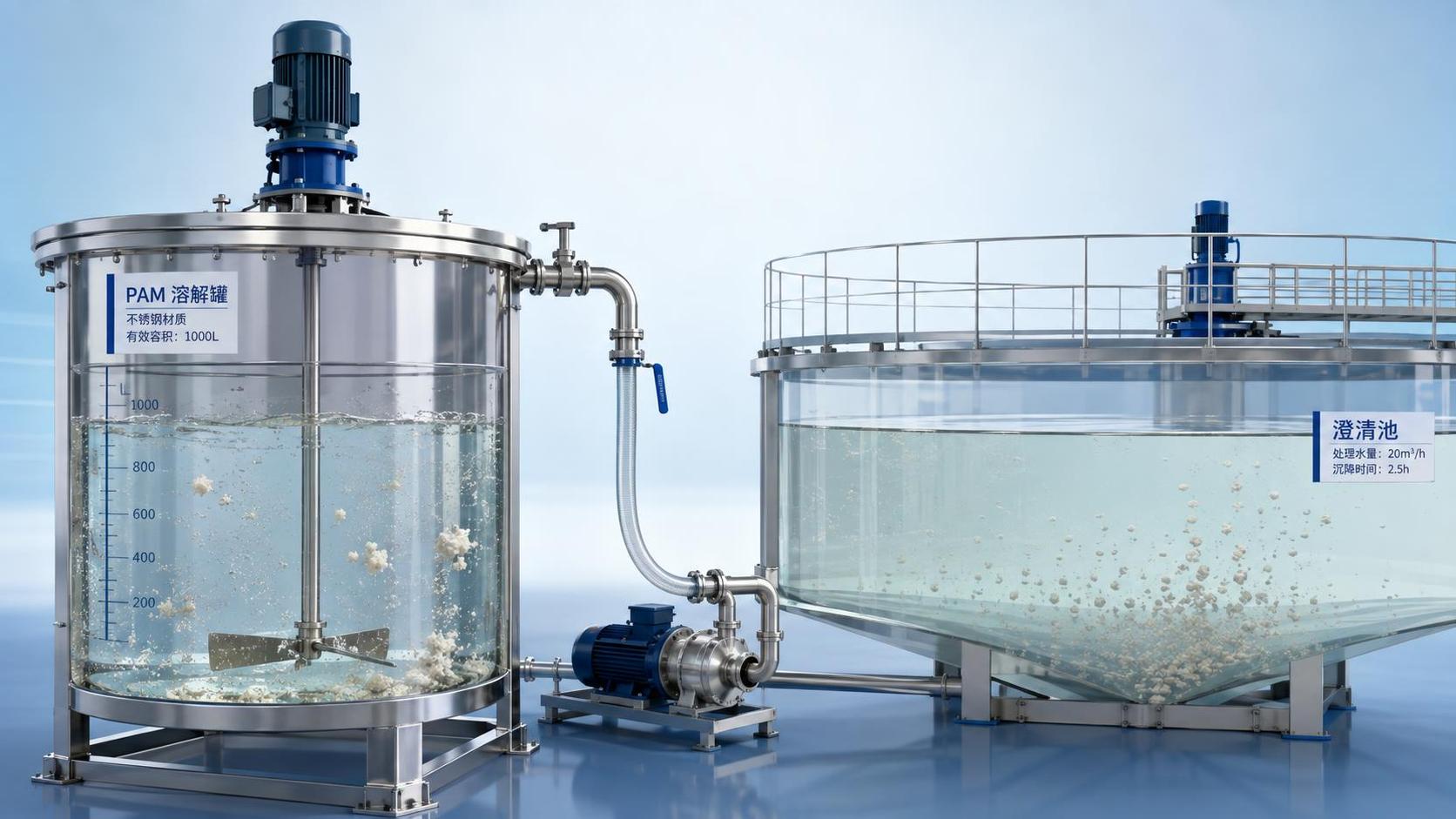
A clarification process can look normal at the start of a shift and then become difficult to control after a fresh batch of polymer solution is prepared. The feed pump is running, the dosage setting has not changed, yet flocs are smaller, settling is slower, filtrate becomes hazy, or sludge carries excess water. It is tempting to blame the raw water, the coagulant, or the Polyacrylamide Flocculant itself.
In many of these situations, the real loss occurs before the product reaches the treatment line. Poor mixing during solution preparation can leave part of the polymer unhydrated, break its long molecular chains, or produce a solution that is uneven from one point in the tank to another. A flocculant works by extending polymer chains through the water and bridging suspended particles. When those chains are not properly activated or are damaged by excessive shear, more chemical may be added without restoring stable floc formation. The practical response is to check dilution water, powder wetting, mixer intensity, maturation time, and the conditions at the final dosing point.
The mixing problem is often hidden in the make-down tank
Polyacrylamide is usually supplied as a dry powder, although emulsion and dispersion grades are also used. Dry polymer particles do not dissolve like a simple salt. Each particle must first contact water, disperse without clumping, absorb water, and uncoil into a high-molecular-weight polymer chain. This hydration process is sensitive to how the product enters the tank.
When powder is dumped too quickly into a vessel, it can form gelatinous lumps often called “fish eyes.” The outside layer hydrates first and becomes sticky, while dry material remains trapped in the center. These lumps may continue circulating in the tank and create the impression that the solution is ready. In reality, only part of the added product is active. Undissolved material may later block strainers, foul dosing equipment, or appear as floating fragments in treated water.
A different problem occurs when the mixer is too aggressive. The same mixing energy that helps distribute powder at the beginning can damage a hydrated polymer if maintained at a high level. Long-chain polymers are vulnerable to shear. High-speed impellers, tight-clearance centrifugal pumps, restrictive valves, and repeated recirculation can shorten the chains that create particle bridges. The solution may look completely clear, but its flocculation strength has already declined.
What poor mixing looks like in the treatment process
Mixing failures do not always produce one obvious symptom. Their effects often resemble underdosing, changes in influent quality, or an unsuitable polymer grade. Looking at the pattern helps separate these issues.
These symptoms should be interpreted alongside changes in pH, solids loading, temperature, and coagulant dose. Still, when process conditions are broadly stable and performance worsens soon after solution preparation, the polymer make-down system deserves attention before the dosage is increased.
Incomplete wetting wastes active polymer
The first stage of preparation is not about forcing the product to dissolve as quickly as possible. It is about exposing individual polymer particles to water before they can stick together. A controlled feed rate matters more than a large initial addition. Powder should enter a well-wetted, gently circulating zone rather than fall onto the tank wall, float on a still surface, or collect in a vortex.
A strong vortex may seem helpful because it pulls powder downward, but it can also draw air into the solution. Entrained air makes wetting less uniform, creates foam, and can interfere with pump priming or metering. A better arrangement provides enough surface movement to disperse the powder while avoiding a deep air-drawing funnel.
Water quality also affects wetting and hydration. Suspended solids in make-up water can consume or coat polymer before it is fully prepared. Water containing residual coagulant, oxidizing agents, incompatible chemicals, or high levels of reactive contaminants may reduce solution quality. Make-up water should be as clean as the process allows, and the preparation tank should not be used as a convenient point for adding unrelated chemicals.
Do not judge readiness by appearance alone
A polymer solution can become visually uniform before the molecular chains have fully hydrated. Clear solution is encouraging, but it does not prove that the Polyacrylamide Flocculant has reached its working condition. Premature use commonly leads to a cycle of dose increases, unstable results, and repeated adjustment of downstream equipment.
Allow the prepared solution to mature according to the product handling guidance and site procedure. The required time depends on polymer form, concentration, water temperature, water quality, and the design of the preparation unit. Cold water can slow hydration. A concentrated stock solution may also take longer to develop evenly than a more dilute preparation. Rather than applying a single time to every product, establish the maturation requirement for the grade in use and keep it consistent between batches.
Too much shear can make a fully dissolved solution perform poorly
Operators sometimes respond to slow dissolution by increasing mixer speed or extending high-speed recirculation. This may reduce visible lumps, but it can introduce another failure mode. Flocculation depends on polymer chains retaining enough length to connect particles. Once chains are mechanically degraded, additional aging will not rebuild them.
The critical distinction is between dispersion mixing and post-hydration mixing. Early in the process, moderate energy is needed to distribute powder through the water. After the product has dispersed and hydrated, the purpose of mixing changes: it should keep the solution uniform without repeatedly subjecting it to high stress.
Potential shear sources are not limited to the tank agitator. Review the complete route from preparation to injection:
- High-speed or poorly selected agitators can create unnecessarily intense local shear near the impeller.
- Fast recirculation through narrow piping can damage polymer chains over time.
- Centrifugal transfer pumps may be unsuitable for some high-molecular-weight solutions, particularly where repeated pumping is required.
- Partly closed valves, undersized strainers, sharp bends, and blocked injection quills create local pressure losses and turbulence.
- Excessively violent mixing at the treatment point can break newly formed flocs after the polymer has done its work.
The final item is easy to miss. Polymer solution must contact the suspended solids quickly enough to distribute through the stream, but floc formation usually needs a lower-energy zone afterward. A rapid, harsh mixing environment may disperse the chemical but prevent fragile flocs from growing. The correct sequence is generally controlled initial contact followed by gentler flocculation, not maximum turbulence throughout the process.
Concentration errors change more than the pump setting
Stock concentration affects solution viscosity, hydration behavior, pumpability, and dosing accuracy. When the solution is prepared too concentrated, powder is harder to wet, circulation becomes uneven, and local gel formation becomes more likely. A concentrated solution may also put extra load on mixers and pumps, increasing the chance of mechanical degradation.
Over-dilution has a different consequence. It may be easier to prepare, but it can require higher feed volumes and make dosage control less responsive. In a small stock tank, a weak solution can also shorten the available run time and create frequent transitions between old and new batches. Those transitions may appear in the clarification process as unexplained swings.
Use the product-specific concentration range established for the grade and equipment. If a process requires a further dilution before injection, make that dilution with steady flow and enough mixing to obtain uniform concentration. Avoid using a dilution line that alternates between water-rich and polymer-rich slugs. A dosing pump may have a stable stroke rate while the actual active polymer concentration entering the process is changing.
A practical way to investigate a sudden performance drop
When flocs become weak, do not begin by making a large dosage increase. That can mask the preparation problem and may create excess residual polymer, poor sludge release, or carryover. Start with the most recent batch and trace its path.
- Inspect the tank contents. Look for gel particles, surface powder, foam, dead zones, settled residues, or material collecting around baffles and corners. Inspect only through safe site-approved methods; polymer spills can make walking surfaces extremely slippery.
- Verify the preparation sequence. Confirm that the tank contained the required water volume before powder addition, that the mixer was operating at the intended condition, and that the product was fed at a controlled rate.
- Confirm actual maturation time. Record when addition ended, not merely when the batch preparation began. A batch started early is not necessarily ready if powder feeding continued for much of that period.
- Check concentration by the preparation calculation. Compare the mass of product and water volume with the approved recipe. Investigate scale errors, incorrect bag counts, level indication errors, and unmeasured top-up water.
- Review transfer conditions. Listen for pump cavitation, inspect pressure changes across strainers, and check whether recirculation or transfer runs longer than normal.
- Compare the final injection point. A blocked quill, altered flow pattern, or change in the point of coagulant addition can prevent proper contact even when the polymer solution is sound.
Small, controlled trials are more useful than broad changes. Once the preparation method is corrected, compare the treatment response at the established dosage before changing polymer demand assumptions. Observe floc size, settling behavior, clarified water appearance, filter performance where applicable, and sludge handling response. One favorable observation is not enough; the goal is repeatable behavior over normal operating variation.
Separate polymer preparation from process chemistry
Flocculant performance is influenced by the chemistry of the stream being treated. Charge balance, pH, alkalinity, particle type, oil content, and coagulant selection all matter. However, these variables should not be confused with polymer activation. A well-selected product cannot compensate for poorly controlled preparation, and a properly prepared solution cannot fully correct an unsuitable coagulation condition.
This separation is useful during troubleshooting. First establish that the polymer solution is uniform, fully matured, and protected from excessive shear. Then assess whether the feed point, coagulant sequence, pH condition, or process flow has changed. Keeping these questions separate prevents operators from changing several variables at once and losing the ability to identify the true cause.
Habits that keep results consistent from batch to batch
Reliable performance usually comes from a repeatable routine rather than an unusually high dose. Keep the make-down tank clean, prevent old gel deposits from entering new batches, and use the same validated addition sequence across shifts. Mark the intended operating range for mixer speed, preparation volume, powder feed duration, maturation period, and transfer route. Where automatic preparation equipment is used, verify that its water flow, dry feeder, and aging section are functioning rather than assuming automation guarantees correct hydration.
Record changes that can affect mixing: a different water source, colder make-up water, a replacement impeller, a modified pump, an altered dilution ratio, or a new polymer grade. These details are often more useful than a single dosage number when a previously stable process begins to drift.
Good mixing does not mean the most powerful mixer or the fastest preparation cycle. It means each polymer particle is wetted, hydrated, and delivered to the process with its chain structure intact. When that condition is controlled, Polyacrylamide Flocculant can form stronger, more predictable flocs with less need for reactive dose adjustments.
Send Us Your Inquiry Today
