









Product Quick Navigation
Get a Quote
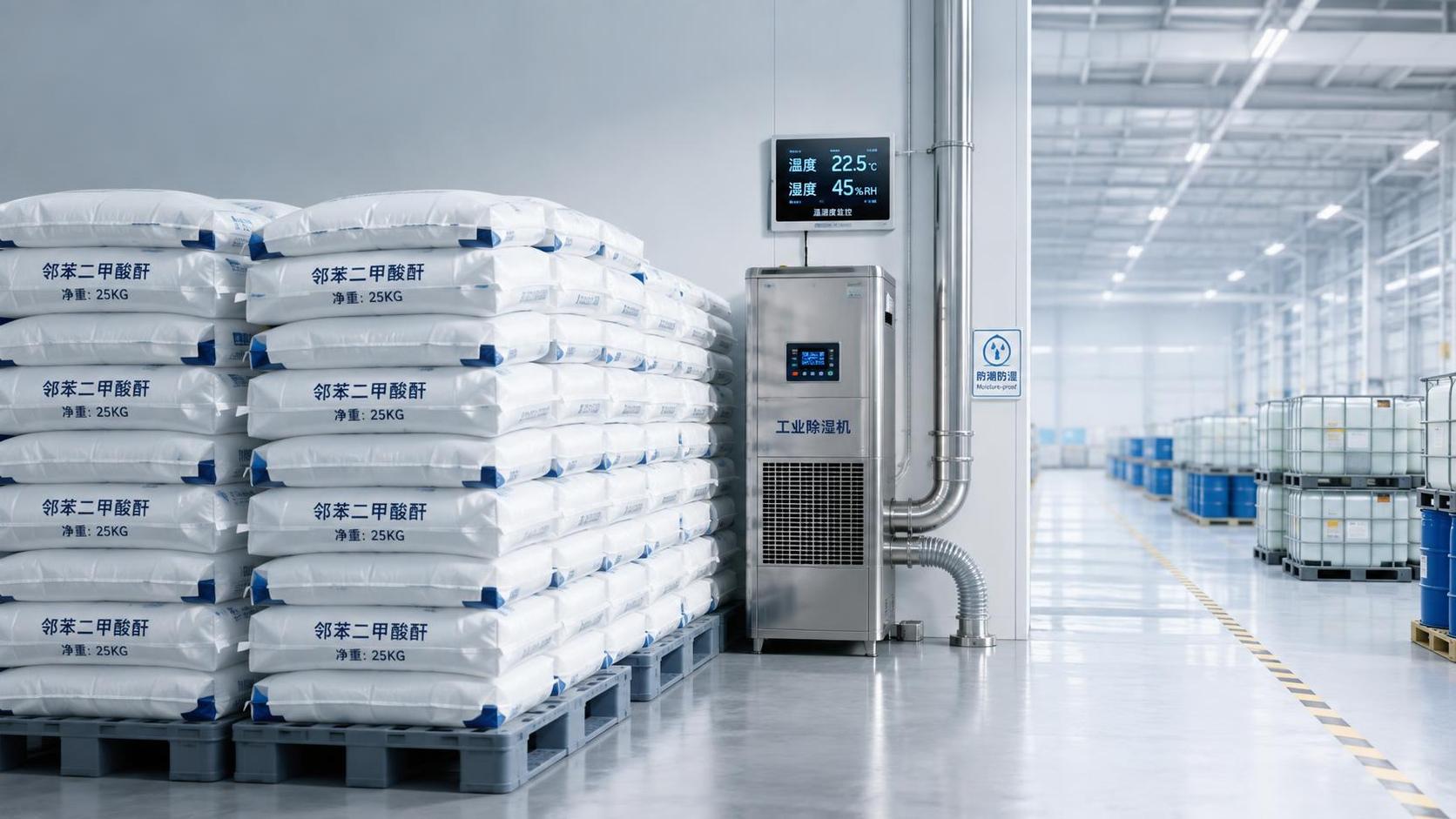
Why Moisture Control Matters When Storing Phthalic Anhydride
Phthalic Anhydride is often treated as a straightforward solid chemical: receive it in bags, place it in a warehouse, and feed it into production when needed. In practice, storage conditions can decide whether the material remains free-flowing and predictable or becomes a source of handling delays, quality concerns, and avoidable cleanup work.
Moisture is one of the most important variables to control. Even when water does not visibly flood a package or create an immediate incident, repeated exposure to humid air, condensation, wet floors, damaged liners, or poorly sealed transfer equipment can gradually affect Phthalic Anhydride quality. The consequences may appear later: material that no longer discharges smoothly, unexpected variation in a downstream formulation, higher filtration demand, or product that needs to be isolated until quality is checked.
For operators, the practical question is not simply whether the warehouse “looks dry.” It is whether the product is protected from moisture from unloading through storage, sampling, internal movement, and final use. That requires attention to packaging condition, building environment, temperature changes, cleaning practices, and the points where the material is exposed to air.
Water Changes More Than the Appearance of the Material
The central chemical issue is hydrolysis. Phthalic Anhydride can react with water to form phthalic acid. This is why moisture is not merely a housekeeping concern. If water reaches the product, the effect may extend beyond wet or lumpy material; it can alter the composition that a user expects to introduce into a process.
In some applications, a limited change may be detected only during incoming inspection or batch analysis. In others, it may show up as a process adjustment problem. Users producing plasticizers, unsaturated polyester resins, alkyd resins, coatings, or other chemical intermediates generally rely on consistent feedstock behavior. When the raw material has absorbed moisture or partially hydrolyzed, reaction balance, acidity-related control points, clarity, viscosity development, or conversion behavior may need closer review. The exact impact depends on the formulation and operating conditions, but it is rarely helpful to discover the issue after charging a reactor.
There is also a physical handling dimension. Moisture can encourage agglomeration and caking. A package may still contain the correct net weight, but hardened areas can slow manual discharge, block conveying systems, or make screening necessary. Operators then face a familiar but inefficient choice: break up the material mechanically, pause the line, or hold the lot for quality assessment. None of these is an ideal response during a production schedule.
It is worth separating caking caused by moisture from caking caused by temperature exposure or long storage time. The symptoms can look similar, but the corrective action is not always the same. A warehouse team that only focuses on “lumps” may miss the more important question: was the package exposed to humid air, condensation, leaking water, or a damaged moisture barrier?
Humidity Is Not the Only Risk: Condensation Is Often Worse
Many storage failures occur despite a warehouse having no obvious water leak. Condensation is a common example. When packaged Phthalic Anhydride moves between different temperature environments, moisture in the surrounding air can condense on cooler packaging surfaces. If the outer bag, pallet wrap, or liner has been compromised, that moisture may find a route into the product.
This is especially relevant after container transport, seasonal weather changes, or unloading at a site where outside and warehouse temperatures differ sharply. A container opened immediately after arrival may appear dry at the door, while packages deeper inside have experienced temperature cycling during transit. Conversely, material transferred from a cool environment into warm humid air can collect surface moisture before it is put away.
A practical rule is to avoid treating visible water as the only warning sign. Wet carton surfaces, softened bag corners, loose closures, torn outer packaging, stains around pallet bases, and unusual clumping near the package wall all deserve attention. They do not automatically prove that the product is out of specification, but they are legitimate reasons to segregate the material and follow the site’s quality procedure before release.
The same thinking applies to internal transfers. A clean, dry warehouse does not protect a product if it is left uncovered near an open loading bay during rain, transferred using damp equipment, or held in an opened container while the line is waiting for capacity. The weak point is often not the main warehouse; it is the few minutes when normal controls are relaxed.
Where Moisture Usually Enters the Storage Process
Moisture exposure is rarely caused by a single dramatic event. More often, it comes from a sequence of small failures. Identifying those points is more useful than issuing a generic instruction to “keep dry.”
- Receiving in poor weather: pallets may be moved through rain, snow, or humid outdoor air without adequate protection.
- Damaged packaging: tears, punctures, weak seams, or poorly resealed inner liners can compromise the intended moisture barrier.
- Direct floor contact: even a concrete floor that appears dry can transfer moisture or expose bags to washdown residue and localized condensation.
- Inappropriate cleaning routines: wet cleaning near stored chemicals can create humidity spikes or leave water where pallets and packaging will sit.
- Open-package handling: partial bags or opened containers are vulnerable if they are not promptly closed using a suitable method.
- Uncontrolled bulk transfer points: hoppers, screw conveyors, flexible connections, and sampling ports can admit humid air when seals are worn or procedures are inconsistent.
For bagged product, the pallet itself is part of the protection system. Keeping packages raised from the floor, away from exterior walls, and clear of roof-drip zones sounds basic, but these measures prevent a disproportionate number of avoidable issues. Stacking practices also matter. Excessive load or poor pallet alignment can damage lower bags and create small openings that are not noticed until discharge.
Dry Storage Does Not Mean Overengineering Every Warehouse
A sensible moisture-control plan should match the storage duration, packaging format, local climate, and production sensitivity. Not every operation needs the same level of environmental control. The important point is to understand the risk rather than rely on a one-size-fits-all rule.
For sealed, intact packages held for a short period in a clean indoor warehouse, good building maintenance and disciplined handling may be enough. For longer storage, humid climates, coastal locations, frequent container arrivals, or highly sensitive downstream processes, additional measures may be justified. These can include routine humidity monitoring, better segregation of opened packages, controlled staging areas, and review of container unloading practices.
It is usually more useful to monitor trends than to react to one isolated reading. A warehouse may have acceptable average conditions while still experiencing repeated humidity peaks during nighttime temperature drops, wet-season deliveries, or after doors remain open for extended periods. If moisture-related complaints or caking appear intermittently, reviewing these operating patterns can reveal more than a single spot check.
Avoid assuming that ventilation always solves the problem. Ventilation can reduce stagnant air in some buildings, but bringing humid outdoor air into a cooler warehouse may increase condensation risk. The best approach depends on the site’s climate, building design, and temperature profile. Facility teams should evaluate the actual environment rather than adopt a control method simply because it works elsewhere.
Practical Handling Measures Before the Product Reaches the Process
A reliable routine starts at receiving. Before accepting a pallet into normal inventory, operators should check for damaged wrap, wet surfaces, collapsed bags, torn liners, unusual odors, stains, or material leaking around seams. Documentation of the package condition at arrival can be valuable if a quality question arises later in the supply chain.
When a package is opened, treat it as a different storage condition. The original sealed-pack protection no longer applies. Use the material according to a defined sequence, close any remainder promptly, and avoid leaving it exposed near process vents, doors, or washdown areas. If the remaining quantity will not be consumed soon, the appropriate resealing and retesting approach should be determined by the user’s quality system and the supplier’s product documentation.
Sampling deserves equal care. A rushed sample taken with a damp or poorly cleaned tool can create a misleading result and introduce contamination into the package. Sampling tools should be clean, dry, compatible with the material, and protected between uses. Where representative quality testing is required, the sampling plan should account for the fact that moisture damage may be localized near an opening, damaged area, or package wall rather than evenly distributed throughout the lot.
If caking or suspected moisture exposure is found, do not assume that simply breaking up the material restores it. Physical size reduction may improve flow, but it does not reverse hydrolysis or remove contamination concerns. The correct next step is normally segregation, inspection, and evaluation against the relevant product specification and process requirements. Whether material can be used, reworked, or rejected depends on actual testing and the application—not on appearance alone.
Storage Quality Is Also a Supply Chain Issue
For imported and exported chemicals, moisture control begins before the shipment reaches the end user. Packaging selection, container loading, transit duration, port delays, weather exposure, and unloading coordination all affect the condition in which a hygroscopic or moisture-sensitive material arrives. A strong storage procedure at the destination cannot fully compensate for packaging damage or uncontrolled exposure earlier in the route.
This is one reason chemical users increasingly look beyond the product name on a purchase order. They need clear communication about packaging, handling expectations, shipping documentation, and response procedures if an issue is found on arrival. In international trade, responsiveness matters because a delayed decision on a questionable lot can disrupt both inventory planning and production scheduling.
Huafeng Chemical, based in Shandong Province, works within this broader export environment, where reliable chemical supply depends on more than arranging shipment. For overseas buyers and operating teams, practical coordination around packaging condition, delivery handling, and technical documentation can be as relevant as commercial terms. The appropriate storage requirements should always be confirmed against the current product specification, safety data sheet, packaging format, and the user’s own process controls.
The Most Useful Check Is the One Made Before a Problem Becomes a Batch Issue
Moisture control for Phthalic Anhydride is not about creating unnecessary warehouse complexity. It is about preventing a known chemical and handling risk from becoming a production problem. Keep packages dry and intact, protect them from condensation and floor moisture, manage opened material carefully, and investigate questionable lots before they enter a process.
The details will vary by site, climate, packaging type, and downstream application. Still, one operational principle holds up well: if water has had a credible path to the product, treat the material condition as something to verify rather than something to assume. That small discipline is often what preserves consistent feed behavior and avoids a much larger interruption later.
Send Us Your Inquiry Today
