









Product Quick Navigation
Get a Quote
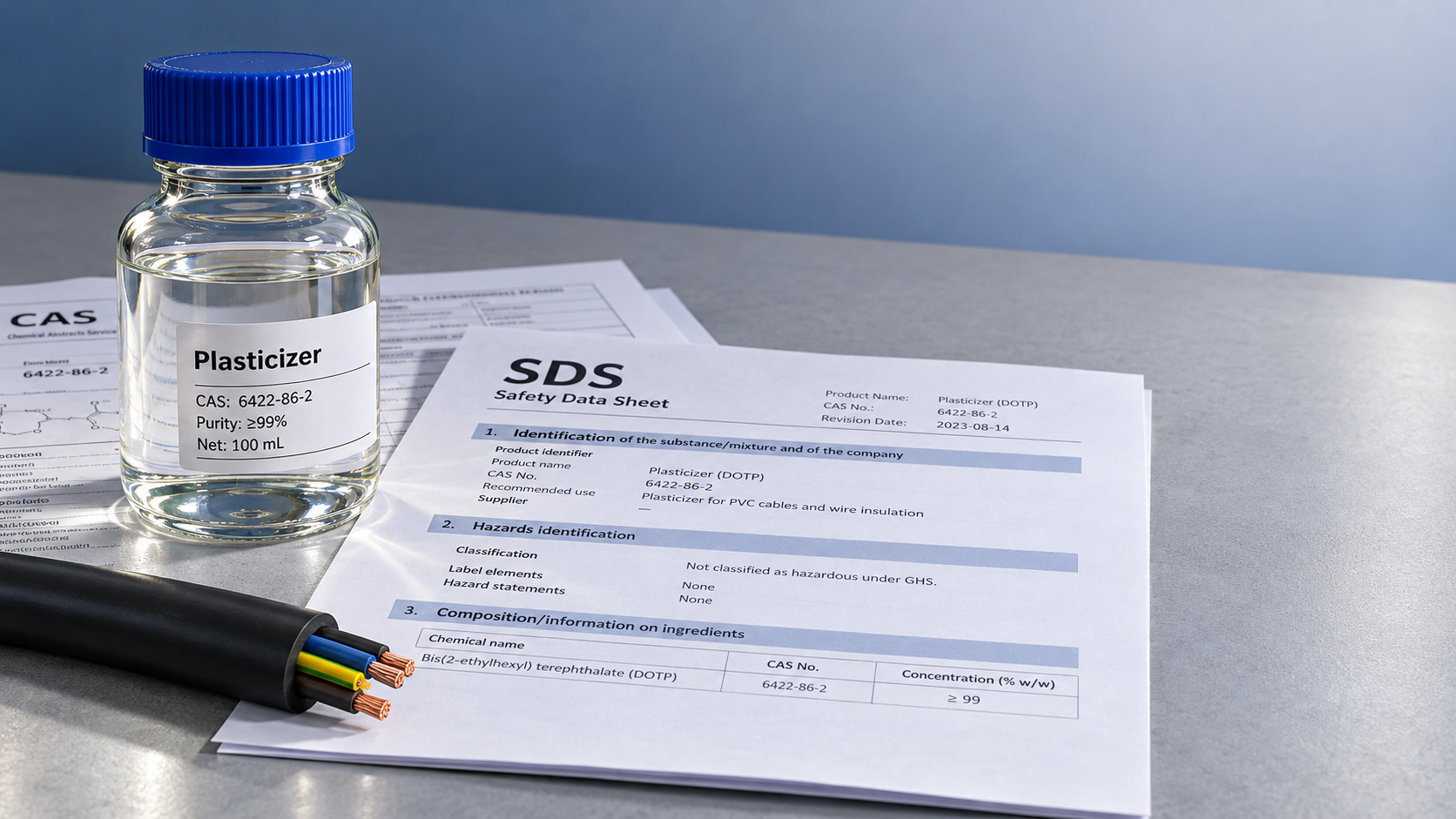
A plasticizer quotation can look acceptable until the incoming-material review reveals that the supplier’s “REACH compliant” statement covers neither the intended application nor the substances actually supplied. Before issuing a purchase order, verify the chemical identity, check applicable Annex XVII restrictions, review Annex XIV authorisation requirements, and establish current Candidate List status. A missed restriction can leave a batch unsuitable for its planned use even when its technical performance is satisfactory.
Which plasticizers are suitable for REACH-sensitive markets? Non-phthalate candidates such as DEHT/DOTP, DINCH, certain citrates, and adipates may enter the shortlist, but none should receive blanket approval based on family name alone. Acceptance depends on the exact substance, impurities, concentration, destination, supply-chain role, and finished application. The practical objective is a documented purchasing decision for a defined grade and use—not a generic compliance label.
Define the use before checking the substance
The same plasticizer may require different screening decisions for industrial flooring, a cable jacket, a toy, or a food-contact component. Start with a short application record that accompanies the supplier enquiry. Without it, the supplier may answer a different compliance question from the one your business needs resolved.
- Destination: identify the actual market. EU REACH should not be treated as interchangeable with UK REACH or other national chemical regimes.
- Material and article: specify the polymer, plasticizer loading, and finished product category.
- Exposure: record foreseeable skin contact, contact with mucous membranes, mouthing by children, or food contact.
- Supply route: establish whether the purchase involves a substance, a mixture, or an already manufactured article.
- Commercial requirements: separate legal restrictions from customer specifications, such as broader phthalate exclusions.
A customer’s “phthalate-free” requirement may prohibit substances beyond those restricted for the particular application. Conversely, meeting a narrow customer test panel does not establish full REACH compliance. Record these as separate acceptance conditions.
Resolve identity mismatches before reviewing certificates
Trade names are not reliable regulatory identifiers. Request the chemical name, CAS number, EC number where available, manufacturer, grade, composition information, and relevant impurity profile. Cross-check these against the quotation, safety data sheet, specification, and certificate of analysis. For mixtures, obtain sufficient component information to assess restrictions, using confidentiality arrangements where necessary.
Pay particular attention to abbreviations. DEHT is commonly marketed as DOTP, while DEHP is often associated with the ambiguous commercial term DOP. These names must not be treated as equivalent. A declaration referring only to “DOP-free” is inadequate unless it defines which substance is excluded.
Catalogue classification also needs checking. A listing for Pyridoxine hydrochloride CAS#58-56-0 concerns a vitamin-related chemical used in pharmaceutical and additive applications, not a plasticizer alternative. Its appearance in the same supplier portfolio provides no evidence about another product’s regulatory status. Keep each approval file tied to its own identity, grade, and intended use.
Place the purchase on hold when identifiers disagree. Testing an unidentified sample may establish what that sample contains, but it does not resolve whether future deliveries will match it.
Run three separate REACH checks
Annex XVII, Annex XIV, and the Candidate List answer different questions. Search the current official ECHA information and applicable legal text by identity, then save the review date and relevant entry. A historical supplier declaration cannot replace this review.
Apply the correct phthalate restriction and denominator
Annex XVII Entry 51 is a central screening point for DEHP, DBP, BBP, and DIBP. Its article restriction addresses these substances individually or in combination at concentrations equal to or greater than 0.1% by weight of the plasticised material, subject to the entry’s scope and derogations. The entry also contains provisions concerning toys and childcare articles. Read the complete entry rather than relying on a summary headed “restricted phthalates.”
The denominator matters. A concentration calculated against the entire assembled article can conceal a higher concentration in its plasticised component. For a cable assembly, for example, metal conductors should not dilute the result used to assess a restriction expressed against plasticised material.
Entry 52 separately addresses DINP, DIDP, and DNOP in toys and childcare articles that can be placed in the mouth by children. It is not a universal prohibition on every industrial application of those substances. Assess the actual product design and the entry’s wording; a supplier’s statement that a grade is suitable for industrial PVC does not answer a toy-compliance question.
Also check other relevant Annex XVII entries, including restrictions affecting supply of certain hazardous substances or mixtures to the general public. Screening only the familiar phthalate entries can miss obligations associated with the supplied product’s classification.
Do not confuse authorisation with an article ban
For an Annex XIV substance, determine whether the intended EU use requires authorisation after the applicable sunset date. Authorisation coverage is tied to specific substances, uses, and supply-chain conditions. A supplier’s registration number or reference to another company’s authorisation is not sufficient proof of coverage.
Importing a finished article containing an Annex XIV substance does not, by itself, trigger the same authorisation requirement as using that substance within the EU. Restrictions and article-related duties may nevertheless apply. This distinction is important when comparing imported plasticizer with imported finished components.
Candidate List inclusion is not automatically a general ban. For articles containing an SVHC above 0.1% weight by weight, Article 33 communication duties can apply; assess the threshold at the relevant constituent-article level in complex objects. Article 7 notification duties have additional conditions. SCIP obligations arise under separate waste legislation and should be reviewed separately where applicable.
Build a shortlist without assuming alternatives are unrestricted
Removing a restricted phthalate from a formulation is only the first filter. The replacement must also meet processing and service requirements, and its precise identity still needs a current regulatory review.
These are screening candidates, not certified substitutes. “Non-phthalate” does not mean suitable for food contact, toys, medical applications, or every customer specification. Those uses can introduce requirements beyond REACH. Confirm technical performance at the intended loading rather than assuming a one-for-one replacement will preserve hardness, migration resistance, or processing behaviour.
Ask for evidence that supports the actual decision
A useful supplier package connects regulatory statements to the material being purchased. Request a current SDS appropriate to the destination, a grade-specific specification, representative batch documentation, a dated regulatory declaration, and relevant analytical evidence. Where registration obligations apply, establish who carries them and whether the supplied substance and intended use are covered. Registration is not regulatory approval for every application.
Read the SDS beyond its revision date. Sections on identity, composition, exposure controls, and regulatory information should be internally consistent. An SDS is a hazard-communication document, not a universal certificate of absence: a substance missing from Section 3 is not necessarily absent at every concentration relevant to a restriction.
Ask the supplier to state which restricted substances were assessed, which Candidate List version was checked, and whether the declaration covers intentional ingredients, impurities, or both. Statements such as “complies with all European regulations” are too broad to serve as measurable purchasing conditions.
Match testing to the unresolved risk
Use testing when composition evidence is incomplete, contamination is plausible, or the application warrants stronger verification. A restricted-phthalate panel can be appropriate, but its analytes must match the substances relevant to the decision. A four-substance result cannot establish absence of every phthalate.
- Identify the sample by grade, manufacturer, batch, sampling date, and sampling source.
- Confirm that the analytical method is suitable for the liquid plasticizer or finished polymer matrix.
- Require reporting limits sufficiently below the applicable acceptance limit.
- Check whether results are expressed against the legally relevant material basis.
- Consider measurement uncertainty when results approach the acceptance boundary.
“Not detected” means below the stated detection or reporting limit, not absolute absence. Results for neat plasticizer also do not automatically establish finished-article compliance: recycled resin, masterbatch, other additives, or shared processing equipment may introduce restricted substances.
Turn the review into a controlled purchase specification
Approval should identify the manufacturer, grade, substance identity, intended use, and evidence reviewed. Set acceptance limits that reflect the legal threshold, analytical capability, and any tighter customer requirement. Specify whether limits apply individually, to a regulated combination, or to a defined substance family; otherwise, supplier and buyer may interpret the same requirement differently.
Include advance notification of changes to composition, manufacturing source, impurity limits, or regulatory status. Require batch traceability and define when a new sample or renewed assessment is necessary. An export intermediary such as Huafeng Chemical can be asked to coordinate manufacturer documentation, but the purchasing file should still distinguish the manufacturer, seller, and relevant EU duty holder.
Release the purchase only when identity, intended-use legality, documentation, and any required test results align. Use conditional approval for clearly defined outstanding evidence, with no release into the restricted application until that evidence is accepted. Reassess after a material change, a relevant regulatory update, or a change in end use—not simply because the previous batch passed.
Send Us Your Inquiry Today
