









Product Quick Navigation
Get a Quote
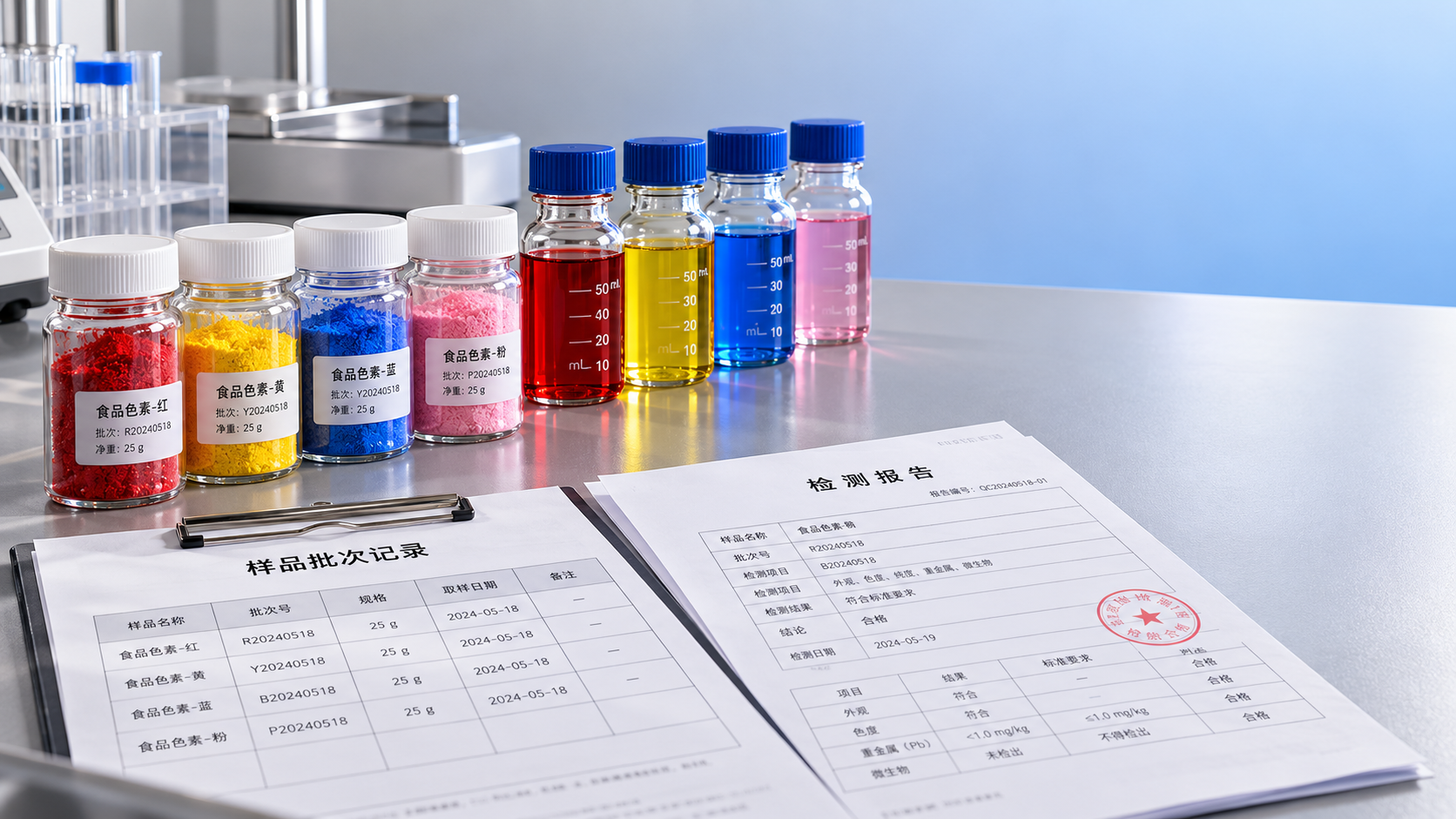
Food colorants do not all require FDA batch certification, and there is no universal FDA product registration that makes every colorant acceptable for food use. The first requirement is that the color additive must be authorized for its intended use. Certain listed colors also require FDA certification of each manufactured batch. Food facility registration is a separate obligation that may apply to businesses manufacturing, processing, packing, or holding the material.
When evaluating food colorants FDA registration requirements, separate these questions before reviewing supplier certificates: Is this substance permitted to color this food? Does its regulatory listing require batch certification? Which facilities and import activities have their own compliance obligations? A document answering one question does not automatically answer the others.
Three requirements that supplier documents often confuse
“FDA registered,” “FDA approved,” and “FDA certified” describe different things. Treating them as interchangeable can allow an unsuitable material through purchasing controls or delay a shipment while missing evidence is collected.
FDA generally does not approve food facilities through registration. A supplier’s registration number therefore cannot replace the regulatory basis for a color additive or the certification record for a batch that requires certification. Commercial registration certificates issued by service providers also do not establish product approval.
Start with the exact color and its intended food use
Before requesting certificates, identify what is actually being purchased. A trade name such as “brilliant yellow powder” or “natural red blend” is insufficient. Obtain the regulated color name, composition, physical form, and intended application. For a preparation, identify the coloring components and relevant carriers, preservatives, or other ingredients.
The U.S. color additive framework distinguishes colors exempt from certification from colors subject to certification. These categories appear principally in Parts 73 and 74 of Title 21 of the Code of Federal Regulations. Certification procedures are addressed separately in Part 80. The applicable listing determines the conditions under which an individual additive may be used.
Read that listing against the actual formulation. Relevant conditions can include:
- The foods in which the additive is permitted.
- Maximum use levels or limits based on good manufacturing practice.
- Identity and purity specifications.
- Restrictions on particular forms, including lakes.
- Required labeling statements or declarations.
A color permitted in one food category may be unsuitable for another. A standardized food may also restrict ingredients beyond the general color additive listing. Approval for cosmetics or externally applied drugs does not establish permission for food use.
Likewise, an overseas authorization, an E number, or a CAS number does not establish U.S. acceptability. These identifiers help match substances across documents, but they do not describe every applicable use restriction. Procurement should connect the supplied identity to a U.S. food-use listing before considering commercial approval complete.
When FDA batch certification is required
For a color additive subject to certification, each manufactured batch must undergo FDA’s certification process before it can be used as a certified color in food. The process involves submission of a representative sample and FDA testing against applicable specifications. Certification belongs to the identified batch; it is not a permanent approval covering all future production from the same factory.
This distinction matters when a supplier provides a successful certification record from an earlier shipment. That record may demonstrate familiarity with the process, but it does not establish the status of the material currently offered.
For purchasing purposes, the documentation should allow the received material to be traced to the appropriate FDA-certified batch. A manufacturer’s production lot, a distributor’s repacking lot, and an FDA certification lot identifier may differ. Different identifiers are manageable when the supplier provides a clear, documented connection between them.
For example, if a distributor divides a certified batch into smaller containers, its internal lot code should lead back to the original certified batch. An unexplained mismatch between the container label, certificate of analysis, and certification documentation is a reason to hold the material until the relationship is established.
A certificate of analysis is not FDA batch certification. A COA reports results against a specification, such as color strength, moisture, or impurity limits. Even a detailed COA from a qualified laboratory does not replace FDA certification where certification is mandatory. Both documents may be necessary because they answer different questions.
Certification-exempt colors still need a regulatory basis
Some listed food colors, including certain plant-derived colors and caramel color, are exempt from batch certification. That exemption removes the FDA batch certification requirement; it does not remove the need to meet the additive’s listing, specifications, and use conditions.
“Natural” is not a reliable shortcut for deciding certification status or food-use eligibility. Source materials, manufacturing methods, and the identity of the resulting additive can affect which listing applies. A plant extract sold as a food ingredient does not automatically become an authorized color additive simply because the plant itself is edible.
For a certification-exempt color, the supplier file should explain the applicable listing and show that the supplied material meets its requirements. Depending on the additive, useful evidence may include source identity, manufacturing information, compositional specifications, contaminant controls, and batch analysis.
General food-ingredient status also cannot substitute for color additive authorization. A substance with a lawful non-coloring use does not automatically have permission to be added for coloring. Its function in the finished food must be part of the assessment.
Blends and lakes require closer document matching
A formulated color preparation may contain multiple colors, a carrier, and ingredients that improve handling or dispersion. Reviewing only the finished product’s trade name can conceal a certification-required component or an ingredient unsuitable for the intended food.
Ask for a composition statement detailed enough to assess every coloring component. Where certification-required colors are used, traceability should connect those components to their certified batches. A blend’s commercial lot number alone does not establish that connection.
Lakes also need explicit identification. A lake is a pigment form made by combining a color with a suitable substrate; it should not be assumed to have exactly the same permissions as the corresponding soluble dye. Match the supplied form to the applicable authorization and certification requirements.
For a beverage, a soluble dye may offer the required clarity, while a coating may need a dispersible pigment. Those performance differences guide product selection, but neither solubility nor successful application trials demonstrate regulatory compliance.
Build a release file that answers specific questions
A useful supplier approval file connects legal identity, batch identity, analytical quality, and intended use. Collecting more certificates is less valuable than ensuring the documents agree.
- Define the application. Record the food category, intended color function, proposed addition level, and relevant processing conditions.
- Establish the regulatory basis. Obtain the applicable U.S. color additive listing and a statement identifying relevant restrictions.
- Determine certification status. Record whether the supplied color requires FDA batch certification and the basis for that classification.
- Link the shipment to its records. Match labels, manufacturing lots, distributor lots, COAs, and certification information where applicable.
- Assess specifications and labeling. Check relevant purity criteria, ingredient declarations, and any additive-specific labeling requirements.
- Control changes. Require notification of changes to the manufacturer, production site, composition, source material, or manufacturing process that could affect compliance.
Acceptance criteria should be agreed before shipment. A purchase specification that merely says “food grade, FDA compliant” leaves too much undefined. Naming the color, permitted application, required documentation, and traceability expectations gives both buyer and supplier a practical release standard.
If the supplier claims exemption from certification, request the regulatory basis for the exemption. Requiring an FDA batch certificate for an exempt color creates unnecessary delays; accepting an unsupported exemption claim creates a different problem. The correct document depends on the additive’s classification.
Registration and import requirements remain separate
A color additive can satisfy its listing and certification requirements while the shipment still has other compliance gaps. Food facility registration, prior notice, and applicable importer obligations must be addressed independently.
Foreign facilities subject to FDA food facility registration generally need a U.S. agent. The U.S. agent’s role is separate from that of an importer responsible for applicable foreign supplier verification obligations. A business may perform more than one role, but the responsibilities should be assigned explicitly.
Registration evidence should identify the relevant facility. A trading company’s documents do not necessarily establish the status of the actual manufacturing or packing site. This is particularly relevant when goods move through several exporters, warehouses, or repackers.
For an export service provider such as Huafeng Chemical, a practical contribution is coordinating consistent manufacturer, product, and shipment documentation across that chain. The buyer still needs enough visibility to connect the supplied material with its regulatory basis and production history.
Apply the correct framework to other food-processing chemicals
Not every chemical used in food processing is a color additive. Sodium carbonate CAS#497-19-8, for example, may be used for pH adjustment or other permitted processing functions. Its white appearance does not make it a food colorant, and color batch certification is not the relevant approval route for those uses.
The assessment instead concerns its intended function, applicable food-use requirements, food-grade specifications, and manufacturing controls. Material sold for glass manufacturing, detergents, or industrial cleaning should not be accepted for food processing solely because it has the same chemical name and CAS number.
This distinction helps prevent two purchasing errors: demanding color certification for an ingredient performing another function, and assuming an industrial chemical is suitable for food because its basic chemical identity matches.
Resolve documentation gaps before material enters production
Hold a shipment when a certification-required color lacks traceable certification evidence, the supplied form differs from the approved specification, or the supplier cannot explain the basis for the intended food use. An SDS, laboratory report, or facility registration document cannot fill those gaps.
The purchasing decision should rest on a connected record: the color is authorized for the planned application, the supplied material meets the relevant specifications, required batch certification is traceable, and facility and import responsibilities are covered. Establish that record before placing the order, then use the same criteria when releasing each shipment.
Send Us Your Inquiry Today
