









Product Quick Navigation
Get a Quote
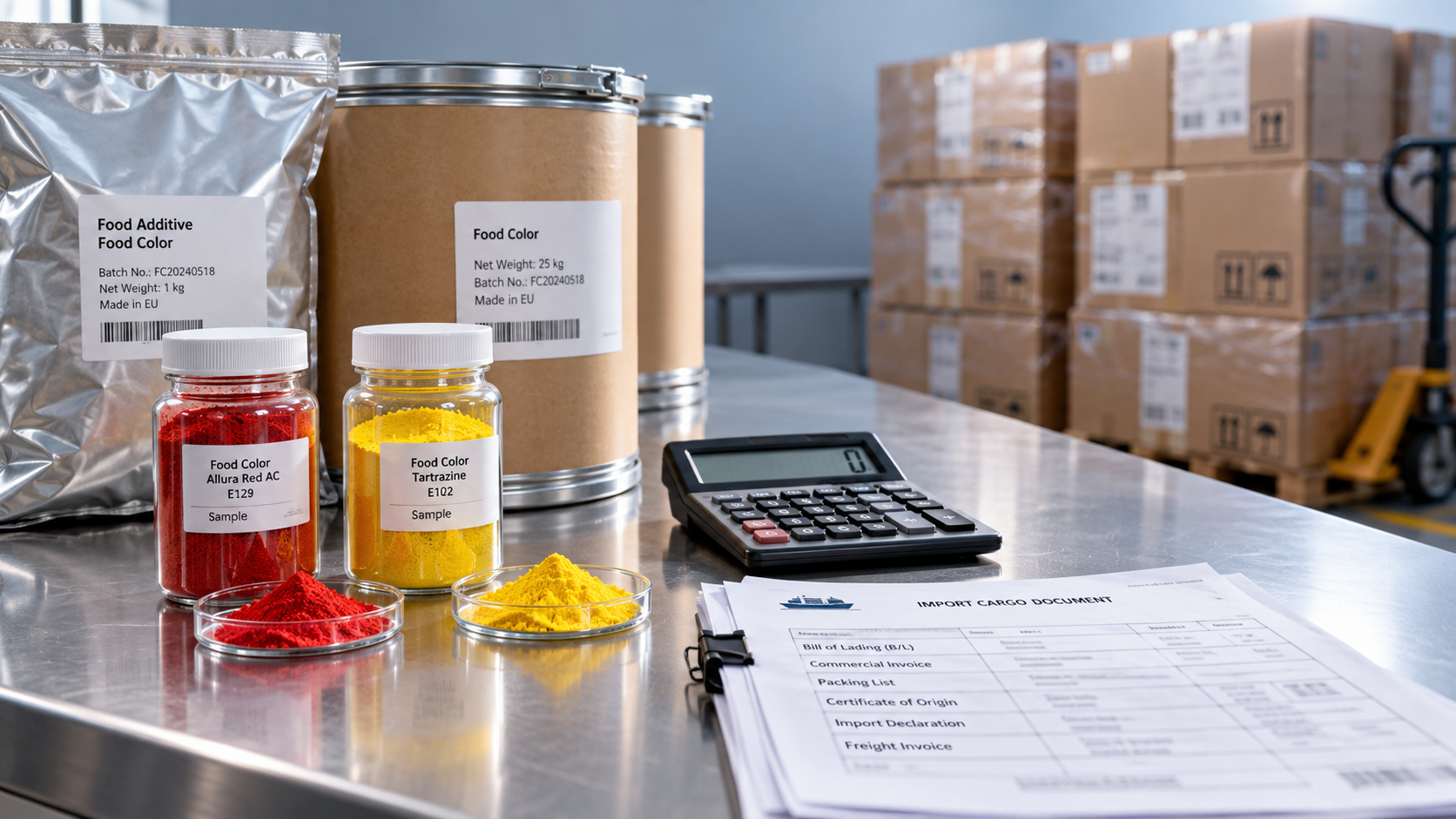
Imported food colorants cost the supplier’s price plus every additional expense required to bring usable material to the receiving warehouse. Freight and duty are only part of that calculation. Insurance, customs clearance, terminal charges, inland transport, and nonrecoverable taxes also affect the final cost per kilogram. Recoverable import taxes require a separate cash-flow calculation because the amount paid at clearance can exceed the amount ultimately recognized as inventory cost.
There is no reliable universal percentage to add to a quotation. The result depends on the shipment size, delivery terms, customs classification, origin, destination, and product specification. A useful calculation produces two figures: landed inventory cost per usable kilogram and cash required to complete the import.
Build the calculation around a defined delivery point
Set the endpoint before collecting quotations. “Landed” might mean arrival at the destination port, customs release, or delivery to a warehouse. Those endpoints leave different expenses outstanding. For a purchasing comparison, delivery to the same receiving location provides a consistent basis.
The core calculation is:
Landed inventory cost = net goods value + transport and insurance not already included + customs duty + clearance and handling + inland delivery + directly attributable preparation costs + nonrecoverable taxes.
Landed cost per kilogram = landed inventory cost ÷ usable net kilograms received.
Use the invoice amount after applicable discounts, then identify which services that amount already includes. Adding an estimated ocean freight charge to a quotation that already includes ocean freight overstates the cost. Omitting destination terminal charges because a quotation says “freight included” creates the opposite error.
The denominator also needs a clear definition. Net product weight excludes drums, bags, pallets, and other packaging. If part of the shipment cannot be released for its intended use, show the effect on usable quantity separately from the supplier’s invoiced weight. Accounting treatment of abnormal losses should follow the applicable policy rather than automatically loading every loss into inventory.
Separate included charges from outstanding charges
Incoterms identify important delivery obligations, cost responsibilities, and risk-transfer points, but they do not provide a complete landed-cost statement. Record the named place and version with the term. An abbreviation without a location leaves too much room for inconsistent assumptions.
A destination agent’s estimate is especially useful for less-than-container-load shipments. A low main-carriage rate can coexist with substantial deconsolidation, documentation, handling, and minimum charges. Compare the complete route to the warehouse, including the shipment’s actual packaging and dimensions.
Determine duty from the actual formulation
A commercial description such as “food color” is insufficient for a dependable tariff calculation. Classification can differ between synthetic coloring matter, natural extracts, pigments, and preparations containing carriers or other ingredients. Powder and liquid products with similar names can also differ in composition and customs treatment.
Collect the composition, physical form, manufacturing description where relevant, intended use, and supporting technical documents before assigning the destination tariff code. A CAS number can help identify a substance, but it does not by itself establish the classification of a formulated product. The supplier’s export code is a starting reference; the importing jurisdiction’s tariff schedule determines the declaration.
Keep adjacent chemical purchases separate. A solvent such as 1,3-Butanediol CAS#107-88-0 requires its own classification and specification review. Its identity does not establish suitability for a food application, and a duty assumption used for that material should not be transferred to a food colorant.
Duty also depends on customs origin, which is not necessarily the country of dispatch. Preferential treatment requires the applicable origin conditions and supporting evidence. Where eligibility remains unresolved, retain a standard-duty calculation and show any preferential saving as a separate scenario.
For an ad valorem tariff, duty = customs value × applicable duty rate. If the tariff uses a specific charge per unit, a compound rate, or additional duties, calculate those components using the applicable rules instead.
Customs value is not always identical to the supplier’s invoice. Freight, insurance, assists, royalties, or other adjustments can enter the valuation under destination rules. Establish that basis before applying the rate; otherwise, an apparently correct tariff percentage still produces an incorrect duty amount.
Keep inventory cost and import cash separate
Recoverable import VAT or a comparable tax generally belongs in the cash requirement rather than the permanent product-cost comparison. Recovery depends on registration, entitlement, documentation, and the actual import arrangement. A tax described as recoverable in a quotation should not be removed from cost until that treatment is supported.
The import-tax base also requires attention. Some systems calculate tax on customs value plus duty and specified incidental expenses. Applying the tax rate only to the goods invoice can therefore understate the clearance payment.
A symbolic worksheet makes the distinction clear without assuming a market price or destination tax rate:
Using these definitions, landed inventory cost per kilogram = (G + F + D + H + N) ÷ Q. Total funding across the purchase and import process also includes R, subject to payment timing. A supplier deposit already paid belongs in the total purchase funding record but should not appear again as an outstanding clearance payment.
Record exchange-rate assumptions explicitly. The rate used to pay the supplier, the customs conversion rate, and the accounting recognition rate can differ. Bank charges and hedging costs also affect the commercial comparison, although their accounting classification may sit outside inventory.
Compare colorants on usable coloring performance
Cost per delivered kilogram supports logistics comparison, but it does not establish which colorant is cheaper in production. Concentration, standardized color strength, carrier content, and the dosage required in the finished application can change the ranking.
A diluted liquid preparation includes water or another carrier in its shipped weight. A concentrated powder may reduce freight per unit of coloring performance while introducing different dispersion, dust-control, or handling requirements. Neither form is automatically the lower-cost option.
Where technical trials establish equivalent results, use:
Colorant cost per unit of finished product = landed cost per kilogram × validated dosage per unit of finished product.
Compare dosage at the same required shade and under the relevant processing conditions. Heat, acidity, light exposure, and the food matrix can affect performance. A color-strength specification measured under one laboratory method is not automatically interchangeable with a value measured under another.
Release requirements belong in the budget when they create attributable expenses. These can include identity or composition testing, contaminant analysis, sampling, and document preparation required for the destination and application. Routine batch-release costs should be distinguished from one-time supplier qualification expenses, so the first shipment does not become a misleading benchmark for every repeat order.
Allocate shared expenses according to what drives them
Mixed shipments need more than one allocation rule. Duty should follow each product line’s classification, customs value, and origin treatment. Freight can follow chargeable weight or volume, while a separately billed laboratory test belongs with the material tested.
Allocating all freight by invoice value can distort the result when an expensive, compact colorant shares a shipment with bulky, lower-value material. Conversely, dividing a shipment-level brokerage minimum entirely by weight can obscure the cost of handling multiple declaration lines. Use a reasonable basis for each charge and retain it consistently across comparable quotations.
Small orders deserve particular attention because minimum fees are spread across fewer kilograms. A larger shipment can reduce those unit charges, but the saving must be assessed alongside consumption, remaining shelf life, storage conditions, and inventory funding. Material that expires before use cannot deliver the expected purchasing saving.
Make uncertainty visible before approving the order
A single precise total can conceal unresolved assumptions. Keep a base estimate supported by current quotations, then show the incremental effect of specific uncertainties: a different duty treatment, a freight surcharge, an exchange-rate movement, or extra storage after free time expires.
Model each change through the calculation. Higher freight can affect both transport expense and a freight-inclusive customs value. A duty increase can also change the import-tax payment where duty forms part of the tax base. Storage delays introduce separate handling and funding effects; they should not disappear inside a generic freight allowance.
Attach a quotation date, currency, validity period, and documentary source to each material assumption. Mark unresolved destination charges explicitly instead of entering zero. The comparison is ready for approval when competing offers share the same specification, delivery endpoint, tax treatment, and usable-quantity basis.
After receipt, replace estimates with actual invoices and released quantities. Record whether each variance came from freight, classification, exchange rates, delays, or quantity differences. That reconciliation gives the next order a more reliable starting point and exposes charges that a favorable supplier price had concealed.
Send Us Your Inquiry Today
