









Product Quick Navigation
Get a Quote
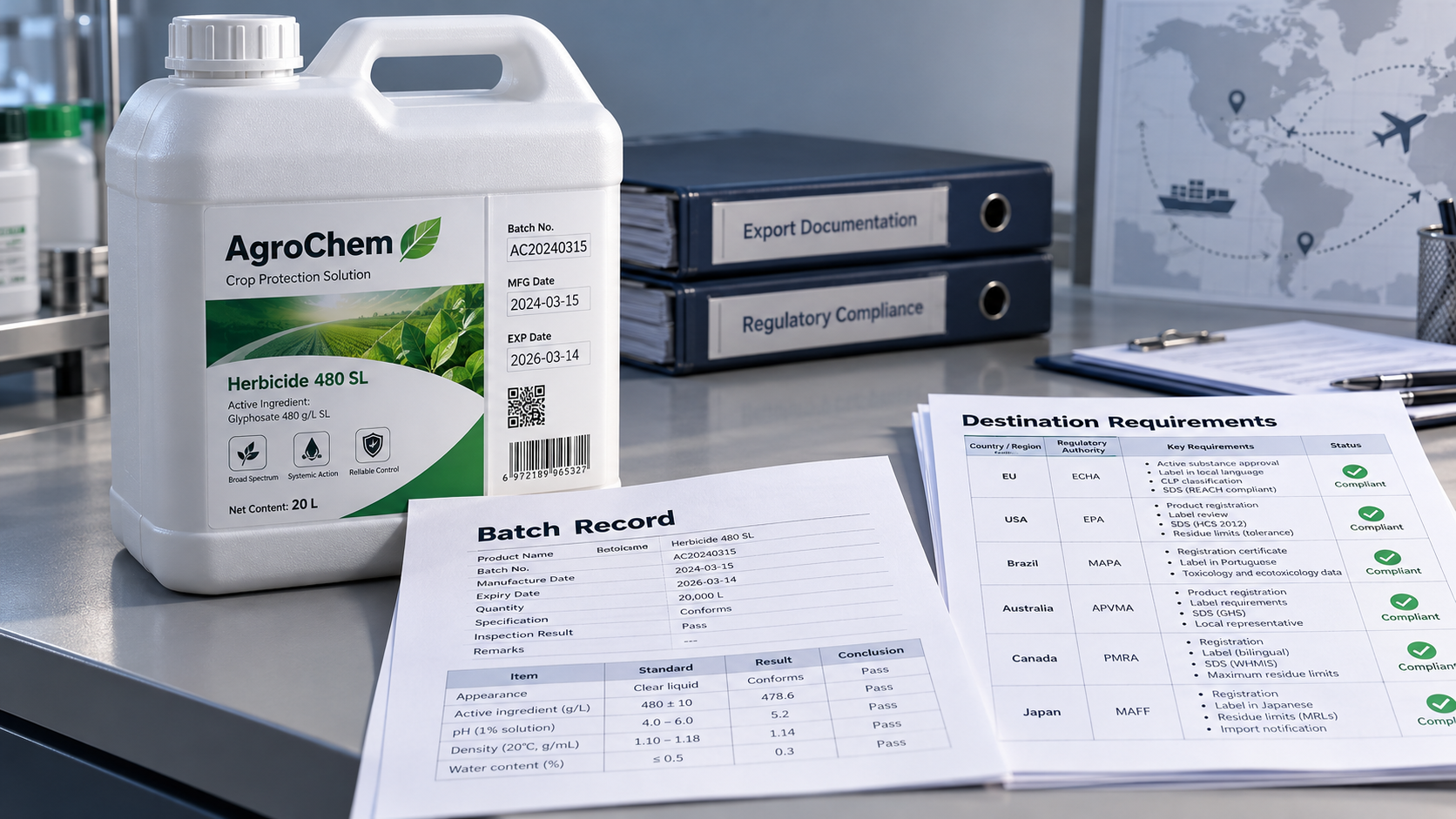
Does agrochemical registration in one country permit export elsewhere?
No. Registration in one country does not automatically authorize an agrochemical’s import, sale, or use in another. It may support an overseas application, but it is not a universal sales permit. The exporting country’s rules and the destination market’s requirements must both be satisfied.
For distributors and agents, the distinction matters before a purchase order is signed. A registered agrochemical export may still need destination-market product authorization, an eligible importer, approved labeling, and shipment-specific documentation. Missing one requirement can leave otherwise compliant goods waiting at customs—or prevent their lawful sale after clearance.
The cross-border chemical trade served by Shandong Huafeng Chemical Co., Ltd. illustrates why supply coordination and regulatory verification belong together. Based in Shandong Province, Huafeng Chemical provides chemical export services across a broad product portfolio. For this type of business, dependable delivery requires more than available stock: the product, paperwork, and intended market must match.
Registration, export permission, and market access are separate questions
The word “registered” often hides several different meanings. A supplier may mean that a substance has an identification number, that its manufacturing business is licensed, or that a specific pesticide formulation has domestic approval. Those statements are not interchangeable.
For pesticides, registration generally concerns a defined product and its authorized conditions of use. Depending on the jurisdiction, the approval may identify the registration holder, formulation, active ingredient concentration, manufacturing source, crops, target pests, application rates, and restrictions. It does not necessarily cover every product containing the same active ingredient.
Three separate checks therefore matter:
- Export legality: May this product leave the country of origin, and what licenses, notifications, or restrictions apply?
- Import eligibility: May this exact shipment enter the destination under the proposed importer and declared purpose?
- Commercial authorization: May the product be distributed, advertised, and used there under the proposed label?
An export declaration does not establish domestic sales rights abroad. Equally, a destination registration does not remove export controls in the supplying country. Even customs release should not be treated as proof that every downstream sale or use is authorized.
What foreign approval can—and cannot—do
An existing registration can be useful evidence. A destination authority may consider foreign assessment reports, toxicology studies, environmental data, residue studies, or evidence of approved use. Some markets provide reliance, equivalence, or regional recognition procedures. These can reduce duplication, but only where the applicable rules permit them.
Recognition is a defined regulatory route, not a commercial assumption. Eligibility may depend on the product, country, agricultural conditions, data access, or the authority that issued the original approval. A supplier’s claim that “other countries accept this certificate” is not enough without identifying the applicable procedure.
The European Union provides a useful distinction. Under Regulation (EC) No 1107/2009, approval of an active substance at EU level is separate from authorization of a plant protection product in a Member State. Zonal assessment and mutual recognition mechanisms exist, but they operate under specified conditions. Active-substance approval alone does not authorize every formulation throughout the EU.
In the United States, pesticide products generally require registration under the Federal Insecticide, Fungicide, and Rodenticide Act unless an exemption applies. State registration requirements may also apply. Approval in another country does not replace those requirements. For an actual transaction, verify the current rules with the relevant regulator rather than relying on a general market summary.
Match the registration to what will actually ship
The practical risk is often not a missing certificate, but a certificate that covers something slightly different. Start with product identity, then work outward to the supplier, label, and intended use.
A matching CAS number helps identify an active substance, but it does not demonstrate equivalence between finished formulations. Concentration, formulation type, relevant impurities, co-formulants, and manufacturing source may affect whether the proposed supply falls within an existing authorization. A technical material and a ready-to-use product should not be treated as the same regulatory item.
Check the registration holder’s rights as well. A local distributor may hold an authorization tied to an approved source, while another distributor cannot simply use that registration number. Depending on local rules, supplier authorization, data access, source approval, or a separate registration may be necessary.
Then compare the proposed commercial use with the approved label. Authorization for one crop and pest does not automatically extend to another. Application method, dose, pre-harvest interval, protective measures, pack presentation, and label language may all require verification. A manufacturer’s standard export label is not necessarily acceptable locally.
Where source approval applies, replacing the manufacturer after registration can create a compliance problem even if the quoted assay remains unchanged. Resolve this before accepting a substitute batch or allowing procurement to switch factories.
A chemical identity record is not a use authorization
This distinction also matters across broader chemical portfolios. For example, Gentamicin sulfate CAS#1405-41-0 is an antibiotic material, not something buyers should classify as an authorized agrochemical merely because it has a CAS number or appears in an EPA substance registry. Its proposed use and destination determine which regulatory framework needs examination.
Product information describes a water-soluble powder and lists storage at 2–8°C. Those details can inform specification and logistics discussions, subject to confirmation against current supplier documents. They do not establish pharmaceutical approval, pesticide registration, or permission for a particular application. Substance identity, quality, storage, and market authorization answer different questions.
Build the shipment file around evidence, not document volume
A thick documentation pack can still miss the decisive point. Each document should answer a specific question, and the identifying details should agree across the file.
- Authorization evidence: Check the destination registration or other lawful pathway, its validity, scope, holder, and restrictions. Verify against an official database where available.
- Product specification and batch certificate: Confirm active ingredient content, applicable impurity limits, test methods, and other registered or contractual quality criteria. A certificate of analysis demonstrates reported batch results, not market approval.
- Safety data sheet and label: Review current hazard information, required language, emergency details, approved claims, and consistency with the actual formulation.
- Import and commercial records: Confirm importer eligibility, permits where required, invoice descriptions, origin information, quantities, and customs classification.
- Transport documents: Determine whether dangerous goods requirements apply to the actual formulation and transport mode, including packaging, marking, and declarations.
An HS code supports customs classification; it does not prove pesticide approval. Likewise, an SDS is not a substitute for a registration decision. If documents use different product names, concentrations, manufacturers, or registration numbers, reconcile the discrepancy before loading rather than asking customs to interpret it.
Certain hazardous pesticides may also fall within the Rotterdam Convention’s Prior Informed Consent procedure or other national controls. Check the substance and the parties’ applicable obligations. Do not assume the same international procedure applies to all agrochemicals.
Samples, bulk supply, and re-export need their own checks
A small sample is not automatically exempt from pesticide controls. Research, laboratory analysis, and field trials may have distinct permit routes, quantity limits, or restrictions. Commercial distribution must not be presented as research simply to avoid registration.
Bulk technical material supplied to a local formulator can follow a different route from a finished retail product. However, the buyer may still need manufacturing permissions, source acceptance, and authorization for the resulting formulation. Local processing does not automatically remove regulatory obligations.
Transit through a trading hub also does not create sales rights. Bonded storage, repacking, relabeling, and re-export may each be subject to separate controls. The final destination’s requirements remain relevant even when the invoice comes from an intermediary elsewhere.
Put regulatory readiness into the delivery plan
For a registered agrochemical export, lead time should include more than production and vessel availability. Registration amendments, source approval, importer permits, and label review can become the critical path. Goods produced before those questions are resolved may consume shelf life while waiting for a lawful route to market.
An export service provider such as Huafeng Chemical can support coordination between product supply, commercial documentation, and shipping arrangements. The useful measure is whether the supplier can provide consistent identity and batch records, clarify manufacturing sources, and respond when destination requirements expose a gap. Export coordination does not replace the local authorization holder’s responsibilities or a regulator’s decision.
Contracts should identify who verifies registration, obtains permits, approves artwork, and releases goods for dispatch. They should also address changes in source or specification, permit refusal, document corrections, and responsibility for storage or return costs. Incoterms allocate defined delivery obligations, costs, and risks; they do not themselves grant regulatory permission.
Before committing to an overseas order, obtain a clear answer to one specific question: can this product, from this source, enter this destination and be sold for this intended use? Support that answer with current authorization evidence and shipment-ready documents. A registration somewhere else is a starting point for that review—not its conclusion.
Send Us Your Inquiry Today
