









Product Quick Navigation
Get a Quote
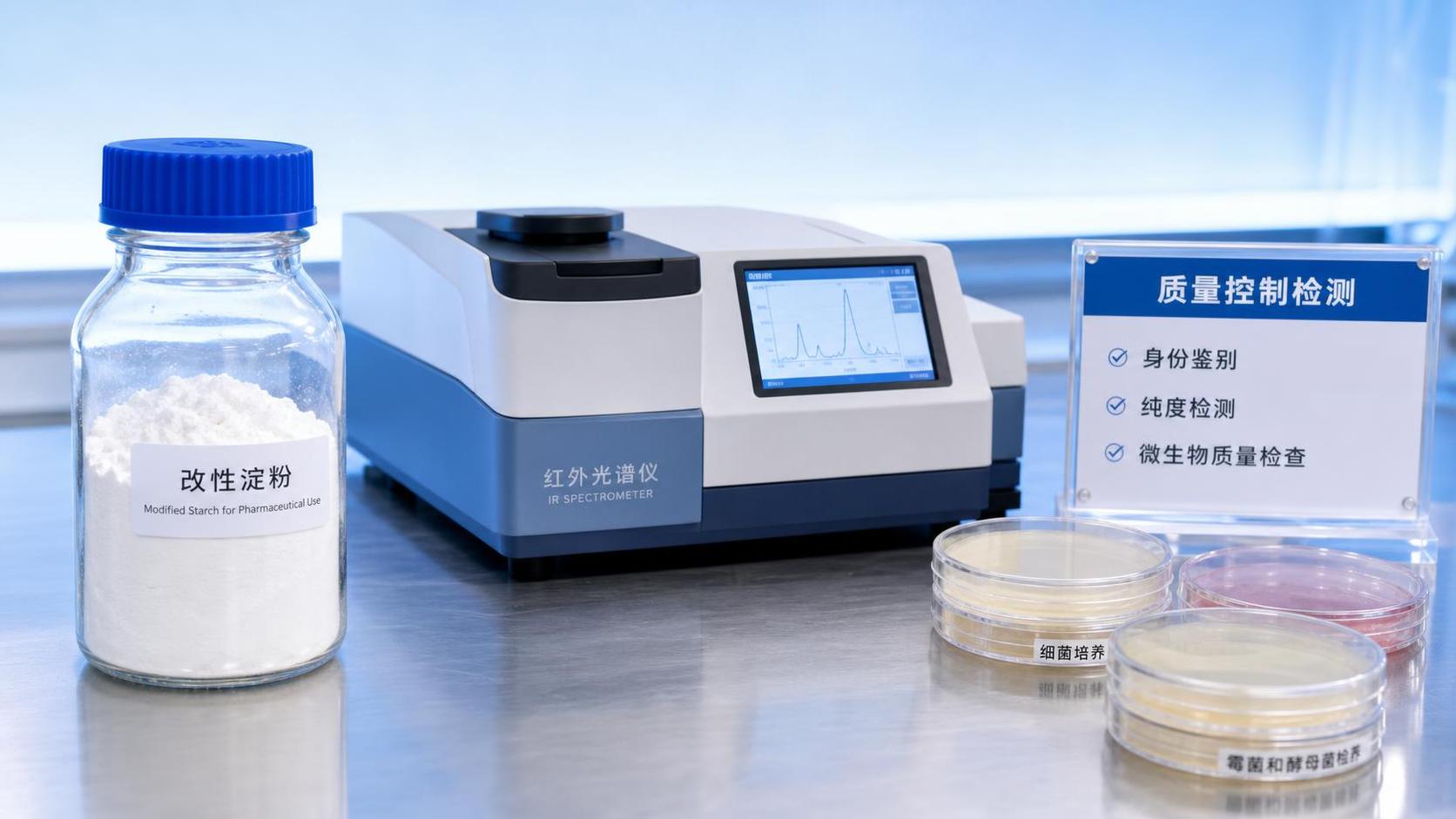
Pharmaceutical Grade Modified Starch must meet rigorous quality, safety, and consistency requirements before approval as an excipient in finished drug products.
For quality control and safety professionals, the essential question is whether each batch consistently supports product performance without introducing regulatory, toxicological, or microbiological risk.
What Excipient Approval Must Demonstrate
Excipient approval is not simply confirmation that a material meets a supplier certificate. It is documented evidence that the material is suitable for its intended pharmaceutical function.
Modified starch may act as a binder, disintegrant, filler, coating aid, stabilizer, or processing support. Each use creates different critical quality attributes and performance expectations.
Quality teams should begin by defining the dosage form, route of administration, maximum daily exposure, formulation function, and potential interaction with active pharmaceutical ingredients.
A starch used in an immediate-release tablet requires strong disintegration control, while a starch supporting suspension stability may require tighter viscosity and particle-size specifications.
The approval decision should connect raw-material testing with patient safety, manufacturing robustness, and finished-product performance. A technically acceptable material can still be unsuitable for a specific formulation.
Regulatory expectations generally require traceability, appropriate pharmacopeial compliance, change control, risk assessment, and evidence that supplier operations consistently control critical material attributes.
For Pharmaceutical Grade Modified Starch, the highest risks commonly involve substitution consistency, microbial contamination, foreign matter, residual processing chemicals, and variable functional performance.
A practical approval package therefore combines identity testing, chemical purity evaluation, microbiological controls, functionality studies, supplier qualification, and ongoing batch trend monitoring.
Identity Testing: Confirm the Material Before Testing Its Quality
Identity confirmation is the first control because test results are meaningless if the received material is not the approved modified starch grade.
Incoming material should be checked against the approved specification, including product name, grade, manufacturer, manufacturing site, lot number, packaging description, and certificate details.
Infrared spectroscopy is commonly used to compare an incoming sample with an approved reference spectrum. It can help identify starch structure and significant chemical modification.
Microscopy may provide additional confirmation by examining granule shape, particle morphology, and visible evidence of foreign botanical material or unusual processing residues.
Iodine staining, solubility behavior, swelling characteristics, or viscosity response may also support identification where those properties distinguish the selected modified starch grade.
Identity methods should be specific enough to distinguish the approved material from native starch, other modified starches, and visually similar carbohydrate-based excipients.
Quality units should not rely exclusively on supplier labels. A controlled sampling and testing plan protects against mislabeling, substitution, transport errors, and unauthorized supplier changes.
When multiple approved suppliers exist, laboratories should maintain clear reference profiles and acceptance criteria for each source, particularly where processing chemistry differs between manufacturers.
Purity and Chemical Safety Tests
Purity testing establishes whether Pharmaceutical Grade Modified Starch contains unacceptable levels of processing residues, contaminants, or chemical components that may affect patient safety.
Moisture content or loss on drying is usually a critical test. Excess moisture can promote microbial growth, alter powder flow, and reduce storage stability.
Ash content can indicate inorganic residue or contamination. Depending on the grade, total ash, sulfated ash, or specific elemental impurity limits may be appropriate.
pH testing helps verify consistency and may reveal residual acids, alkalis, or degradation products. The method should define sample concentration, water quality, mixing time, and temperature.
Where chemical modification uses reagents or catalysts, the specification should evaluate relevant residual substances. Testing should be based on process knowledge and toxicological risk.
Residual solvents require particular attention when organic solvents are used during manufacture, purification, or downstream processing. Suitable analytical methods should follow recognized regulatory expectations.
Elemental impurity assessment should consider raw-material origin, processing equipment, catalysts, water systems, and packaging. Risk-based justification is essential even when routine testing is unnecessary.
Pesticide residues, mycotoxins, and environmental contaminants may require evaluation when botanical feedstock sourcing creates a credible risk. Supplier controls alone may not always be sufficient.
Microbiological Quality and Hygiene Controls
Modified starch is often derived from agricultural raw materials, making microbiological control a central approval requirement rather than a routine administrative check.
Total aerobic microbial count and total yeast and mold count should be tested using validated methods and limits appropriate for the intended pharmaceutical application.
Specified microorganism testing should address relevant pathogens, commonly including Escherichia coli, Salmonella species, Staphylococcus aureus, and bile-tolerant gram-negative bacteria when justified.
Acceptance limits should be linked to route of administration, dosage form, patient population, and downstream processing. Oral solid dosage forms may differ substantially from sterile-product applications.
Microbiological testing is only one part of control. Supplier hygiene, warehouse conditions, pest management, moisture protection, personnel practices, and sanitation programs also require assessment.
Sampling plans must reflect material heterogeneity. Testing a single small sample may miss localized contamination, particularly after damaged packaging, water exposure, or prolonged storage.
Quality teams should investigate recurring high counts even when individual results remain within specification. Trending can reveal deteriorating raw material, seasonal variation, or warehouse weaknesses.
Any microbial excursion should trigger evaluation of material disposition, manufacturing impact, cleaning implications, retained samples, distribution history, and corrective actions at the supplier site.
Functional Testing Matters as Much as Compliance Testing
A pharmacopeial-compliant starch can still fail in production if its functional behavior changes. Performance testing should therefore be part of excipient approval.
For tablet applications, useful tests may include particle-size distribution, bulk density, tapped density, flowability, compressibility, moisture sorption, and tablet disintegration performance.
For binder applications, quality teams may evaluate granulation behavior, binding strength, drying response, tablet hardness, friability, and dissolution impact at representative use levels.
For disintegrant applications, the key concern is rapid and repeatable tablet breakup. Swelling capacity, water uptake, and disintegration time can be highly informative.
Viscosity is often critical for starches used in liquids, suspensions, or coatings. The test method must tightly control concentration, shear rate, temperature, and hydration time.
Particle morphology and particle-size distribution can influence blending uniformity, segregation risk, dust generation, and content uniformity, especially in low-dose formulations.
Compatibility studies should examine the active ingredient and other excipients under realistic stress conditions. Look for degradation, color change, odor formation, altered dissolution, or moisture-mediated instability.
Establishing performance ranges from several acceptable batches is more reliable than approving a material based only on one successful laboratory trial or pilot batch.
Supplier Qualification and Supply Chain Risk
Excipient approval depends on the supplier's ability to repeat compliant manufacturing, not merely on the quality of one delivered batch.
A supplier assessment should review quality systems, manufacturing controls, traceability, deviation management, complaint handling, data integrity, laboratory capabilities, and change-notification procedures.
Audit depth should reflect material risk. Higher scrutiny is justified where the starch has direct product-performance impact, limited purification, complex modification chemistry, or limited alternative sources.
Supply chain mapping should identify the original starch source, modification site, testing laboratory, storage facilities, repackers, distributors, and transport conditions before receipt.
Quality agreements should clearly define specifications, testing responsibilities, certificate requirements, notification timelines, retention sample practices, and handling of out-of-specification investigations.
Safety professionals should also assess adjacent chemical operations at supplier or logistics sites. Segregation from corrosive, toxic, or odor-generating chemicals reduces cross-contamination risk.
For example, facilities handling Hexafluorosilicic acid CAS#16961-83-4 should maintain robust segregation, spill control, labeling, and transport procedures when pharmaceutical materials share logistics infrastructure.
This does not imply such industrial chemicals are associated with excipient production. It demonstrates why site-level chemical segregation and transport controls belong in supplier risk assessments.
How to Build a Defensible Batch Release Program
A strong batch release program starts with a written specification that separates identity, compendial requirements, safety limits, and application-specific functional attributes.
Each test method should identify the analytical procedure, sampling approach, acceptance criteria, reference standard, validation status, and actions required when results are atypical.
Incoming testing may be reduced only after a justified supplier qualification program demonstrates reliable performance. Reduced testing should never become undocumented reliance on certificates.
Certificates of analysis should be reviewed for completeness, consistency, authorized approval, correct lot identification, analytical dates, methods, and alignment with approved specification limits.
Retained samples should be stored under controlled conditions for investigation purposes. Their retention period should support shelf-life review, complaint investigations, and finished-product deviation assessments.
Trend charts are especially valuable for moisture, viscosity, microbial counts, particle size, ash, and disintegration performance. Statistical shifts can precede formal specification failures.
Out-of-trend results deserve investigation even when they pass specifications. A gradual movement may indicate changes in botanical source, process conditions, equipment wear, or analytical variation.
Batch release decisions should be documented by trained quality personnel who understand both laboratory compliance and the material's role in finished-product manufacturing performance.
Change Control and Requalification Protect Long-Term Consistency
Pharmaceutical Grade Modified Starch should be subject to formal change control because apparently minor supplier changes can affect product quality and regulatory commitments.
Changes requiring assessment may include raw-material source, chemical modification process, manufacturing location, equipment, packaging, sterilization approach, test method, and specification range.
Before approving a change, assess whether bridging studies are needed. These may include comparative functionality testing, compatibility testing, pilot manufacturing, stability studies, or dissolution comparison.
Supplier notifications must be timely enough to allow pharmaceutical manufacturers to evaluate impact before changed material enters the production supply chain.
Periodic requalification should confirm that the supplier remains capable. The frequency should reflect risk, performance history, regulatory status, complaint trends, and supply-chain complexity.
Requalification should include review of certificates, deviations, audit findings, quality metrics, analytical trends, regulatory changes, and whether product-use conditions have changed.
Cross-functional participation improves decisions. Quality control, quality assurance, regulatory affairs, procurement, manufacturing, and safety personnel often identify different material-related risks.
A disciplined requalification program prevents approval status from becoming a historical assumption. It keeps excipient control aligned with current manufacturing and patient-safety expectations.
Final Approval Decision: Use Evidence, Not Assumptions
Approval of modified starch should conclude only when identity, purity, microbiological quality, functional performance, supplier controls, and change-management commitments are adequately supported.
The most useful approval file explains why each test matters for the intended use, rather than collecting analytical data without connecting it to product risk.
For quality control professionals, the objective is confidence that every released batch is comparable to the material used during formulation development and process validation.
For safety managers, the objective is broader: prevent contamination, ensure proper storage and transport, verify chemical segregation, and maintain reliable response procedures for incidents.
When these controls work together, Pharmaceutical Grade Modified Starch becomes a controlled formulation component rather than an uncertain agricultural derivative with variable manufacturing behavior.
A risk-based, well-documented approval program gives organizations a clear basis for supplier selection, batch disposition, audit priorities, regulatory inspection readiness, and continued product-quality assurance.
Send Us Your Inquiry Today
