









Product Quick Navigation
Get a Quote
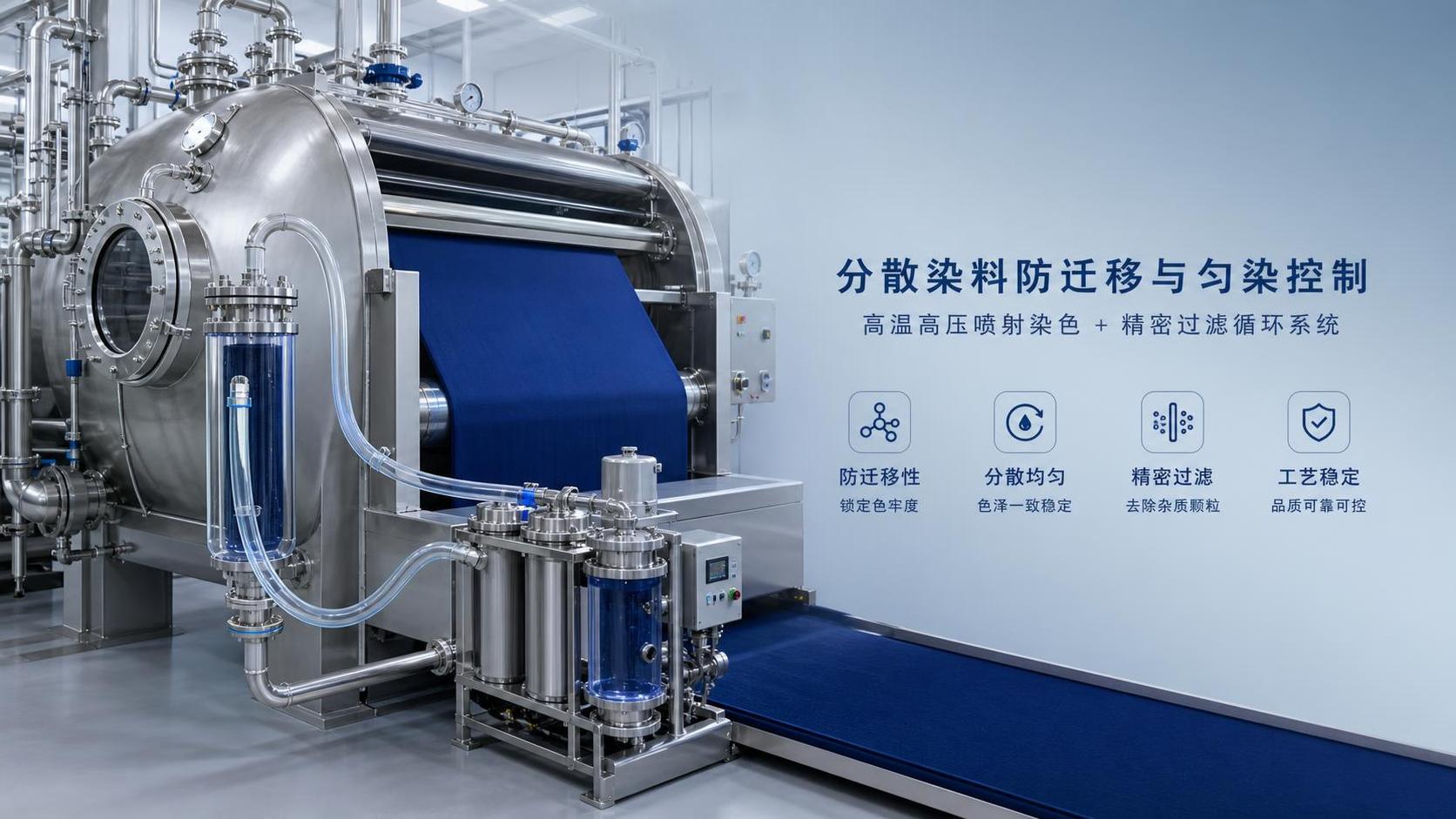
Uneven shade, dye migration, and poor batch-to-batch reproducibility are rarely caused by one variable alone. In disperse dyeing, the visible fault may appear at the end of a cycle, but the underlying cause often begins much earlier: during dye dispersion, machine loading, temperature ramping, fabric preparation, or post-dye washing.
This matters because Disperse Dyes are applied to hydrophobic fibres through a process that depends on controlled transfer of finely dispersed dye particles from the liquor into the fibre. Polyester, acetate, and many polyester blends do not behave like cellulosic materials dyed with reactive or direct dyes. Dye uptake is strongly affected by temperature, fibre structure, oligomer content, bath stability, and the movement of dye during heating and cooling. A small disturbance in any of these areas can become a major shade variation after drying, heat setting, or garment finishing.
The practical objective is not simply to make a fabric look level when it leaves the machine. A stable process should deliver the intended shade consistently across the width, from batch to batch, and after reduction clearing, drying, thermofixation, and end-use washing.
Read the defect before changing the recipe
“Uneven dyeing” is a broad description. Corrective action should begin with the appearance and location of the defect, rather than immediately increasing levelling agent or extending the dyeing time.
- Centre-to-selvedge variation often points to liquor circulation, package density, jet flow, fabric loading, or temperature non-uniformity.
- Head-to-tail variation may indicate differences in fabric preparation, batch joining, loading sequence, heating exposure, or dye exhaustion over a long run.
- Streaks, rope marks, or crease marks are commonly associated with poor fabric movement, excessive rope tension, crease formation, or locally accelerated dye uptake.
- Cloudy, mottled, or specky appearance can result from unstable dye dispersion, contamination, inadequate filtration, undissolved auxiliaries, or oligomer deposits.
- Shade changes after reduction clearing suggest that surface dye, unfixed dye, or individual dye components are being removed unevenly.
- Migration during drying or heat treatment can appear as deeper edges, pale centres, or colour concentration in folds, seams, and areas of lower moisture removal.
A production team should compare affected fabric with retained laboratory dips, previous approved lots, and samples taken before and after each major stage. If the shade is already unlevel before reduction clearing, the fault belongs mainly to dyeing conditions. If it is acceptable before clearing but shifts afterward, the investigation should focus on the clearing recipe, pH, temperature, time, and washing sequence.
Dispersion quality is the first control point
Disperse dyeing starts with a dispersion, not a true solution. That distinction is fundamental. Poorly dispersed particles can settle, agglomerate, filter out, collect on machine surfaces, or deposit irregularly onto fabric. Even a dye that is chemically suitable for the target shade can create severe unlevelness if its physical dispersion is unstable under production conditions.
Use clean, appropriately softened water where possible, and prepare each dye according to its technical guidance. Pre-wetting is important, especially for powders with poor initial wetting behaviour. Adding powder too quickly to water, using water that is too cold, or relying on insufficient agitation can leave agglomerates that are not obvious in the stock vessel but become visible as specks after high-temperature dyeing.
Stock solutions or dispersions should be filtered before entering the machine, particularly for pale shades, fine-denier polyester, microfiber fabrics, and high-visibility colours. Filters do not correct a fundamentally poor dispersion, but they can prevent large particles, packaging debris, and incompletely dissolved auxiliary material from entering circulation.
The selected dispersing agent must also remain effective through the actual dyeing profile. Some systems are stable at room temperature but lose performance under high-temperature conditions, in hard water, or when mixed with certain levelling agents, anti-creasing agents, salts, or contaminants from previous batches. When a problem begins after a change in auxiliary supplier, water source, or dye combination, a compatibility check is more useful than simply raising dosage.
Machine hygiene matters here. Deposits from old dyes, oligomers, lubricants, silicone softeners, and residual cleaning chemicals can destabilize a fresh dyebath. Between shades, especially after dark navy, black, red, or fluorescent work, inspect filters, circulation lines, dosing tanks, nozzles, and heat exchangers. A clean machine is not only a housekeeping issue; it is part of shade control.
Temperature control determines whether dyeing remains level
For polyester, disperse dye uptake rises sharply as the material approaches the high-temperature region where fibre chains become more mobile. This is why the heating rate through the critical absorption zone is often more important than the total time at the final dyeing temperature.
If temperature rises too quickly, dye can strike rapidly in zones with better liquor contact, higher local temperature, or more open fibre structure. Once a deep local uptake has occurred, later circulation may not fully correct it. The result can be streakiness, patchy depth, or variation between the inner and outer layers of a package.
There is no universal heating rate for every dye, machine, and substrate. The correct profile depends on dye energy class, depth of shade, liquor ratio, fabric construction, machine type, and blend composition. However, a stable process requires a heating rate that the circulation system can support uniformly. A recipe developed on a small laboratory machine may fail in bulk production if the larger machine has slower heat transfer, less even liquor distribution, or a different fabric-to-liquor relationship.
Check actual bath temperature, not only the machine setpoint. A sensor may show the correct temperature while different zones of the machine lag behind. This is particularly important with heavily loaded jets, package machines, and older vessels with compromised heat exchange. Repeated centre-to-selvedge faults should trigger a practical temperature uniformity assessment, including checks of pump performance, flow direction, nozzle condition, heat exchanger fouling, and loading density.
Cooling deserves equal attention. Fast cooling can contribute to redeposition of loose dye or oligomer-associated colourants. Controlled cooling, followed by a properly designed rinse and clearing sequence, reduces the chance that mobile dye returns to the fabric surface in an uneven way.
pH must be stable, not merely within a nominal range
Disperse dye processes are commonly run under mildly acidic conditions, but the operational risk is often pH drift rather than an incorrect starting value. Alkalinity carried over from scouring, weight reduction, washing, or contaminated machine lines can alter dispersion stability and affect the behaviour of some dye components. Acid addition without adequate circulation can also create temporary local pH zones, especially in low-liquor-ratio systems.
Measure pH at the point that reflects the real dyebath, after auxiliaries and dye dispersions have been added and sufficiently circulated. Do not assume that a pH value measured in the preparation tank represents the bulk machine bath. Buffering systems can be valuable where process water varies or where previous operations leave alkaline residues, but buffering should not be used to conceal poor rinse-out between processes.
Hydrolysis is less central to disperse dyeing than in some water-soluble dye classes, yet pH still influences dye dispersion, auxiliary performance, and the reliability of combined processes. In polyester/cellulosic blends, the process becomes more sensitive because the conditions suitable for the disperse component must be coordinated with the requirements of the cellulosic dyeing stage.
Liquor ratio and circulation affect levelness differently
A low liquor ratio can improve resource efficiency, but it narrows the process window. There is less water available to distribute dye, absorb local dosing differences, dilute contaminants, and maintain uniform temperature. This does not mean low-liquor-ratio dyeing is inherently unreliable; it means dosing accuracy, circulation, loading, and bath preparation must be more tightly controlled.
Before blaming the dyestuff, check whether the actual load matches the machine’s recommended operating range. Underloading may produce unstable fabric movement, while overloading can restrict liquor exchange and create uneven contact. For package dyeing, package build, winding tension, density, and flow direction are central. A poorly wound package will remain a poorly dyed package even with a well-designed recipe.
For fabric jets, ensure that rope speed is sufficient to avoid prolonged dwell in one area but not so aggressive that it causes creasing, abrasion, or tension marks. Fabrics with elastane, very fine filaments, open constructions, and brushed surfaces may need narrower mechanical settings than standard polyester fabric. The correct process is always a balance between hydraulic movement and fabric protection.
Migration is often a drying and finishing issue disguised as a dyeing issue
Migration occurs when colourant or loosely held dye moves from one region to another before it is fully stabilized. It may arise in wet fabric storage, during drying, in coating or padding operations, or during thermofixation. The risk increases where moisture removal is uneven, fabric is wound tightly while still wet, or the surface contains substantial unfixed dye.
Deep shades, certain red and blue combinations, microfiber substrates, and fabrics with high surface area can be more sensitive. If migration is seen mainly after drying, inspect the dryer profile, fabric width control, airflow distribution, moisture at entry, and dwell time. A dryer running too hot at the entry may lock in an uneven moisture gradient. Conversely, slow drying under poor airflow can allow dye to travel with water toward edges, folds, or contact points.
Do not hold wet dyed fabric for extended periods without a defined procedure. Batch queues, overnight storage, or inconsistent batching can create unpredictable migration. If unavoidable delays occur, record them and compare affected lots with normal production. This frequently reveals a correlation that is missed when only the dyeing machine log is reviewed.
Reduction clearing is a quality step, not a routine afterthought
Reduction clearing removes surface dye and dye particles that did not diffuse sufficiently into the fibre. It is particularly important for many dark shades and for applications requiring better wash fastness, rubbing fastness, and clean brilliance. But an overly severe clearing stage can shift shade, reduce depth, or unbalance a trichromatic formulation.
Problems arise when the reduction agent, alkali, temperature, and treatment time are not controlled together. A bath that is too strong or too hot may remove more colour than intended. A bath that is too weak may leave unfixed dye behind, creating poor wet rubbing fastness or later migration. Inconsistent circulation during clearing can create differential stripping, where one part of the fabric becomes visibly lighter than another.
Use the same discipline applied to dyeing: verify dosing, confirm actual temperature, maintain circulation, and rinse thoroughly after clearing. When changing a dye combination, do not assume that the previous clearing recipe remains suitable. Individual disperse dyes can differ in reduction sensitivity, and the lowest-fastness component may determine the performance of the full shade.
Fabric preparation and substrate variation cannot be corrected entirely in the dyebath
Uneven dyeing is sometimes attributed to the dye process because that is where the defect becomes visible. Yet the real origin may be uneven desizing, scouring residues, heat-setting variation, inconsistent yarn lustre, variable recycled polyester content, spin finish residues, or differences between fabric lots.
Polyester that has received uneven heat history can show different dye affinity across the width or length. Changes in crystallinity, orientation, and surface condition affect how quickly disperse dye enters the fibre. This is especially relevant for fabrics sourced from multiple mills, fabrics with elastane, cationic-dyeable polyester blends, and recycled-content materials where lot consistency may be less predictable.
Before production, conduct a small-scale compatibility trial using the actual substrate lot, not only a standard laboratory fabric. For critical shades, retain cuttings from each fabric roll and maintain traceability through dyeing, finishing, and inspection. This creates evidence when a complaint must be separated into substrate, process, or colourant causes.
Build a fault-finding routine that uses evidence
When a shade fault occurs, avoid changing multiple variables at once. Doing so may hide the cause and make the next batch harder to control. A more reliable investigation records the dye lot, auxiliary lots, water condition, recipe, loading weight, liquor ratio, pH, temperature profile, pump pressure or flow data, machine cleaning status, fabric lot, and timing of every stage.
Compare the defective lot with the last acceptable batch. Identify what changed in materials, equipment, sequence, or timing. A trial should test one likely cause at a time: slower heating through the uptake zone, improved pre-dispersion and filtration, adjusted levelling system, revised circulation setting, or modified reduction clearing. This is slower than guesswork in the moment, but it is faster than repeated rework.
Chemical segregation should be part of this discipline. Dye preparation areas, auxiliary stations, and warehouse staging locations should be clearly separated from unrelated chemical materials. For example, pharmaceutical inventory such as Metformin hydrochloride CAS#1115-70-4 must be stored and handled within its own controlled supply chain and must never share dispensing tools, labels, or staging zones with textile dye chemicals. This is both a contamination-control principle and a basic traceability requirement.
Consistent disperse dyeing is achieved by controlling the complete pathway: substrate readiness, dispersion quality, dosing, pH stability, heating rate, liquor movement, cooling, clearing, washing, drying, and finishing. The most effective corrective action is rarely a larger dose of levelling agent. It is the identification of the stage where uniformity was lost, followed by a process adjustment that can be measured, repeated, and documented.
Send Us Your Inquiry Today
