









Product Quick Navigation
Get a Quote
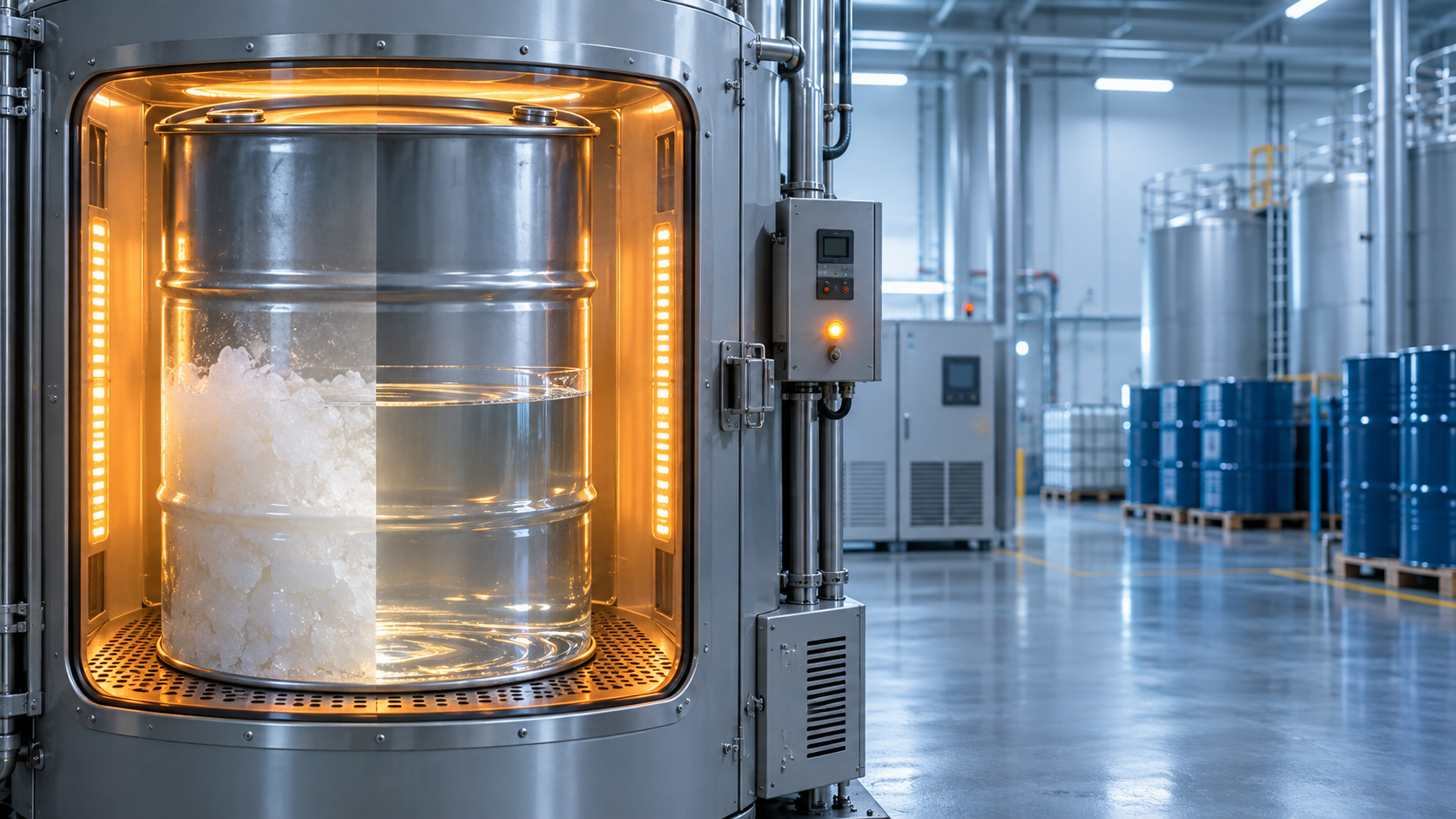
A pail or drum of epoxy resin that was clear at receiving can become cloudy, grainy, waxy, or partly solid after storage in a cool warehouse. That change can stop dispensing, distort mix-ratio calculations by volume, and raise concern that the resin has expired. In many cases, it has not degraded: it has crystallized. The safe way to restore crystallized epoxy resin is to warm the sealed container gradually and uniformly, then mix until the material is fully clear and homogeneous before allowing it to cool and inspecting it again.
Direct flame, an unregulated hot plate, or very high heat is not a shortcut. Local overheating may darken the resin, increase side reactions, deform packaging, or create an uneven material in which some crystals remain hidden. When people ask, “How do I handle epoxy resin crystallization during storage?”, the useful answer is controlled warming, careful agitation, and verification that the resin has returned to its normal appearance and processing condition.
Recognize crystallization before trying to fix it
Crystallization is a physical change in certain epoxy resins, especially bisphenol-A-based liquid grades. Molecules that were previously dispersed in a liquid arrangement form ordered solid structures. The process may begin with a few crystals at the bottom, around the drum wall, or near the closure, then spread through the container. Low storage temperature, extended storage, repeated cooling cycles, and residue on a container surface can encourage it.
A crystallized resin may look different depending on its degree of crystallization. It can appear as:
- fine white particles or a sparkling sediment;
- cloudiness or a milky haze in an otherwise liquid resin;
- soft wax-like masses attached to the wall or base of the container;
- a thick, paste-like material that no longer flows normally;
- a nearly solid mass that resists normal pumping or pouring.
These signs should be distinguished from contamination, gel formation, or phase separation. Crystals typically melt back to a uniform clear liquid with appropriate heat and mixing. A permanently gelled resin does not. Dark burnt areas, foreign particles, unusual odor, a swollen container, or material that stays hazy after complete warming may point to a different problem. Do not assume every thick or opaque resin is merely crystallized.
Start with the container, label, and safety information
Before applying heat, confirm that the material is the resin component, not the curing agent. Epoxy hardeners can have different temperature limits and may be more sensitive to heating, moisture, or oxidation. Check the product label, safety data documentation, technical data, batch identification, recommended storage conditions, and any supplier-specific warming instructions. The resin’s epoxy equivalent weight, viscosity range, color requirement, and maximum recommended heating temperature are especially relevant.
Keep the original container closed during the initial warming stage whenever practical. Opening a cold container in a humid area can introduce moisture through condensation. Water contamination may later cause foaming, reduced electrical properties, poor coating appearance, or defects in cured parts. A tightly sealed container also prevents dust, shop debris, and cleaning chemicals from entering while the resin is being handled.
Use suitable protective equipment for the product and task. Gloves, eye protection, protective clothing, and good ventilation are basic precautions. Even before curing, epoxy resin can irritate skin and repeated exposure can lead to sensitization. Heating does not make the handling risk disappear.
Use gentle, even heat rather than concentrated heat
The preferred method is warming in a temperature-controlled environment that heats the entire container as evenly as possible. A warm room, controlled cabinet, circulating-air oven designed for chemical containers, or a properly managed warming enclosure may be appropriate, provided the selected equipment is compatible with the package and site safety procedures. The goal is not to reach the highest possible temperature; it is to bring the resin above its crystallization melting range gradually without creating hot spots.
Exact temperatures and holding times depend on the resin formulation, package size, and degree of crystallization. Follow the material supplier’s stated limits when available. A small container with light haze may recover relatively quickly, while a large drum with a solid crystal mass may need a longer, lower-intensity warming cycle. Raising the surrounding temperature too aggressively can produce a warm outer layer and a cold crystalline core, making it appear that the resin has recovered when it has not.
Water-bath warming may be used in some controlled operations, but only where the container closure and label are protected and there is no realistic route for water to enter. The container should never be submerged in a way that compromises seals. For industrial packages, external heating blankets or drum heaters can be useful only when they provide distributed, adjustable heat and are operated within the resin and packaging limits. Heat the sidewall and base evenly; avoid a single narrow band of intense heat.
Methods to avoid
- Open flames or direct gas burners: these can overheat a small area, damage packaging, and introduce obvious fire and exposure hazards.
- Uncontrolled hot plates: the base of a container can become far hotter than the measured surrounding air.
- Microwave heating: it is unsuitable for most resin containers and may heat unevenly or damage the package.
- Steam injected into the resin: direct contact introduces moisture and can contaminate the product.
- Adding solvent to improve flow: solvent addition changes formulation properties and should not be used as a substitute for restoring crystallized resin.
A practical restoration sequence
The following process is appropriate as a general operating framework. It does not replace the instructions for a specific epoxy grade.
- Inspect without forcing the package. Check for leaks, container damage, bulging, label loss, or signs of contamination. Do not try to puncture, pry, or violently strike a solidified package to make it flow.
- Move the container to a clean controlled warming area. Keep it upright. If the resin is in a drum, make sure the drum is supported securely and can be rotated or agitated safely later.
- Apply gradual external heat. Set the warming system according to the product guidance. Allow enough time for heat to move through the whole mass, not only the exterior.
- Monitor the process. Check the surface and, where safe and permitted, the material temperature using an appropriate method. Do not rely only on the heater setpoint. A large package can have substantial internal temperature differences.
- Agitate once the resin is mobile. Gentle rolling, rotation, recirculation, or mechanical mixing can help dissolve remaining crystals into the liquid phase. Use clean, dry, compatible equipment. Avoid whipping air into the resin.
- Continue until uniform. The resin should have a consistent appearance from top to bottom, with no visible crystals, haze, wall deposits, or thick zones.
- Let the material equilibrate. After mixing, hold the container long enough for temperature and viscosity to become uniform. This is important before sampling, metering, or comparing the resin with specification values.
Do not use excessive mechanical force on a cold, partly solid resin. A mixer may create a channel through the material while leaving unmelted crystal clusters elsewhere. Pumping before full recovery can overload equipment, produce inconsistent flow, and deliver resin of non-uniform composition to the production line.
How to tell whether the resin is ready for use
Visual clarity is useful but not sufficient for every application. A fully restored resin should look uniform throughout the package and should behave consistently during transfer. For clear casting, electrical encapsulation, transparent coatings, or tightly controlled composites, more detailed checks may be needed before release.
Viscosity must be evaluated at a known temperature. Warm resin naturally has lower viscosity than resin at a cooler reference condition. Comparing a freshly warmed sample with a specification measured at another temperature can create a false impression that the material is out of range. Allow the sample to reach the prescribed test temperature before making a release decision.
What epoxy resin specifications matter for sample approval?
Crystallization recovery is often discovered during incoming inspection or sample approval. Approval should not be based only on whether the resin becomes pourable. The appropriate specifications depend on the end use, but purchasing and technical teams commonly review appearance, color, viscosity, epoxy equivalent weight, hydrolyzable chlorine where relevant, volatile content, and density. For formulated systems, compatibility with the selected hardener, diluent, pigment, filler, or reinforcement may be equally important.
Ask the supplier how the reported values are tested: method, test temperature, sample preparation, and acceptable tolerance all affect interpretation. A resin that looks clear after warming but has an epoxy equivalent weight or viscosity outside the agreed specification should not be accepted solely because crystallization has disappeared. Conversely, a product that meets its documented limits after correct restoration is not automatically unsuitable just because crystals formed during cold storage.
For a new material sample, it is sensible to keep a retained sample and record the condition on receipt, the warming procedure used, the final appearance, and the temperature at which testing was performed. This creates a usable comparison point if later deliveries experience the same storage conditions.
Why repeated crystallization can become an operational problem
One controlled restoration cycle may be manageable, but repeated crystallization and rewarming can disrupt production planning. It consumes time, makes transfer equipment less predictable, and increases the chance of contamination each time a container is opened or moved. Repeated heating beyond recommended conditions may also affect color or storage stability, even if the resin initially appears normal.
Prevent recurrence by maintaining storage temperatures within the supplier’s recommended range and avoiding cold corners near loading bays, exterior walls, or unheated floors. Insulate or relocate inventory that is exposed to seasonal temperature swings. Keep containers tightly closed, store them upright, and use stock rotation so packages do not remain dormant long enough to experience repeated cooling cycles. Before winter shipment or long-distance transport, confirm whether the route includes conditions likely to initiate crystallization and plan receiving capacity for controlled warming if needed.
When not to release the material
Set the resin aside for further review when it remains cloudy after sufficient controlled warming and mixing, contains insoluble particles, develops abnormal color or odor, shows evidence of leakage or water exposure, or does not meet the agreed technical specification at the correct test temperature. The same applies when the package was heated above its documented limit or when there is no reliable record of what happened during recovery.
A restored epoxy resin should be judged by more than its ability to flow. The safe outcome is a clean, uniform material that has been warmed within its handling limits, mixed without introducing contamination, and checked against the properties that matter to the intended formulation or process.
Send Us Your Inquiry Today
