









Product Quick Navigation
Get a Quote
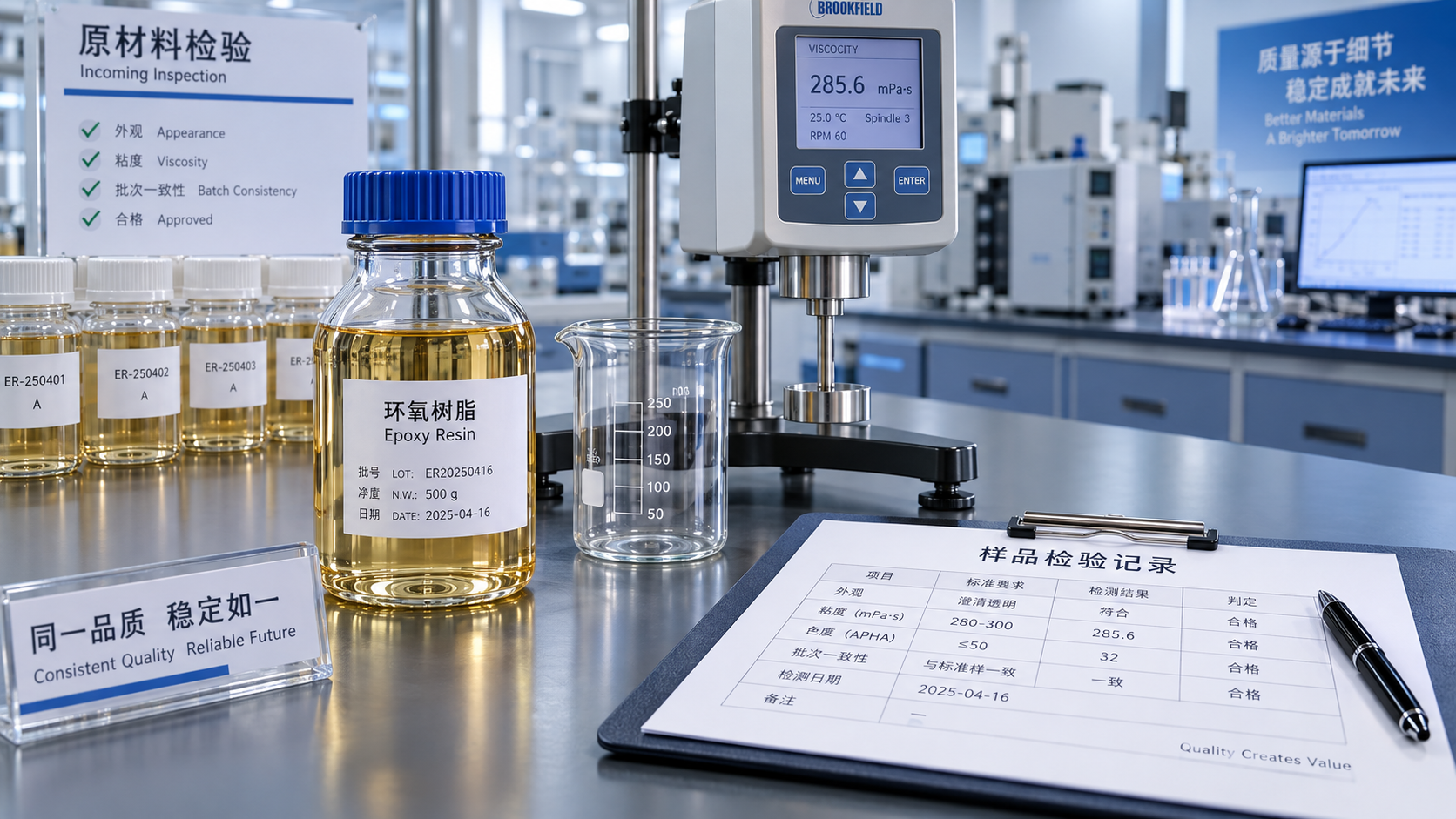
An epoxy resin sample should be accepted only when it demonstrates that the supplied material can be processed, cured, and documented in the same way as the production-grade resin the buyer intends to purchase. A clear liquid, a competitive quotation, or a certificate of analysis alone is not enough. The acceptance decision should connect the sample to the buyer's actual formulation, process window, compliance obligations, and future batch consistency.
For most industrial buyers, the practical question is not whether a sample can cure under ideal laboratory conditions. It is whether it will behave predictably after storage, mixing, metering, curing, and exposure to the conditions of its intended application. That distinction matters for coatings, adhesives, composites, electrical encapsulation, flooring systems, tooling, and many other epoxy uses where a small change in resin properties can affect viscosity, pot life, adhesion, heat resistance, or finished appearance.
Start with a written sample specification
Before evaluating a sample, define the acceptance limits that matter for the intended resin grade. Without this step, testing can become a subjective comparison of color, feel, and cure speed. A specification does not need to be overly long, but it should identify the properties that control the buyer's process and finished-product performance.
For a standard liquid bisphenol-A epoxy resin, viscosity, epoxy equivalent weight, color, hydrolyzable chlorine, volatile content, and appearance are commonly relevant. For solid resins, softening point, epoxy equivalent weight, particle form, and melt behavior may matter more. Modified, diluted, brominated, phenolic, flexible, waterborne, and specialty epoxy systems need criteria matched to their chemistry and intended use.
The sample request should also state the planned curing agent, accelerator, filler loading, solvent package, application method, target cure schedule, and end use where these factors affect evaluation. A resin that appears acceptable when cured with one amine hardener may perform differently with an anhydride, polyamide, mercaptan, phenalkamine, or latent curing system.
Confirm identity before judging performance
The first acceptance criterion is simple: confirm that the sample is the material described in the quotation, technical data sheet, safety documentation, and batch paperwork. Trade names are not enough. Suppliers may use similar product names for grades with different molecular weight ranges, diluents, or impurity controls.
The buyer should verify the resin type, grade designation, manufacturing batch number, production date, net weight, and stated shelf life. The technical data sheet should provide test methods or at least clearly identify the reported properties. The certificate of analysis should correspond to the physical sample rather than a generic specification sheet.
Appearance is part of this initial check, although it is rarely sufficient by itself. Liquid epoxy resin should be visually consistent with the agreed grade: free of obvious haze, sediment, foreign particles, phase separation, or unexpected crystallization. Solid resin should show the agreed physical form without excessive fines, contamination, or abnormal agglomeration. If a liquid sample has crystallized, the buyer should record whether gentle controlled warming restores a clear, homogeneous liquid and whether the condition is compatible with the planned receiving and storage environment.
Packaging integrity deserves the same attention. Damaged seals, residue around closures, unsuitable container materials, incomplete labels, or poor protection against moisture and temperature can signal problems that become more serious in commercial shipments. A technically acceptable resin is still a poor supply choice if its packaging does not preserve the material during transport and warehouse storage.
Test the properties that control formulation accuracy
Epoxy equivalent weight, often abbreviated as EEW, is one of the most important acceptance parameters. It represents the amount of resin containing one equivalent of epoxy functionality and directly affects the stoichiometric amount of curing agent required. When EEW shifts outside the expected range, the formulated mix ratio may no longer be correct. The result can be incomplete curing, excess hardener, reduced chemical resistance, soft films, brittleness, or variable thermal behavior.
Buyers should compare the sample's measured EEW against both the supplier's stated range and the tolerance their own formulation can accommodate. A value that sits within a broad supplier specification may still be too variable for a tightly controlled adhesive, electrical insulation compound, or high-performance composite process.
Viscosity is equally important for liquid epoxy systems. It influences pumping, metering, mixing, wet-out of reinforcement, filler dispersion, spray or roll application, and air release. Test viscosity at a defined temperature and with a stated method. A number without its test temperature has limited value because epoxy resin viscosity changes substantially with temperature.
Where the resin will be processed in a filled formulation, the most useful test is often not resin viscosity alone but the viscosity of a representative blend. A sample may meet the neat-resin value yet create an unacceptable increase in mixed viscosity after fillers, pigments, or reactive diluents are added. For applications with automated dispensing equipment, the buyer should also assess whether the material remains stable through the expected processing temperature range.
Color is often treated as a cosmetic issue, but it can be a real acceptance criterion for clear coatings, decorative floor systems, castings, light-colored formulations, and products exposed to ultraviolet light. The buyer should agree on the measurement method and reference condition. A low initial color does not automatically predict resistance to yellowing during cure or service, so a heat-aging or application-specific appearance check may be needed where color retention is critical.
Evaluate cure behavior in the intended system
A resin sample should be evaluated with the curing chemistry and processing conditions expected in production. Testing the resin with an arbitrary hardener can provide a preliminary indication of reactivity, but it cannot establish application suitability.
At minimum, the evaluation should confirm the recommended resin-to-hardener ratio, mixability, pot life, gel time, cure schedule, and cured state. The test should also record the ambient temperature and humidity because both can influence the behavior of many curing systems. For a two-component product, assess whether the blend remains workable long enough for the actual operation, not merely long enough to prepare a laboratory coupon.
Exotherm should be considered when the commercial product will be cast, potted, laminated in thick sections, or mixed in larger volumes. A small laboratory mixture may dissipate heat easily, while a production batch can build heat rapidly. Excessive exotherm can lead to cracking, shrinkage stress, discoloration, boiling of volatile components, or a shortened usable life.
After cure, the acceptance tests should follow the product's functional requirements. Depending on the application, this may include hardness, glass transition behavior, tensile or flexural properties, adhesion, impact resistance, chemical resistance, water resistance, dielectric behavior, flame-related performance, or dimensional stability. There is no universal cured-property checklist. An epoxy used in a corrosion-resistant lining should not be judged by the same priorities as one used in a flexible adhesive or electrical encapsulant.
Adhesion testing deserves care because substrate preparation can dominate the result. Use a documented substrate, surface treatment, film thickness or bond-line thickness, cure condition, and test method. If results are poor, it may indicate a resin issue, but it may also arise from incompatible hardener selection, surface contamination, moisture, improper cure, or an unsuitable primer. Acceptance testing should help separate those causes rather than assign blame based on one failed panel.
Check purity and impurities in proportion to the risk
Not every epoxy application requires the same impurity controls. For general coatings or construction materials, broad conformance to the agreed resin grade may be adequate. Electrical insulation, electronic encapsulation, drinking-water-contact systems, food-contact adjacent applications, pharmaceutical equipment coatings, and corrosion-sensitive systems can require more specific review.
Relevant controls may include moisture, residual solvent, nonvolatile content, ionic contamination, hydrolyzable chlorine, ash, extractables, or restricted-substance declarations. The appropriate list depends on the final product and its regulatory pathway. A purchaser should avoid requesting an extensive set of analytical tests simply because they are available; each test should answer a defined quality, process, or compliance question.
Documentation needs the same discipline. Safety data sheets, technical data sheets, certificates of analysis, origin information, transport classifications, and compliance statements should identify the actual supplied material and remain consistent with one another. Where downstream markets impose specific chemical restrictions or food-contact, electrical, or environmental obligations, buyers should identify those requirements before sample approval. A broad statement that a resin is “compliant” is less useful than documentation tied to the relevant substance limits, intended use, and jurisdiction.
This is similar to the diligence behind the question, “Is modified starch suitable for halal food production?” The material name alone cannot settle the decision. Its source, processing aids, additives, manufacturing controls, certificates, and intended use must be reviewed against the applicable requirement. Epoxy procurement follows the same logic: acceptance is based on verifiable characteristics and use conditions, not on a generic material category.
Do not approve a sample without considering repeatability
A single sample can prove that one container meets expectations. It cannot, by itself, establish that future lots will be equivalent. Batch-to-batch stability is often the decisive issue once the resin moves from development to routine purchasing.
The buyer should ask for the normal specification range for the properties that affect production, rather than relying only on a single target value. It is useful to understand which properties are routinely controlled at release, how batch numbers are assigned, and whether future deliveries will be from the same manufacturing route and grade definition. This is particularly important where a formulation has a narrow viscosity window, a fixed hardener ratio, or highly visible finished appearance.
For critical materials, approval can be staged. First, confirm that the sample meets analytical and formulation requirements. Next, evaluate a larger trial quantity under conditions closer to production. Finally, retain a reference sample and record the test results, cure conditions, and accepted documentation package. Those records provide a practical baseline if a later shipment behaves differently.
Retained samples should be stored under suitable conditions and labeled clearly. Comparing a disputed production lot against the original approved reference can be more informative than comparing it only with a data-sheet range. It also helps determine whether the change occurred in the incoming resin, the hardener, the formulation, storage conditions, or the production process.
A practical acceptance sequence
An efficient sample review usually follows a progression from low-cost confirmation to application-specific testing. The order reduces wasted laboratory work and makes any rejection easier to explain.
- Review the quotation, grade description, technical data sheet, safety data sheet, and sample certificate of analysis for consistency.
- Inspect container condition, labels, appearance, homogeneity, and evidence of leakage, sediment, crystallization, or contamination.
- Measure the core incoming properties that control the formulation, especially EEW and viscosity for liquid epoxy systems.
- Prepare the resin with the intended curing agent, additives, fillers, pigments, and process conditions.
- Assess pot life, gel behavior, cure completion, exotherm where relevant, and the finished material's required performance.
- Review compliance documentation and impurity controls against the actual end-use requirement.
- Set an approval record with accepted values, tolerances, test methods, batch identification, and conditions for requalification.
The final approval should distinguish between a sample that is suitable for laboratory development and one that is suitable for purchasing. A resin may be useful for a prototype while still lacking the documentation, packaging quality, storage stability, or lot consistency needed for commercial supply. Making that distinction early prevents a technically successful trial from becoming a supply problem later.
The best acceptance criteria are therefore specific enough to protect the process, but limited to properties that genuinely affect the buyer's product and obligations. For epoxy resin samples, that usually means confirming identity, formulation-critical values, cure behavior, application performance, documentation, and the supplier's ability to reproduce the approved material from batch to batch.
Send Us Your Inquiry Today
