









Product Quick Navigation
Get a Quote
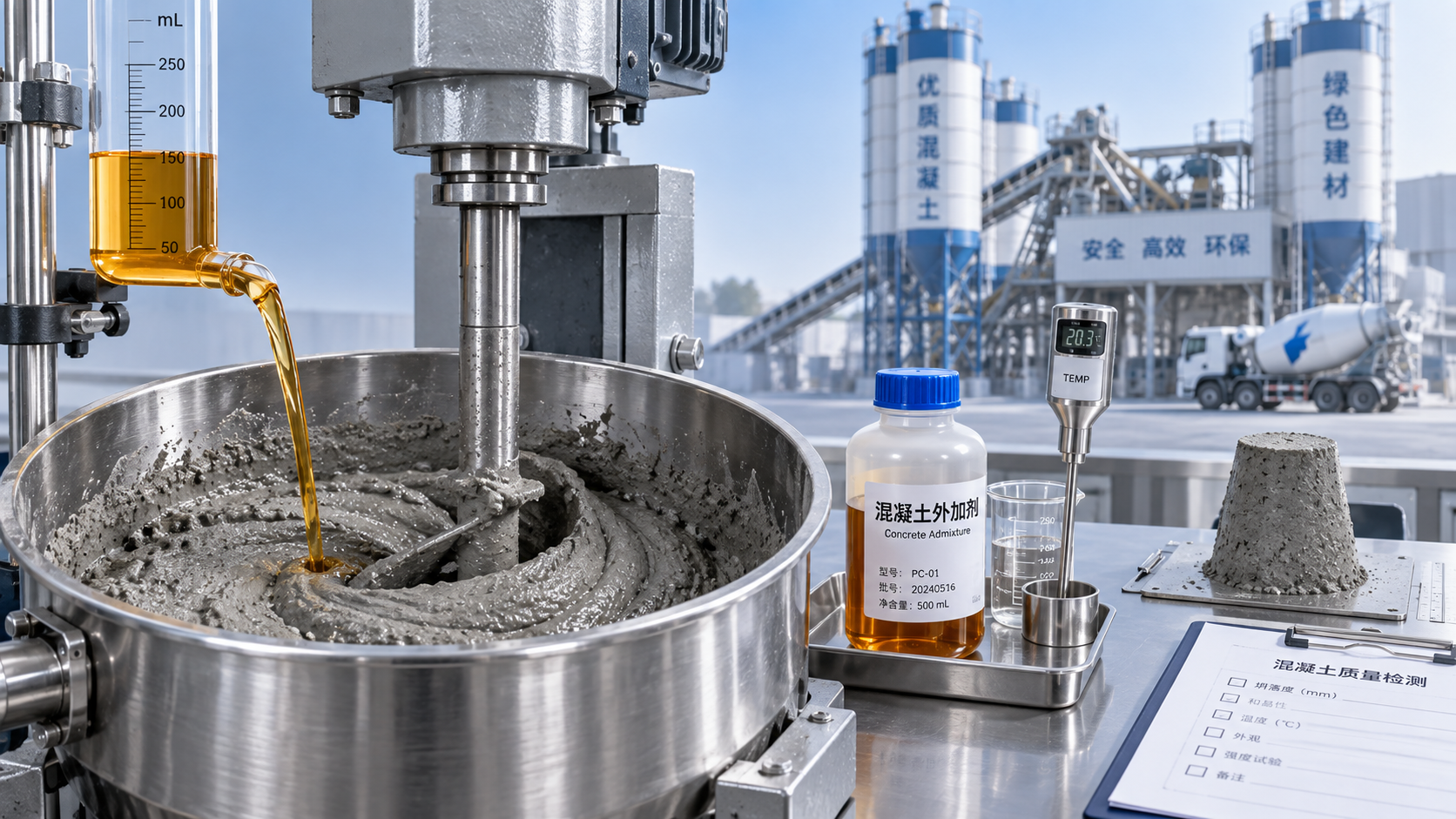
A concrete mix that remains plastic far longer than expected after an admixture is added is not automatically “bad concrete,” but it is a warning that one or more parts of the mix system have changed. The delay may come from the admixture itself, an incorrect dose, low concrete temperature, cement chemistry, added water, contamination, or a sequence error at the mixer. Treating every slow-setting load as a simple retarder overdose can lead to the wrong corrective action.
The practical priority is to determine whether the delay is caused by a controllable site variable or by a compatibility problem between materials. Fresh concrete can still appear workable and finishable while hydration has been substantially slowed. If this is not recognized early, crews may face delayed finishing windows, difficulty scheduling saw cuts, premature curing decisions, and uncertainty about when forms or loads can be removed.
Setting delay begins with hydration, not with slump alone
Cement sets as its mineral phases react with water and form hydration products that bind aggregate into a hardened mass. Many Construction Chemical Admixtures alter this process intentionally. Water reducers and superplasticizers disperse cement particles; retarders slow the early hydration reaction; set-controlling admixtures may be used to maintain workability during transport or hot-weather placement.
A mix can therefore have a normal-looking slump yet set late because the admixture has changed the reaction rate. Conversely, a mix with rapid slump loss may still have a delayed setting time. Slump, flow, temperature, and time to initial set are related, but they are not interchangeable measurements.
The key question on site is not simply, “Is the concrete still wet?” It is whether the concrete is developing a stable structure at the expected rate for that mix, temperature, and placement condition. A prolonged plastic state can be harmless when it matches the approved mix design and environmental conditions. It becomes a problem when the expected setting window changes without a clear reason.
Incorrect dosage is the most direct cause—but not always the root cause
Many admixtures are supplied as liquids and introduced by calibrated dispensers. A small volume error can be significant because dosage is normally based on cementitious material content, not on a rough estimate per truck. A pump that is out of calibration, a partially blocked line, a leaking valve, an incorrect product density entered into the batching system, or a manual addition made twice can all create excessive dosage.
Overdosing a retarding admixture is an obvious cause of delayed setting. Overdosing some high-range water reducers can also extend set, especially where the product chemistry has a retarding effect or where the cement is sensitive to that chemistry. The outcome may be more pronounced when supplementary cementitious materials are present, because the admixture is interacting with the entire binder system rather than Portland cement alone.
Before blaming the product, verify the batch record. Compare the target dose, actual recorded dose, cementitious content, truck number, loading time, discharge time, and any additions made after the truck left the plant. A reliable investigation starts with facts that can be checked. Visual judgments made after placement cannot confirm dosage.
It is also important to distinguish an admixture overdose from an excessive water addition. Water added on site can make concrete appear as though it has been heavily retarded because the mix becomes more fluid and weaker in early age. However, the mechanism differs: added water changes the water-to-cementitious-material ratio and can dilute the concentration of admixture in the paste. Both conditions can delay operations, but they require different correction and prevention measures.
Temperature can turn a normal mix into a late-setting mix
Concrete temperature strongly affects hydration. Cool concrete sets more slowly because the chemical reactions in cement proceed more slowly. A load placed during a cold morning, on a chilled subgrade, or in contact with cold reinforcement can behave very differently from the same mix placed later in the day.
Low ambient temperature is only part of the picture. Concrete temperature at discharge is more useful than air temperature because it reflects the condition of the cement, aggregates, water, mixing process, and delivery period. A concrete mix that is cold at discharge will not recover quickly merely because it is later exposed to warmer air.
Temperature effects are often mistaken for admixture failure when the admixture was added correctly but the concrete temperature fell outside the conditions assumed in the mix design. This is especially likely when a mix already includes a retarding component for haul time or workability retention. The combined effect of cold materials and a normal retarder dosage can be much larger than expected.
At the other extreme, high temperature generally accelerates setting, but it may encourage additional water or a late-dose superplasticizer to recover workability. If those adjustments are poorly controlled, the final load can show an irregular setting profile. The issue is not simply hot versus cold weather; it is whether the material temperature, delivery time, and admixture addition plan are working together.
Cement–admixture compatibility can change from one delivery to another
An admixture that performs consistently with one cement source may give a different result with another cement, even when both meet the same general specification. Cement composition, sulfate balance, alkali content, fineness, and the proportion of reactive aluminate phases can influence how admixture molecules are adsorbed on cement particles and how early hydration develops.
This does not mean the cement or admixture is necessarily defective. It means the combination may require evaluation. A change in cement supplier, mill source, clinker blend, or cement grinding conditions can alter setting behavior without an obvious change in fresh concrete appearance. The risk is greater when the mix already has a narrow operating window—for example, when it contains a high dosage of water reducer, retarder, fly ash, slag, silica fume, or other binder components.
Supplementary cementitious materials deserve particular attention. Their influence depends on type, replacement level, fineness, temperature, and cement interaction. Slag-containing binders, for example, may show slower early-age strength development under cool conditions. Some fly ashes can alter water demand and early hydration behavior. A set delay should therefore be investigated against the complete binder composition, not only against the admixture label.
Where compatibility is suspected, retain samples of the cement, admixture, and fresh concrete where practical, and compare the affected mix against a verified reference mix under controlled temperature conditions. The point is to isolate variables. Changing cement, admixture, water content, and mixing time all at once may restore production temporarily but will not establish why the delay occurred.
Water quality and unintended contamination are easy to overlook
Batch water should be consistent with the approved mix design. Recycled wash water, water from poorly managed storage tanks, or water carrying dissolved salts, sugars, organic matter, suspended fines, or residual chemicals can affect setting and air content. The effect may be intermittent, which makes diagnosis more difficult than a clear dosing error.
Contamination can also enter through mixer washout practices, shared transfer lines, drums, buckets, and unlabelled containers. Residual retarder from a previous batch can be enough to alter the next load if the system is not properly flushed. Similar problems arise when site personnel use equipment that previously held another chemical product.
Material identification matters because not every chemical kept at a construction or logistics facility belongs anywhere near a concrete batching system. For example, Xanthophyll CAS#127-40-2 is a carotenoid ingredient associated with nutritional and food-related applications, not a concrete admixture. Clear labelling, segregated storage, and dedicated dispensing equipment reduce the chance that an unrelated material is mistaken for a construction chemical.
Water added from hoses also deserves control. A hose lying in standing water, connected to an unknown source, or used after cleaning operations may introduce more than water. When a setting delay appears only on certain placements or crews, review the actual water-addition practice rather than assuming the ready-mix batch was the only source of variation.
Mixing sequence and mixing energy affect how admixtures work
Admixtures are not always interchangeable in the point at which they are added. Some are designed for addition with batch water, while others may be introduced after initial mixing to achieve stronger dispersion and slump retention. Adding a product at the wrong stage can change its effectiveness, especially in mixes with low water content or high powder content.
Insufficient mixing can leave admixture unevenly distributed. One portion of the load may appear normal while another remains unusually plastic or develops inconsistent air content. Excessive waiting after a late addition can also complicate interpretation because hydration, truck agitation, temperature change, and evaporation are occurring simultaneously.
When a late-dose admixture is used, the loading record should show the addition time and required mixing revolutions. A truck that receives an admixture but is discharged before adequate mixing cannot be assumed to represent the approved mix design. The same applies when a truck is held for an extended period and receives repeated workability adjustments.
Do not attempt to correct slow setting by adding a random “accelerator” on site. Some accelerators are incompatible with particular admixtures, reinforcement conditions, durability requirements, or mix designs. Uncontrolled addition can create local rapid setting, uneven strength development, increased shrinkage risk, or other quality issues. Any correction should follow the approved technical procedure for that concrete system.
Separate true set delay from finishing and curing problems
Delayed finishing is not always delayed setting. Surface water, evaporation control measures, bleed water, cold subgrades, finishing technique, and curing membrane timing can make a slab appear slow even when the underlying concrete is progressing normally. A surface that remains soft because it has been overworked or because bleed water has been trapped should not be diagnosed solely as an admixture issue.
Likewise, a surface may crust in wind or sun while the concrete below remains plastic. That condition can mislead crews into starting finishing operations too early. Surface appearance must be read together with concrete temperature, elapsed time, mix records, bleed behavior, and in-place consistency.
A meaningful concern exists when the full section remains plastic beyond the expected setting period, finishing cannot proceed according to the placement plan, or early-age strength development is clearly slower than anticipated. In those cases, protect the concrete from temperature loss and moisture loss, maintain curing conditions appropriate to the project requirements, and avoid loading or form removal based only on the clock.
A practical response when a load is setting late
Record the time of batching, arrival, admixture additions, water additions, discharge, and observed changes in workability. Measure concrete temperature rather than relying only on weather conditions. Preserve the delivery ticket and identify the admixture batch or storage tank used. These details are far more useful than a general statement that the concrete “would not set.”
Check whether the issue is isolated to one truck, one day, one mix design, or one material source. A single affected load points toward batching, late addition, contamination, or truck-specific factors. Repeated delays across multiple loads suggest temperature, binder compatibility, water quality, or a systematic dosing issue. The pattern narrows the investigation.
Keep the affected concrete protected and follow the project’s quality-control process for setting and strength verification. Avoid premature curing removal, form stripping, saw cutting, or loading merely because the planned schedule says those activities should occur. Concrete maturity depends on temperature and hydration progress, not elapsed hours alone.
Unexpected setting delay is usually manageable when the cause is identified early. The most reliable prevention is disciplined control of material identity, dosage calibration, batch water, mixing sequence, concrete temperature, and changes in cementitious materials. Concrete admixtures perform within a system; when that system changes, the setting behavior can change with it.
Send Us Your Inquiry Today
