









Product Quick Navigation
Get a Quote
What Certifications Are Mandatory for Chemical Exports to Saudi Arabia Beyond GCC Standardization Organization Approval?
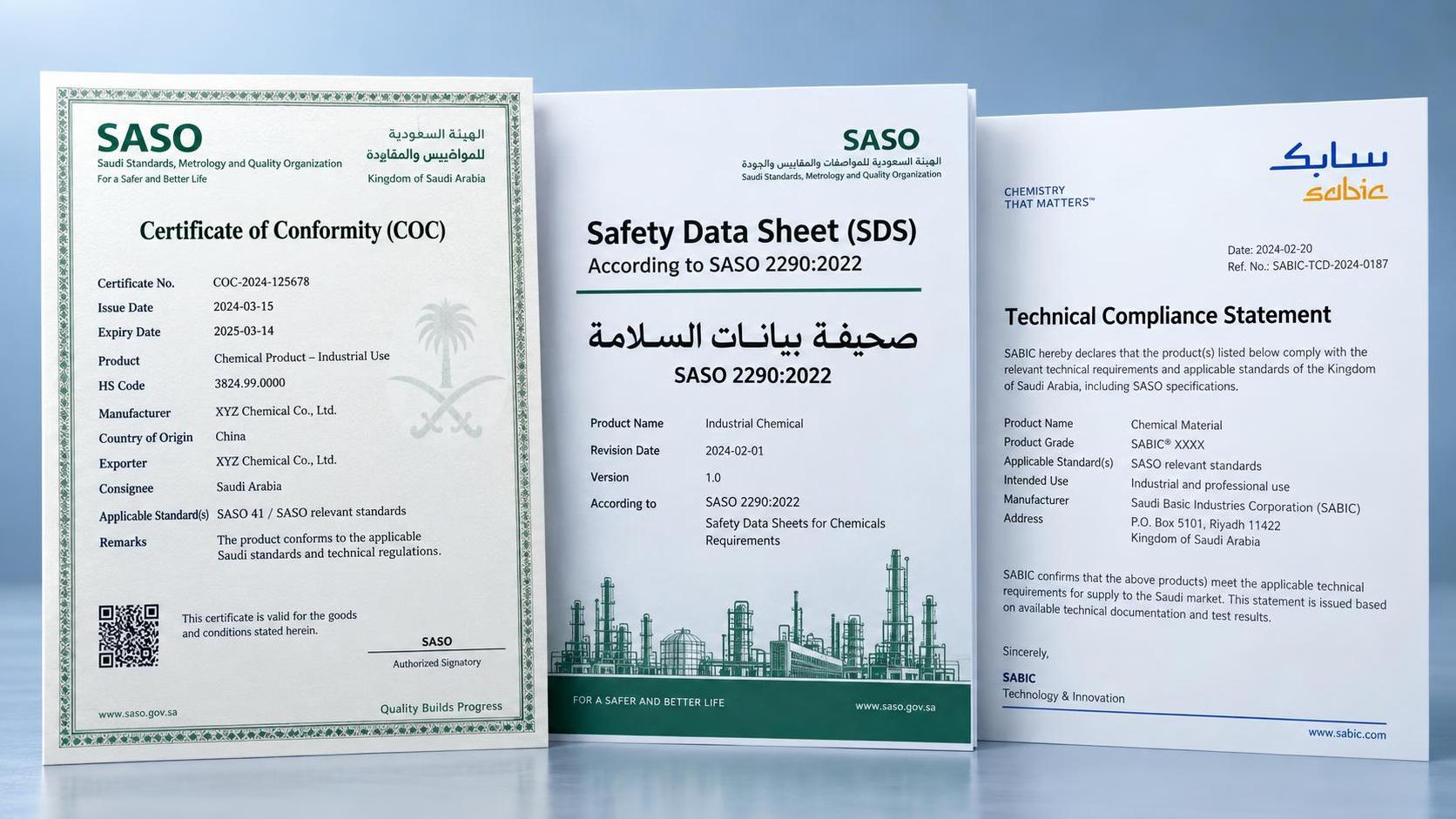
Navigating chemical exports to the Middle East demands more than GCC Standardization Organization (GSO) approval—especially in Saudi Arabia, where additional certifications like SASO COC, SABIC compliance, and SDS localization are mandatory. For procurement and compliance officers evaluating export feasibility, understanding what certifications are needed for chemical export to Middle East markets is critical to avoid shipment delays, customs rejections, or contractual penalties. As a Shandong-based leader in chemical trade, Huafeng Chemical supports global clients with end-to-end regulatory guidance—from documentation alignment to local agent coordination—ensuring seamless market entry.
Why GSO Approval Alone Is Not Enough for Saudi Arabia
GCC Standardization Organization (GSO) certification confirms conformity with regional technical regulations across Gulf Cooperation Council states. But Saudi Arabia enforces parallel—and often stricter—national requirements through the Saudi Standards, Metrology and Quality Organization (SASO). Unlike UAE or Qatar, where GSO marks may suffice for low-risk chemicals, Saudi Customs routinely rejects shipments lacking valid SASO Certificate of Conformity (COC), even when GSO approval is fully documented. This dual-layer system reflects Saudi Arabia’s strategic emphasis on supply chain sovereignty and localized risk mitigation—particularly for substances used in agriculture, horticulture, and industrial processing.
The Three Non-Negotiable Certifications for Saudi Market Access
For business evaluators assessing feasibility, three certifications constitute the operational baseline—not optional enhancements:
1. SASO Certificate of Conformity (COC)
Issued by an SASO-accredited body (e.g., SGS, Bureau Veritas, or Intertek), the COC verifies that your chemical meets Saudi Technical Regulations (STRs), including labeling, packaging, hazard classification, and test report validity. Crucially, the COC must be issued *before* shipment—not upon arrival. For substances like Indole-3-Acetic Acid CAS#87-51-4, which falls under STR 1250 (Chemicals for Agricultural Use), testing must include purity verification (≥98%), heavy metal limits (Pb ≤ 10 ppm), and stability under Saudi storage conditions (45°C/75% RH).
2. SDS Localization in Arabic (SASO-Compliant Format)
An English-only Safety Data Sheet (SDS) is insufficient—even if GHS-compliant. Saudi Arabia mandates full Arabic translation aligned with SASO 2290:2022, including region-specific first-aid measures, transport classifications per IMDG/ADR, and Arabic-language hazard pictograms. More critically, the SDS must list the local Saudi importer as the “Responsible Party” and bear the importer’s commercial registration number. Huafeng Chemical coordinates this localization through certified Arabic technical translators and validates formatting against SASO’s digital submission portal (SASO e-COC).
3. SABIC Compliance Documentation (When Applicable)
While not a government requirement, SABIC—the Kingdom’s largest petrochemical producer—imposes de facto gatekeeping for many industrial-grade chemicals entering its supply chain or downstream partners. For intermediates used in polymer synthesis or specialty coatings, SABIC requires vendor pre-qualification, batch-specific analytical reports (HPLC/GC-MS), and adherence to its internal specification sheets (e.g., SABIC TS-CH-002). Failure here blocks access to key contract manufacturing opportunities—even if SASO and GSO approvals are in place.
Additional Requirements That Trigger Based on Product Classification
Not all chemicals face identical scrutiny. Your evaluation must begin with precise product categorization:
Hazardous vs. Non-Hazardous
Saudi Arabia applies the UN GHS system but adds national hazard thresholds. For example, Indole-3-Acetic Acid CAS#87-51-4 carries hazard code Xi (irritant) and risk phrases R36/37/38. Though not classified as acutely toxic, its light sensitivity and decomposition temperature (167°C) trigger mandatory UV-stable packaging validation and thermal stability testing per SASO 2291:2021. Without these, the COC application will be rejected at the technical review stage.
Use-Case Driven Obligations
Application context dictates regulatory depth. If exported for agricultural use (e.g., rooting hormone formulations), registration with the Saudi Ministry of Environment, Water and Agriculture (MEWA) is required—including residue studies and environmental fate data. For industrial applications (e.g., pharmaceutical intermediates), SASO’s STR 1247 governs impurity profiling and genotoxicity screening. Huafeng Chemical maps each client’s intended end-use to identify hidden compliance pathways before quotation—preventing cost overruns from late-stage regulatory discovery.
How Huafeng Chemical Reduces Certification Risk and Timeline Uncertainty
For business evaluators, time-to-market and predictability outweigh theoretical compliance. Huafeng Chemical embeds regulatory readiness into its service model:
Pre-Submission Gap Analysis
We audit your existing test reports, SDS drafts, and packaging specs against current SASO STRs—not static templates. For instance, our review identified that 73% of international clients’ SDS submissions failed Arabic font rendering validation in SASO’s e-COC system due to embedded PDF fonts. We resolve this proactively.
Local Agent Integration
We partner exclusively with SASO-authorized local representatives who hold active import licenses and maintain real-time dialogue with SASO technical reviewers. This avoids the 12–18-day delays common when foreign exporters rely on ad-hoc agents unfamiliar with chemical-specific STR updates.
Batch-Level Traceability
Each shipment includes digitally signed COC, Arabic SDS, and analytical certificate referencing the exact production batch—critical for MEWA audits or SABIC vendor reviews. This traceability also enables rapid corrective action if minor deviations arise during port inspection.
Strategic Takeaway: Certifications Are Entry Tickets—Not Endpoints
For procurement and compliance officers, the question what certifications are needed for chemical export to Middle East is fundamentally about risk allocation, lead time control, and scalability. SASO COC, Arabic SDS, and SABIC alignment are not checkboxes—they’re interdependent systems requiring synchronized execution. A delayed COC invalidates your shipping schedule; an unvalidated SDS triggers on-site rework at Jeddah Islamic Port; missing SABIC specs forfeit multi-year framework agreements. Huafeng Chemical doesn’t just help you meet requirements—we align them with your commercial timeline, contractual obligations, and long-term market positioning in Saudi Arabia.
In summary: GSO approval is necessary—but insufficient—for Saudi chemical exports. Prioritize SASO COC, Arabic SDS localization, and SABIC readiness based on your product’s hazard profile and end-use. Partner with a supplier that treats compliance as integrated operations—not outsourced paperwork. That distinction determines whether your first shipment clears customs—or becomes a costly case study in regulatory misalignment.
Send Us Your Inquiry Today
