









Product Quick Navigation
Get a Quote
Understanding Shelf-Life Testing Protocols for Low-Moisture Pharmaceutical Starch Under Accelerated Stability Conditions
For quality control and safety professionals overseeing pharmaceutical excipient stability, understanding the appropriate shelf-life testing protocols for low moisture pharmaceutical starch under accelerated conditions is critical to ensuring compliance, product integrity, and regulatory acceptance. As global pharmacopeial requirements tighten—and with Shandong Huafeng Chemical supplying rigorously tested, export-ready low moisture pharmaceutical starch to international markets—this article outlines scientifically sound, ICH-aligned acceleration methodologies, including temperature/humidity stress testing, kinetic modeling, and real-time correlation strategies.
Why Accelerated Stability Testing Matters for Low-Moisture Pharmaceutical Starch
Low moisture pharmaceutical starch is widely used as a diluent, disintegrant, or binder in solid-dose formulations. Its low water activity (<0.3 aw) makes it inherently resistant to microbial growth—but not immune to chemical degradation pathways such as oxidation, Maillard reactions, or retrogradation over time. Accelerated stability testing bridges the gap between real-time data (which can take 24–36 months) and urgent commercial timelines. For QC and safety teams, the priority isn’t theoretical protocol adherence—it’s selecting tests that predict actual shelf life with statistical confidence while satisfying FDA, EMA, and WHO prequalification expectations.
ICH Q1A(R2) & Q5C: The Foundational Framework
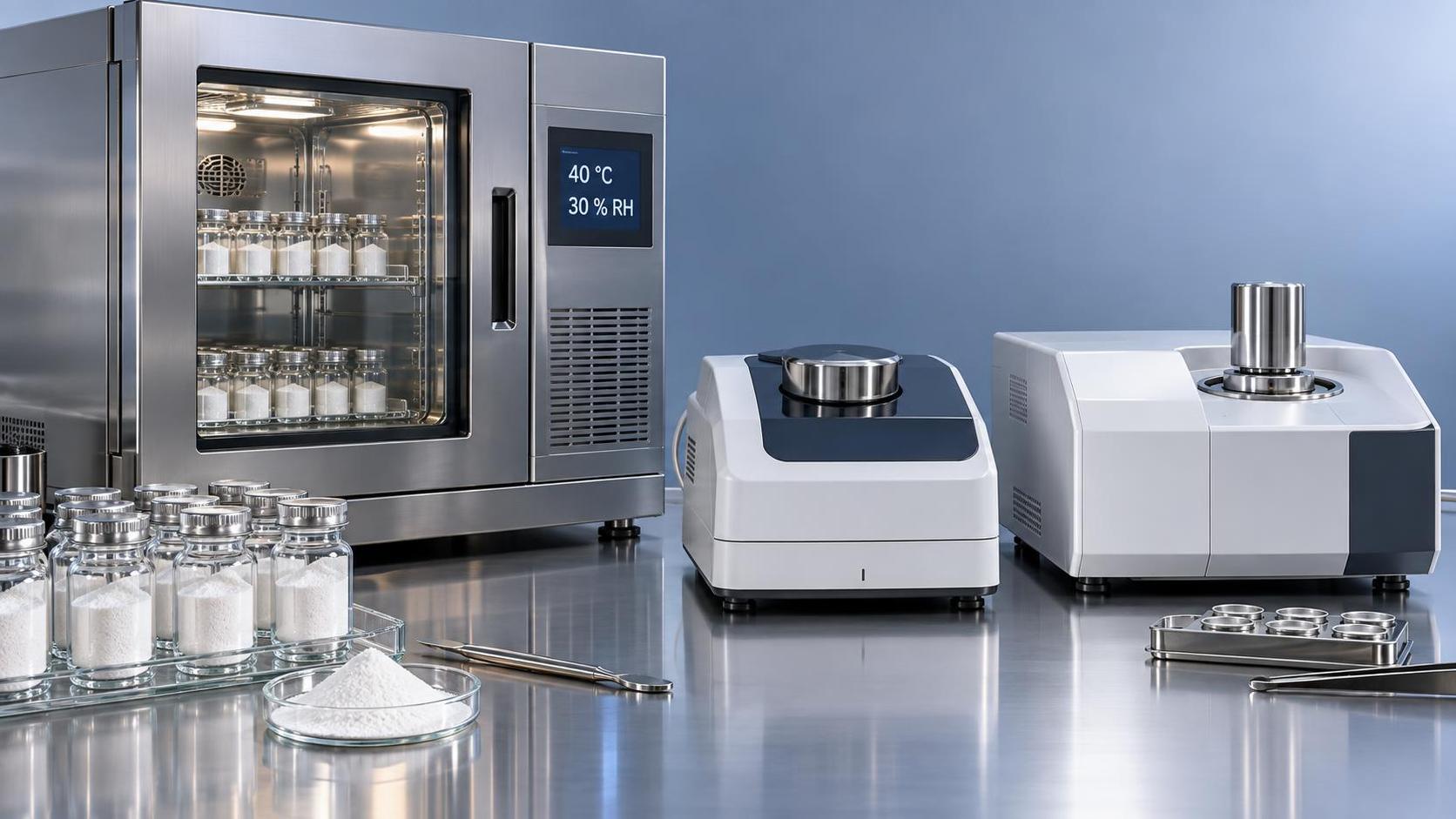
The International Council for Harmonisation (ICH) Q1A(R2) guideline remains the gold standard for stability testing of new drug substances and products. For low-moisture excipients like pharmaceutical starch, Q1A(R2) mandates three storage conditions: long-term (e.g., 25°C/60% RH), intermediate (30°C/65% RH), and accelerated (40°C/75% RH). Crucially, Q1A(R2) explicitly permits deviation from standard humidity levels when justified—for low-moisture starch, 40°C/≤30% RH is often more appropriate than 75% RH, which risks inducing artificial moisture uptake and non-representative degradation.
ICH Q5C further supports this nuance by emphasizing that excipient stability must be evaluated in context—not just as isolated material, but in combination with active pharmaceutical ingredients (APIs) and other formulation components. This means accelerated protocols must account for potential interactions: e.g., starch’s reducing end groups reacting with amine-containing APIs under heat stress.
Practical Acceleration Parameters: Beyond “40°C/75% RH”
Applying generic accelerated conditions to low-moisture starch invites misleading results. At 75% RH, even tightly sealed packaging may allow gradual moisture ingress—triggering gelatinization or hydrolysis not seen under real-world storage. Instead, QC labs should adopt tiered approaches:
- Stage 1 (Screening): 40°C/0–15% RH for 3 months—monitors oxidative discoloration, peroxide value, and residual solvent loss.
- Stage 2 (Interaction Focus): 50°C/25% RH for 1 month—assesses compatibility with common APIs (e.g., acidic or basic molecules) via HPLC-UV and DSC.
- Stage 3 (Kinetic Validation): Isothermal microcalorimetry (IMC) at 30°C, 35°C, and 40°C to derive activation energy (Ea) for key degradation markers (e.g., 5-HMF, carbonyl content).
This staged strategy reduces false positives, avoids over-conservative expiry dates, and aligns with Huafeng Chemical’s export-focused quality system—where every batch undergoes dual-condition accelerated profiling before release.
Key Analytical Endpoints: What to Measure—and Why
Unlike high-moisture excipients, low-moisture starch degradation rarely manifests as microbial contamination. Instead, QC teams must track subtle physicochemical shifts:
Water activity (aw): Measured quarterly during testing. A rise >0.35 indicates compromised packaging or hygroscopic impurity ingress—immediate root-cause investigation required.
Viscosity & paste clarity: Assessed after standardized gelatinization (95°C, 30 min). Increased viscosity signals amylose retrogradation; cloudiness suggests protein or lipid oxidation byproducts.
Residual peroxides & carbonyl value: Quantified via iodometric titration and DNPH derivatization. These directly correlate with oxidative shelf life and are predictive of API degradation in co-formulations.
Notably, sodium benzoate CAS#532-32-1—a common preservative in liquid dosage forms—is often co-packaged with starch-based tablets. Its stability under accelerated conditions must be cross-validated, as benzoic acid migration into starch matrices can catalyze esterification side reactions. Sodium benzoate CAS#532-32-1’s pH-dependent antimicrobial efficacy also shifts under thermal stress, requiring parallel buffer capacity assessment.
Real-Time Correlation & Bracketing Strategies
Accelerated data alone cannot replace real-time studies—but it can dramatically reduce their duration. Huafeng Chemical employs a bracketing model: batches manufactured across three consecutive months undergo identical accelerated protocols, then one representative batch proceeds to real-time testing at 25°C/60% RH. When Arrhenius plots show R² >0.98 for ≥2 degradation markers, extrapolated shelf life is accepted for all bracketed batches—subject to ongoing monitoring per ICH Q5C Annex 1.
This approach cuts validation cycle time by ~40%, without compromising statistical rigor. It also enables proactive risk mitigation: if accelerated data shows unexpected 5-HMF formation at 40°C, real-time samples are pulled early for targeted analysis—turning reactive QA into predictive quality management.
Regulatory Readiness: Documentation That Holds Up
Inspectors don’t review protocols—they review evidence. For low-moisture pharmaceutical starch, the most defensible submission includes:
- A justification memo explaining why 40°C/30% RH was selected over 75% RH, citing starch’s hygroscopicity profile and packaging permeability data;
- Raw chromatograms showing baseline separation of degradation products (e.g., maltose vs. isomaltose);
- Stability-indicating assay validation reports per ICH Q2(R2), including specificity, robustness, and LOD/LOQ for each endpoint;
- Batch-specific packaging integrity records (e.g., helium leak test results, seal strength metrics).
Huafeng Chemical embeds these elements directly into its Certificate of Analysis (CoA) templates—ensuring overseas clients receive audit-ready documentation with every shipment.
Conclusion: Prioritize Predictive Accuracy Over Protocol Conformity
For QC and safety professionals, the goal of accelerated shelf-life testing for low-moisture pharmaceutical starch isn’t checklist compliance—it’s building a defensible, science-led prediction of functional stability. This requires moving beyond default ICH conditions to tailor humidity, temperature, and analytical endpoints to starch’s unique physicochemical behavior. When combined with rigorous real-time correlation and transparent documentation, such an approach delivers not only regulatory acceptance but also tangible supply chain resilience—especially for exporters like Shandong Huafeng Chemical, where consistent, compliant, and export-ready starch batches underpin global client trust. Ultimately, the strongest shelf-life claim isn’t the longest date—it’s the one backed by reproducible, mechanistically grounded data.
Send Us Your Inquiry Today
