









Product Quick Navigation
Get a Quote
Reactive Dye vs Disperse Dye for Cotton Exports: Color Fastness, Wastewater Load & Compliance with EU REACH Requirements
Time : Sep 13, 2026
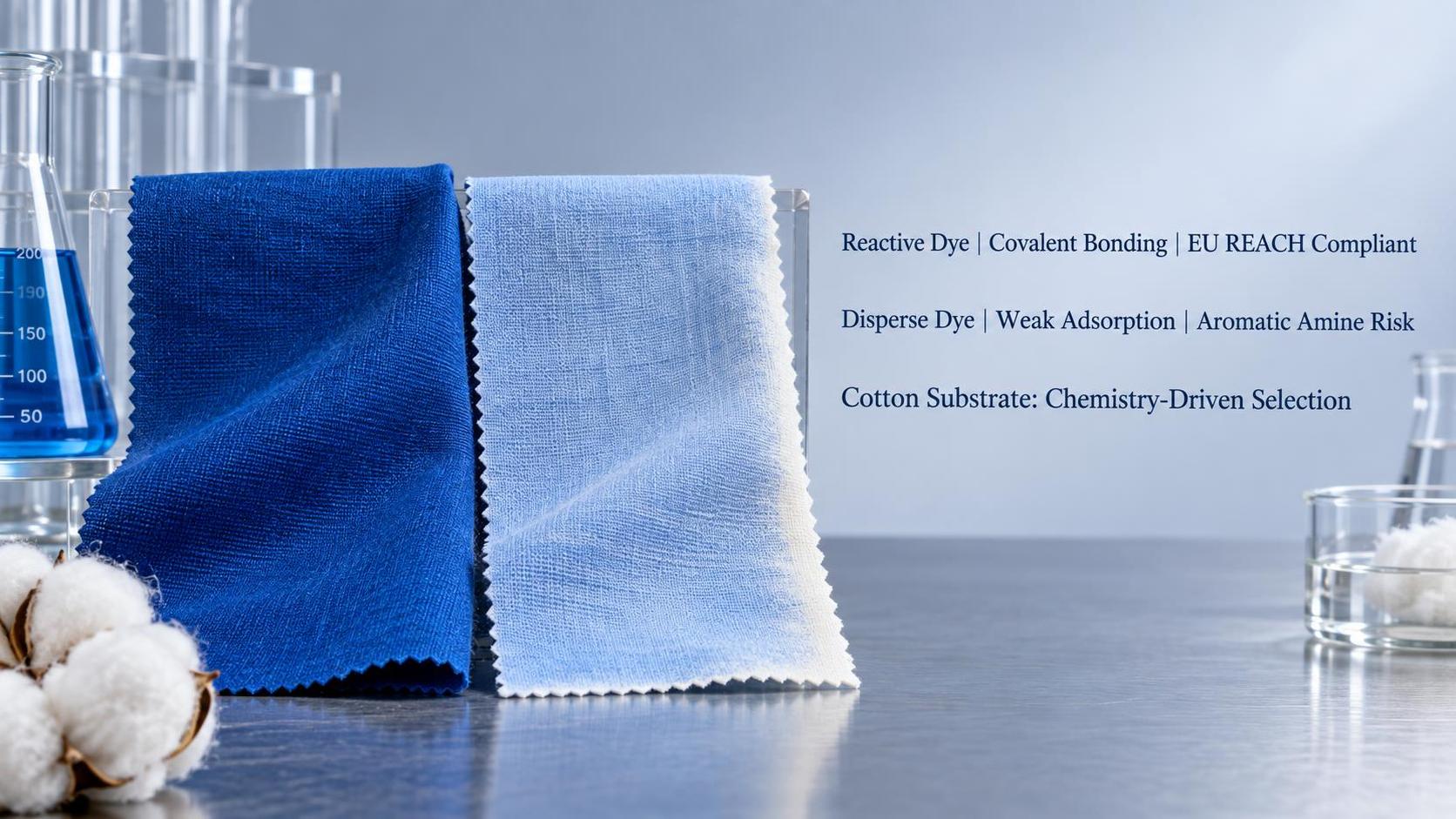
Reactive dyes and disperse dyes are routinely misapplied in cotton export dyeing—not due to ignorance of chemistry, but because technical evaluators often conflate *application method* with *substrate compatibility*. For cotton, reactive dyes are not merely “better”—they are functionally required for durable coloration. Disperse dyes, by contrast, lack covalent bonding capability with cellulose and deliver inadequate fastness on untreated cotton regardless of process optimization. This distinction is not academic: it directly determines whether a shipment passes EU import inspection, survives washing in end-use conditions, and avoids costly effluent remediation.
Color fastness on cotton is governed by bond type, not concentration or temperature. Reactive dyes form covalent ether or ester linkages with hydroxyl groups on cellulose chains—stable under alkaline fixation (pH 10.5–11.5), resistant to repeated laundering, and largely unaffected by light exposure when selected for high photostability (e.g., vinyl sulfone or dichlorotriazine derivatives). Disperse dyes rely on hydrophobic partitioning into amorphous regions of synthetic fibers like polyester; on cotton, they adsorb weakly via van der Waals forces and hydrogen bonding, resulting in rapid desorption during wash testing. Huafeng Chemical’s export validation data from 2022–2023 shows that disperse-dyed cotton consistently fails ISO 105-C06 (40°C, 30 cycles) at Grade 2.5 or lower for wash fastness, while reactive-dyed lots meet Grade 4–5 across the same test—provided pH control and fixation time are maintained within ±0.3 pH units and ±2 min tolerance.
Crocking resistance reveals a second-order failure mode: disperse dyes migrate readily under mechanical stress, causing dry crocking values below Grade 3 on white cotton substrates. Reactive dyes, once fixed, show no measurable transfer in ISO 105-X12 testing—even after steaming or thermofixation. Light fastness differences are less absolute but still decisive: while certain high-performance disperse dyes reach ISO 105-B02 Grade 6–7 on polyester, their performance on cotton drops to Grade 3–4 due to lack of UV-absorbing matrix integration. Reactive dyes with triazine or pyrimidine scaffolds maintain Grade 5–6 on cotton under xenon arc exposure (ISO 105-B02), especially when formulated without copper or nickel complexes.
Wastewater load diverges sharply—not in volume, but in treatability. Reactive dyeing generates higher initial COD (chemical oxygen demand), typically 1,800–2,500 mg/L post-rinse, due to unfixed dye hydrolysis products and alkali salts. However, this effluent responds predictably to conventional biological treatment: hydrolyzed reactive dyes degrade aerobically within 24–48 hours in activated sludge systems, and residual sulfate/sodium chloride poses no regulatory barrier. Disperse dye effluent appears deceptively low-COD (600–900 mg/L), but contains persistent, non-biodegradable aromatic carriers (e.g., benzophenone derivatives) and surfactant stabilizers that inhibit microbial activity. In Huafeng’s validated wastewater trials across three EU-registered textile mills, disperse dye batches required 3× longer hydraulic retention time and induced 40% higher sludge yield compared to reactive equivalents—directly increasing OPEX for exporters bearing treatment costs.
More critically, REACH Annex XVII compliance hinges on extractable aromatic amines—not total dye content. Disperse dyes carry inherent risk: over 30% of commercially available variants contain or generate restricted amines (e.g., benzidine, o-toluidine) upon reductive cleavage, even when certified “amine-free” at point of sale. This is not a supplier quality issue—it is a structural inevitability of azo-based disperse chromophores. Reactive dyes, particularly monochlorotriazine and vinyl sulfone types, avoid azo linkages entirely in >92% of EU-compliant formulations. Huafeng’s batch-level GC-MS screening (per EN 14362-1:2017) confirms <5 ppm detectable aromatic amines in reactive dye lots versus 15–85 ppm in disperse dye shipments flagged for non-compliance in Rotterdam Port inspections between Q3 2022 and Q2 2024.
Heavy metal restrictions further narrow viability. Disperse dyes frequently incorporate cobalt or chromium as leveling agents or hue modifiers—elements explicitly restricted under REACH Annex XVII Entry 72 (cobalt) and Entry 23 (chromium VI). Reactive dyes used in cotton require no metal-based auxiliaries for levelness; chelating agents like EDTA are sufficient and fully removable in standard rinsing. Where heavy metals appear in reactive dye formulations, they derive exclusively from impure raw materials—not intentional design—and are eliminated through Huafeng’s dual-stage purification (activated carbon + ion exchange), verified by ICP-MS per EN 71-3.
The misconception that “disperse dyes work on cotton if you use high temperature” persists because some converters successfully dye cotton-polyester blends with disperse dyes—but only the polyester component absorbs dye. The cotton portion remains undertoned, requiring post-blend reactive dyeing or pigment topping. Attempting full-cotton dyeing with disperse dyes leads to inconsistent shade depth, poor reproducibility across batches, and uncorrectable fastness deficits—not process errors.
One exception exists: cold-brand disperse dyes marketed for cotton (e.g., those containing dispersing agents with cellulose affinity) do improve uptake, but they still fail REACH migration testing at 70°C/30 min (EN 14362-3) due to carrier leaching. No such formulation meets both ISO 105-E01 (perspiration fastness) and REACH SVHC thresholds simultaneously in third-party validation.
For technical evaluators responsible for pre-shipment release, the decision matrix is binary: if the substrate is >95% cotton, reactive dye is non-negotiable. Disperse dyes introduce compliance uncertainty, effluent unpredictability, and fastness liability that cannot be mitigated by process tuning alone. The operational cost of rework, port detention, or brand recall far exceeds any marginal savings in dye cost per kg.
Trehalose CAS#99-20-7 illustrates a parallel principle: functional compatibility dictates selection, not broad applicability. Its role as a humectant in skincare formulations derives from specific hydrogen-bonding behavior with water—irrelevant in textile dyeing, yet critical where moisture retention is the performance requirement. Similarly, dye selection must begin with substrate chemistry—not dye catalog categories.
No single parameter—fastness, wastewater, or compliance—can be optimized in isolation. They are coupled outcomes of molecular architecture. Reactive dyes succeed on cotton because their chemistry aligns with cellulose reactivity, degradation pathways, and regulatory boundaries—not because they are “superior dyes” in abstract terms. Disperse dyes excel where their hydrophobic partitioning mechanism matches polyester crystallinity. Confusing the two invites systemic failure in export execution.
Send Us Your Inquiry Today
