









Product Quick Navigation
Get a Quote
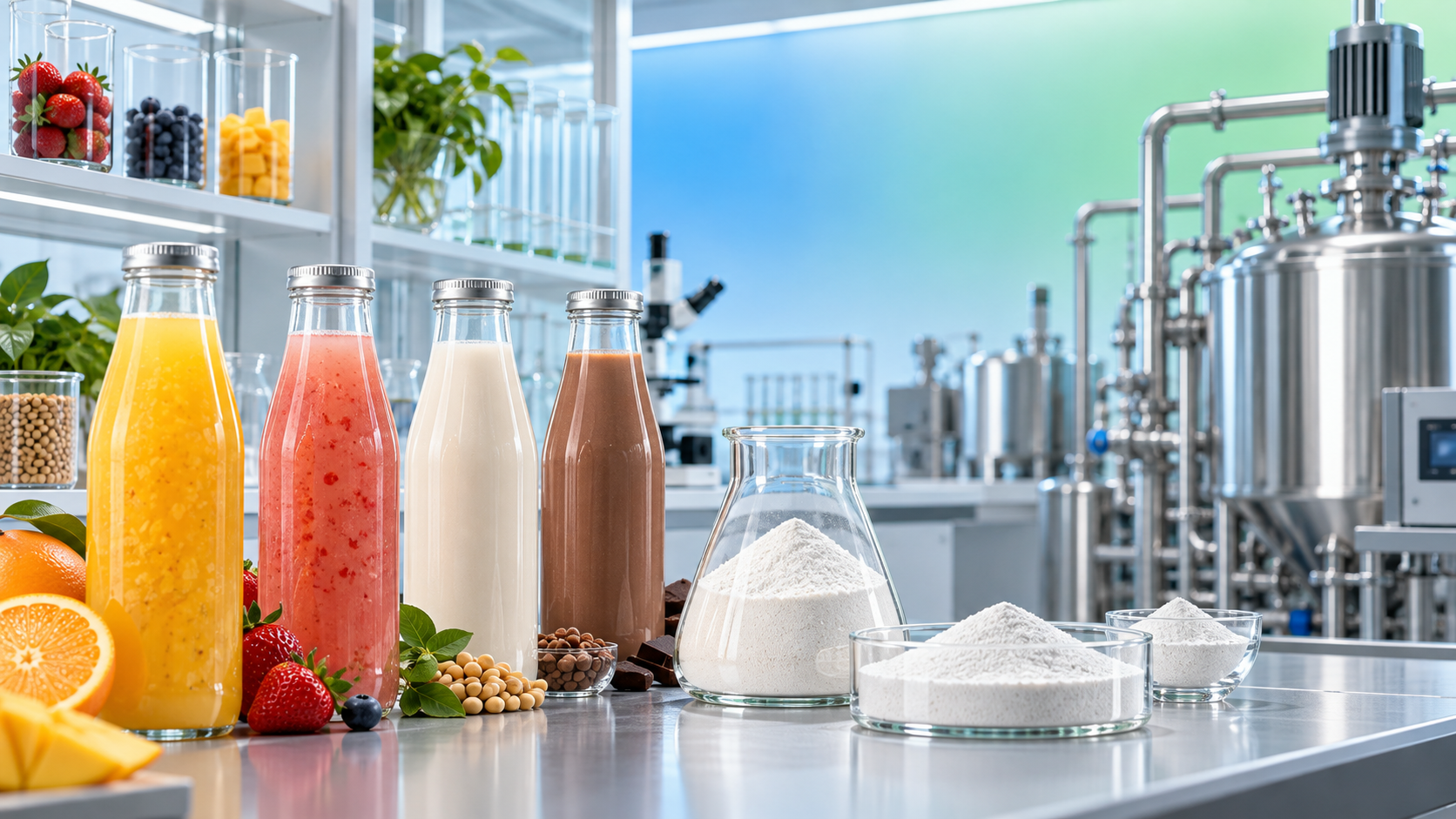
Choosing Food Hydrocolloids for a Cleaner Beverage Texture
For a beverage formulator, texture is often where a promising concept succeeds or fails. A drink may have an excellent flavor profile, attractive color, and a credible nutrition claim, yet still feel thin, dusty, ropy, chalky, or unstable after a few weeks on the shelf. Consumers rarely describe these issues in technical language. They simply say the beverage feels “artificial,” “too thick,” or “not smooth enough.”
Food Hydrocolloids are frequently the quiet part of the solution. Used carefully, they can add body, keep insoluble ingredients suspended, reduce phase separation, improve foam control, and create a more even sip from the first serving to the last. Used without a clear selection logic, they can introduce haze, excess viscosity, sediment, stringiness, or process inconsistency. The goal is not to use the strongest thickener available. It is to choose the hydrocolloid system that gives the intended sensory result with the least visual and processing compromise.
Start with the beverage’s failure mode, not the ingredient list
“Cleaner texture” means different things across beverage categories. In a clear fruit drink, it may mean a light body with no visible settling and minimal haze. In a dairy alternative, it may mean creamy lubrication without a gelatinous finish. In a protein shake, the priority can be controlling sediment and preventing a dry, astringent perception. A botanical beverage may need to carry fine particles while still pouring easily from the bottle.
That distinction matters because viscosity alone is a poor selection criterion. Two systems can show a similar viscosity reading under one test condition and behave completely differently in the consumer’s mouth or in a filling line. One may flow freely under shear and recover structure in the bottle; another may remain uniformly thick and feel heavy. A formulation target should therefore describe the actual problem: particle settling, whey separation, cloud instability, thinness, foam persistence, or loss of body after heat treatment.
Before screening ingredients, define the beverage’s pH, soluble solids, protein source, mineral load, fat level, processing route, expected storage temperature, and shelf-life target. These are not background details. They determine whether a gum hydrates properly, whether it interacts with protein, and whether a stable result in a lab beaker will remain stable after homogenization, pasteurization, transport, and repeated opening by the consumer.
Match hydrocolloid behavior to the drinking experience
The most useful way to compare beverage stabilizers is by functional behavior rather than by a generic “natural” or “clean label” description. Ingredient declarations, local regulations, and customer expectations still need to be checked market by market, but functionality comes first in early development.
Pectin is often considered when acidity and fruit positioning are central, particularly where protein stabilization is also relevant. Its performance, however, depends heavily on pH, soluble solids, calcium availability, pectin type, and process sequence. It should not be treated as a universal answer simply because it fits the product story.
Gellan gum is often evaluated when suspension is needed at a low apparent viscosity. It can be particularly useful for beverages containing calcium, cocoa, plant particles, or other dispersed solids, but ion sensitivity and hydration conditions must be controlled. A formula can look excellent in a pilot sample and then become less forgiving when changes in water hardness, mineral premixes, or processing order are introduced.
Xanthan gum provides strong viscosity and useful suspension at relatively low levels. It also offers pronounced shear-thinning behavior, which can be desirable when a beverage needs body in the bottle but should still pour easily. The trade-off is sensory: at excessive use levels, xanthan can create a long, slightly elastic or “slimy” finish. This is usually a formulation issue, not an ingredient defect.
Guar gum, locust bean gum, cellulose-based ingredients, carrageenan, alginates, and starch systems each have their place. Some are selected for creaminess, some for protein stabilization, some for cost control, and some for process robustness. Blends are common because one material rarely delivers body, stability, process tolerance, and a clean finish equally well.
Do not judge a stabilizer before it has been processed properly
Hydration is one of the most underestimated causes of beverage texture problems. A gum that is technically appropriate can perform poorly if it is added too quickly, introduced into the wrong phase, exposed to insufficient shear, or allowed to contact sugars before it is properly dispersed. The familiar complaint that “this gum formed fish eyes” is usually a process design issue.
Dry blending with sugar or another carrier may help dispersion, but it is not automatically suitable for every system. Some hydrocolloids require heat for full hydration; others need controlled cooling or specific ionic conditions. In protein beverages, the order of adding protein, mineral salts, acid, and stabilizer can be as consequential as the stabilizer selection itself. A sensible bench trial should record not only final viscosity but also mixing time, hydration temperature, shear conditions, homogenization pressure where applicable, and the point at which each ingredient entered the batch.
It is also worth tasting samples at more than one temperature. A beverage that feels pleasantly full at room temperature may seem overly thick when chilled. Conversely, a low-viscosity drink may feel acceptable immediately after production but expose a watery or gritty texture after cold storage. Instrument readings help comparison; they do not replace a structured sensory check.
Heat, acid, minerals, and time change the decision
A hydrocolloid selection should survive the real product pathway. Acidification can alter charge interactions and hydration. Thermal treatment may improve or weaken the final network, depending on the material and system. Calcium and other salts may be required for one stabilizer’s function but can destabilize another component. Even the packaging format matters: a beverage held in a refrigerated chain behaves differently from one designed for ambient distribution.
A practical screening plan is usually more informative than a large initial ingredient list. Compare a control against a small number of single ingredients and blends at realistic dosage ranges. Evaluate immediately after processing, after a defined storage interval, and after temperature cycling if the product is likely to encounter variable logistics. Look for sediment height, serum separation, viscosity drift, ring formation at the bottle neck, flavor release, and changes in pour behavior. These observations are more useful than declaring a formulation “stable” after one day.
For international projects, compliance documentation deserves attention early rather than just before shipment. The permitted use, naming convention, purity requirements, and documentation expectations for Food Hydrocolloids can vary with the destination market and beverage category. A technically suitable material can still create avoidable delays if its specification, allergen statement, origin information, microbiological criteria, or food-contact documentation is incomplete for the customer’s needs.
Clean label is a formulation conversation, not a shortcut
“Clean label” is not a single technical standard. For one brand, it may mean a shorter ingredient statement. For another, it may mean recognizable ingredient names, plant-derived sources, non-GMO positioning, or avoidance of a particular additive category. Formulators need to translate that marketing direction into specific allowable options before beginning development.
There is a common temptation to remove a stabilizer and assume the beverage will feel cleaner. Sometimes that works. Often it exposes another issue: faster settling, weaker body, reduced emulsion stability, or greater batch-to-batch variation. The cleaner result may instead come from using a lower dosage, choosing a more efficient grade, improving homogenization, revising the particle size distribution, or using two compatible materials at modest levels rather than one gum at a high level.
In other words, a clean texture is not necessarily the same as a minimal formula. It is a formula where the structure is not obvious to the drinker.
Supplier evaluation should include separation of technical expertise
When sourcing functional ingredients across borders, a supplier’s ability to manage documents, samples, lot consistency, packaging, and shipment timing is part of formulation risk management. Shandong Huafeng Chemical, based in Shandong, works within an export-oriented chemical supply environment where overseas customers commonly require clearer communication around specifications, logistics, and responsiveness. For beverage projects, food-grade materials should always be handled through the appropriate food-ingredient supply chain, with relevant product documentation reviewed before use.
That separation is especially important for companies with broad chemical portfolios. For example, SBS Thermoplastic Elastomer (Styrene-Butadiene-Styrene Block Copolymer, SBS) CAS 9003-55-8 is an industrial thermoplastic elastomer intended for applications such as asphalt modification, adhesives, footwear, and plastic modification; it is not a beverage hydrocolloid or food formulation ingredient. Broad sourcing capability can be valuable, but it should never blur product segregation, intended use, or food-safety review.
A more reliable way to make the final choice
The best hydrocolloid is usually the one that solves the beverage’s dominant problem without creating a new consumer objection. If suspension is the key issue, prioritize stable particle management over a high viscosity number. If the drink needs creaminess, assess lubrication and flavor release rather than thickness alone. If acid and heat are non-negotiable, test the complete process, not just the finished blend.
Keep the first trials narrow, document process conditions carefully, and resist making decisions from a freshly mixed sample. Texture is a moving target: it changes with temperature, time, pH, minerals, shear, and packaging. A hydrocolloid system that remains quiet in the background—smooth on the palate, stable on the shelf, and manageable in production—is generally the one worth carrying forward.
Send Us Your Inquiry Today
