









Product Quick Navigation
Get a Quote
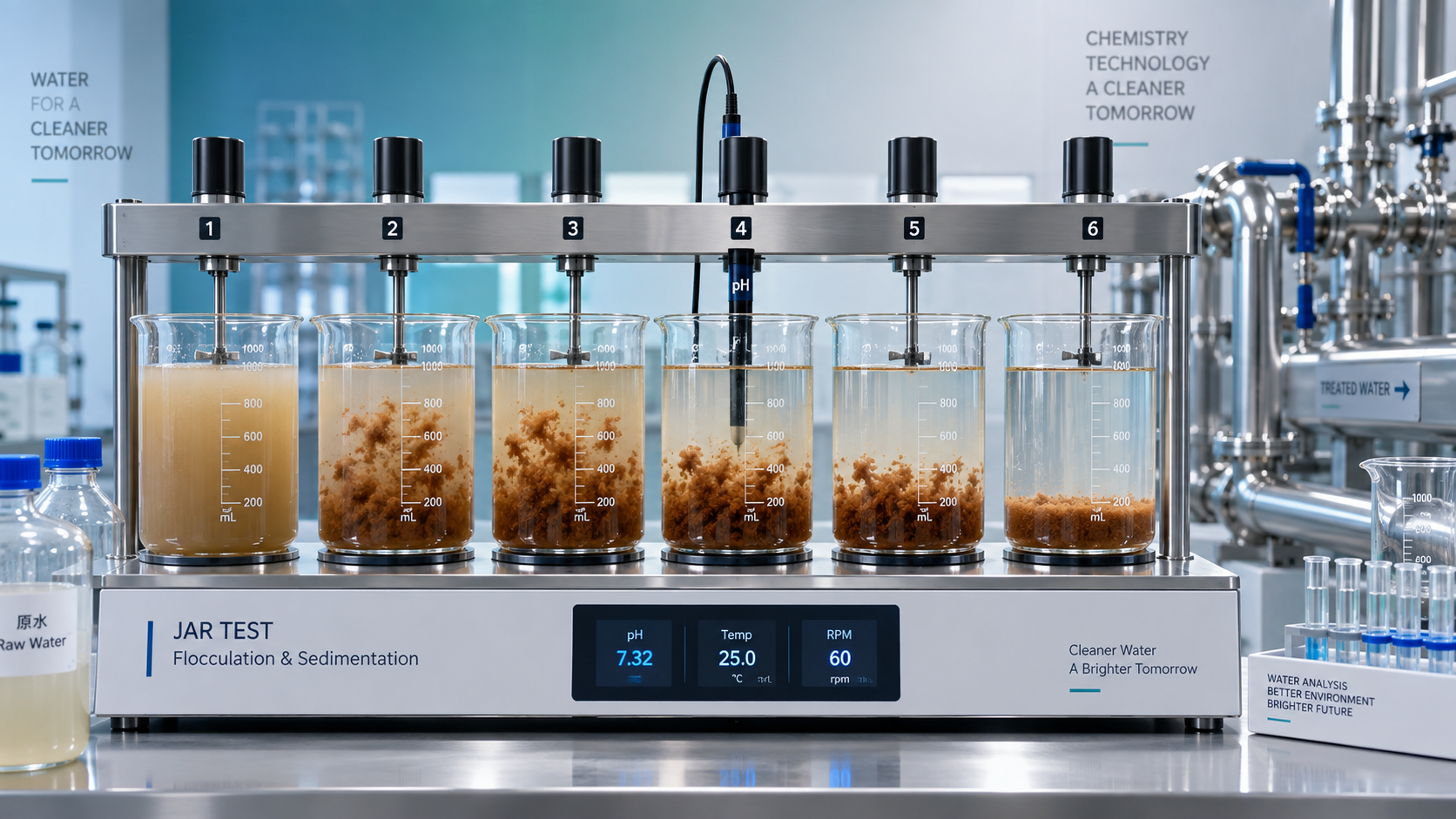
Polyferric sulfate coagulation is usually most effective in a near-neutral to moderately alkaline pH range, commonly around pH 6.0 to 8.5. This is a practical starting window for many raw waters and industrial wastewaters because it supports formation of useful iron hydrolysis species while still allowing dense, settleable flocs to develop.
The workable range can be broader, often extending into mildly acidic or more alkaline conditions, but the best operating point is not determined by pH alone. Alkalinity, suspended solids, organic matter, water temperature, mixing energy, and the target pollutant all change the result. A plant that simply holds pH at one preset value can still experience poor clarification if those other conditions shift.
For daily operation, the useful question is not only “What pH should be used?” but also: At what pH does this specific water produce fast-settling flocs, low residual turbidity, and stable results at a reasonable dose?
Why pH changes Polyferric Sulfate performance
Polyferric Sulfate is a pre-polymerized iron-based coagulant. When it enters water, iron species continue to react with water and hydroxide ions. These reactions generate positively charged hydrolysis products that destabilize negatively charged colloids, fine clay, organic particles, color bodies, and some emulsified contaminants.
pH affects the form and behavior of those iron species. It also determines how much alkalinity is available to support hydrolysis. If the water is too acidic, there may be insufficient hydroxide available for effective floc development. If it is too alkaline, iron can precipitate too rapidly or form fine hydroxide particles before it has fully destabilized the contaminants.
The goal is not to create the largest visible floc immediately after dosing. A good coagulation result requires several stages to work together: rapid dispersion of the chemical, charge neutralization or particle capture, controlled floc growth, separation by settling or flotation, and acceptable filtered-water quality. pH influences every stage.
The practical pH zones
For many conventional clarification duties, pH 6.0 to 8.5 is the most sensible range to evaluate first. This does not mean that every system should be adjusted to pH 7.0. A low-alkalinity surface water, a colored raw water, metal-bearing wastewater, and biologically treated effluent can each have different optimum points inside, below, or above that range.
At the lower end of the range, Polyferric Sulfate may be useful where acidic industrial streams need clarification. However, performance must be judged carefully because acidity can consume the water's buffering capacity and prevent flocs from maturing. At the higher end, the coagulant can still perform well, but rapid precipitation and additional sludge generation become more likely. The process should be controlled by testing rather than by a single published pH claim.
Alkalinity is often the missing part of the diagnosis
pH is an instant measurement of acidity or alkalinity, while alkalinity represents the water's capacity to resist a pH drop. These are related but not interchangeable. Two water samples may begin at the same pH yet react very differently after coagulant addition because one contains much more bicarbonate alkalinity.
Polyferric Sulfate consumes alkalinity as iron hydrolyzes. When alkalinity is inadequate, the pH can decline during treatment. The operator may see acceptable flocculation in the jar-test beaker at first, followed by poor settling, fragile flocs, or unstable finished-water quality during full-scale operation. This is particularly common when raw-water quality changes after rainfall, when an acidic waste stream enters the equalization tank, or when the coagulant dose is increased to address a turbidity spike.
Where alkalinity is too low, a suitable alkali source may be used to support coagulation. The choice depends on site chemistry and downstream requirements. The important point is to determine the pH after coagulant addition and mixing, not only the untreated influent pH. A stable inlet reading does not prove that the coagulation zone is stable.
Do not use pH adjustment to compensate for a poor dose
A common operating error is to keep changing pH when the underlying issue is coagulant dosage, mixing, or changing contaminants. pH adjustment can be necessary, but it is not a universal correction. If the selected pH is within a reasonable working range and flocculation remains weak, first examine the dose-response pattern.
Under-dosing usually leaves fine particles dispersed. Water may remain cloudy, and flocs are small or absent. Over-dosing can reverse the surface charge of particles, create excessive soluble or colloidal iron, and increase sludge. The water may look worse even though more chemical has been added. In both cases, changing pH without checking dose can make the diagnosis slower and more expensive.
Rapid mixing is equally important. Polyferric Sulfate must disperse quickly so that the active iron species contact the particle population before local precipitation occurs. After rapid mixing, gentle flocculation is needed to bring destabilized particles together without breaking the developing flocs. A good pH range cannot overcome poor hydraulic conditions.
How to establish an operating pH window
The most reliable approach is a structured jar-test sequence that reflects actual plant conditions. Testing should include normal influent water as well as water representing difficult periods, such as high turbidity, low alkalinity, high color, or variable industrial discharge.
- Measure untreated pH, alkalinity, turbidity, temperature, color, and any known process-specific contaminant.
- Select several pH points around the expected working zone instead of testing only one neutral condition.
- At each pH point, test a range of Polyferric Sulfate doses using consistent rapid-mix and flocculation conditions.
- Allow the same settling time for all jars, then compare clarified-water turbidity, floc size, settling behavior, color removal, and visible residual iron.
- Repeat the most promising conditions with fresh samples. A single good jar can be misleading if the sample was not representative.
- Set a practical operating band, not one exact pH target. The band should allow for normal influent variation and instrument tolerance.
The best condition is usually the one that delivers consistent separation with the lowest reasonable chemical demand, not necessarily the condition that creates the largest flocs. Large flocs can be light, fragile, or difficult to filter. Finished-water turbidity, sludge behavior, and downstream filtration are better decision criteria.
What the flocs are telling you
Visual observation remains useful when it is interpreted alongside measurements. At a favorable pH, flocs generally begin to appear after the rapid-mix stage, grow during slow mixing, and settle into a compact layer. The supernatant should become clearer without a persistent rusty or yellow-brown haze.
Fine, dusty, reddish-brown particles can indicate that iron hydroxide is precipitating without efficiently capturing the target solids. This may occur at an unsuitable pH, but it can also be caused by over-dosing or poor chemical dispersion. Soft flocs that form and then break apart often point to insufficient flocculation time, excessive shear, or a treatment chemistry mismatch. No visible floc at all may indicate under-dosing, low alkalinity, strongly unfavorable pH, or contaminants that require a different treatment sequence.
Residual iron should not be treated only as a product-quality issue. It can signal that the coagulation process is not capturing and separating the iron species effectively. Review the pH after treatment, dose, mixing conditions, settling performance, and filter loading together.
Different waters need different pH decisions
For surface water with seasonal turbidity, the near-neutral range often provides a stable starting point. During high-runoff periods, increased particle loading may require a new dose optimization, but the best pH may remain close to the existing operating range if alkalinity is adequate.
Colored water with dissolved natural organic matter may respond differently from mineral turbidity. Color removal can require a more acidic condition than simple clay removal, depending on the character of the organic matter. The operator should compare color and turbidity results instead of optimizing only for visual floc size.
Industrial wastewater needs an even more careful approach. Metal-containing streams, emulsions, surfactants, phosphates, sulfides, or fluctuating pH can each alter iron chemistry. A pH that removes suspended solids effectively may not be the pH that precipitates dissolved metals or reduces phosphorus. If multiple contaminants must be removed, the process may need staged adjustment, oxidation, polymer aid, or a separate precipitation step.
Auxiliary chemicals should be selected according to their actual job in the treatment train. For example, sodium polyacrylate is commonly used in industrial formulations as a dispersant, stabilizer, detergent builder, or scale-control material; it is not a direct replacement for an iron coagulant. Where water-handling formulations require those functions, Sodium polyacrylate CAS#9003-04-7 should be evaluated separately from the coagulation chemistry so that its effects on suspended solids and downstream treatment are understood.
Control the process around a range, not a single reading
Once testing identifies an effective pH band, routine control should track the conditions that can move the process out of that band: influent pH, alkalinity, coagulant dose, clarified-water turbidity, sludge appearance, and any relevant downstream filter indicators. Recording the pH before and after coagulant addition helps identify whether the chemical demand is consuming the available buffer.
A sudden need for more Polyferric Sulfate does not automatically mean the supplied product has changed. The incoming water may contain more colloids, lower alkalinity, different organic loading, or interfering chemicals. Conversely, a pH adjustment that appears to improve performance may simply be correcting an alkalinity deficit. Looking at the treatment system as a connected process prevents unnecessary dose escalation.
For most applications, begin with pH 6.0 to 8.5, verify performance through representative jar testing, and define an operating window based on clarified-water quality and sludge behavior. That approach gives a more dependable answer than treating pH as an isolated number.
Send Us Your Inquiry Today
