









Product Quick Navigation
Get a Quote
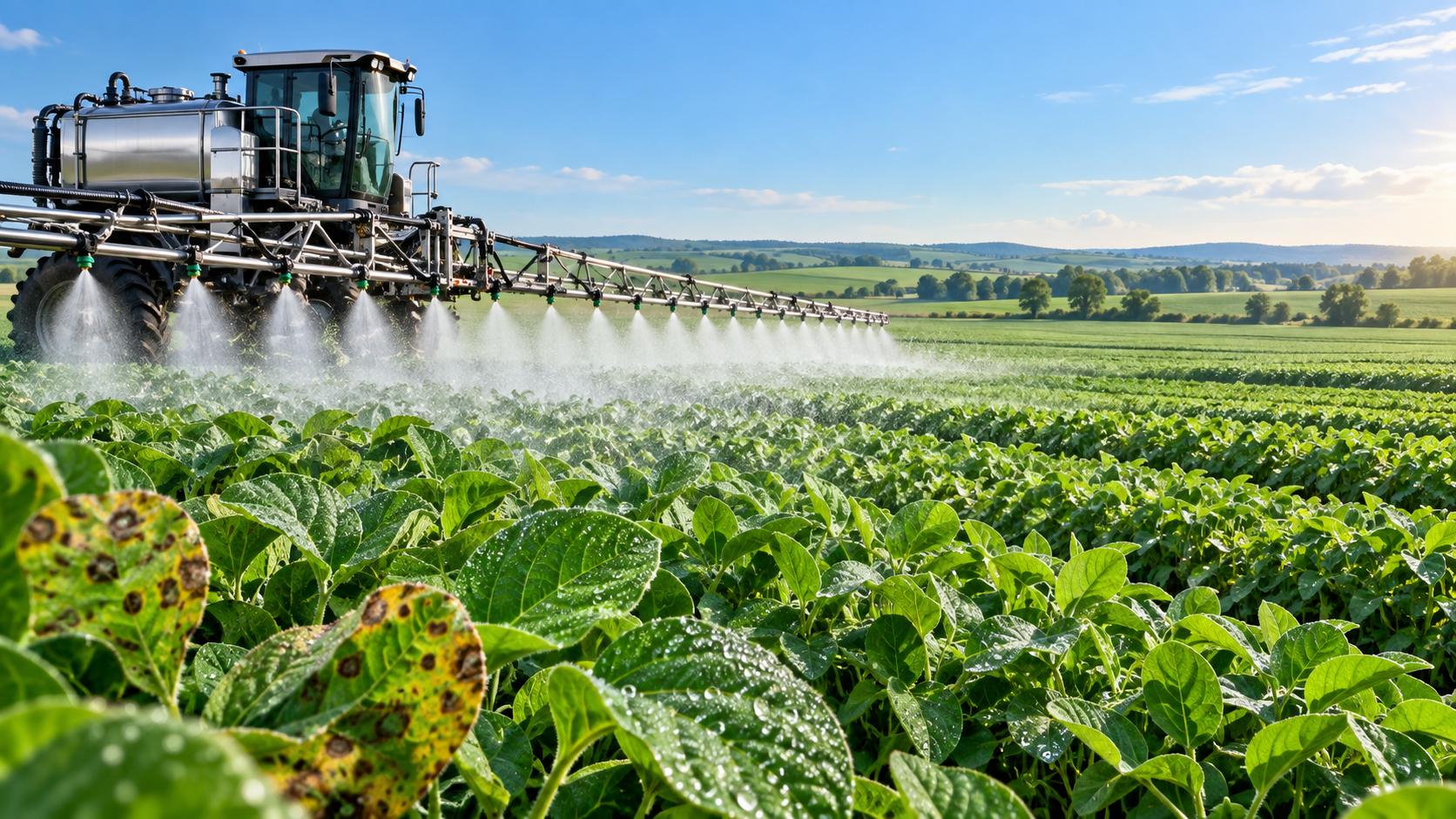
When Fungicide Performance Drops: Diagnosing Coverage, Timing, and Resistance
When a fungicide treatment appears to fail, the immediate reaction is often to blame the product. Sometimes that is justified: a batch may have been stored improperly, the selected active ingredient may not fit the disease, or resistance may have reduced its usefulness. More often, though, weak disease control starts earlier in the chain. The spray never reached the target tissue, the crop was treated after infection was already established, rain disrupted the spray deposit, or an incompatible tank mix changed the behavior of the application.
For operators, the practical task is not to guess which explanation sounds most likely. It is to separate the possible causes in the right order. A field with poor coverage needs a different correction from a field with confirmed resistance. Applying a higher rate to compensate for a nozzle problem wastes product and can create compliance concerns. Switching chemistry repeatedly without checking application timing can produce the same disappointing result under a different label.
The most useful question is simple: where did control begin to break down? Start with the disease pattern in the field, then work backward through canopy penetration, equipment condition, spray timing, weather, water quality, product handling, and the fungicide mode of action. This sequence usually reveals more than an immediate product change.
Read the Field Pattern Before Opening the Spray Log
Disease distribution gives the first clues. If symptoms are concentrated along tramlines, field edges, headlands, or areas where the sprayer changed speed, coverage and boom performance deserve attention. A disease problem that is strongest in dense, shaded sections of a crop may point to poor canopy penetration, persistent leaf wetness, or an infection window that was missed. If the whole field declines evenly after several applications made according to label instructions, resistance becomes a more serious possibility—but it should still not be assumed without checking the basics.
Look closely at leaf position and disease stage. Many foliar Fungicides are primarily protectant products. They work best when a sufficient deposit is present before spores germinate or before the pathogen gains a foothold. A lower canopy that was already infected before spraying may continue to deteriorate even when upper leaves are well protected. That is not necessarily treatment failure. It may simply show the limit of what the product is designed to do.
Operators should also distinguish the target disease from look-alike symptoms. Nutrient disorders, herbicide injury, drought stress, bacterial diseases, and some virus symptoms can all be mistaken for fungal activity in the early stages. If the diagnosis is uncertain, changing fungicide programs too quickly can hide the real issue. Local agronomy support or diagnostic testing may be worthwhile when the economic crop risk is high.
Coverage Is Not Just About Applying Enough Liquid
A spray application can use the correct rate and still leave too little active material where it is needed. The label rate describes how much product should be applied per area; it does not guarantee distribution across leaf surfaces, stems, fruiting zones, or the inner canopy. This distinction matters especially in rapidly growing crops, dense cereal stands, vineyards, orchards, and vegetables with layered foliage.
Begin with the equipment rather than the tank. Worn nozzles can alter output and droplet pattern. Partially blocked nozzles create obvious gaps, but uneven pressure across a boom can be less visible and just as damaging. Boom height, forward speed, nozzle orientation, and spray volume all affect where droplets land. In a thick canopy, spraying from above may protect exposed leaves while leaving lower disease sites almost untreated.
Water-sensitive paper can be useful as a practical diagnostic tool when used thoughtfully. Place it at more than one canopy level and compare the deposition pattern rather than looking for a single “perfect” result. If the upper leaves receive heavy coverage and the lower target surfaces show very little, adding more fungicide to the tank is not the answer. Adjust nozzle selection, air assistance where available, water volume, travel speed, or application angle according to the crop and equipment.
Droplet size involves a real trade-off. Fine droplets can improve surface coverage but are more vulnerable to drift and evaporation. Coarser droplets are less drift-prone but may not provide adequate coverage for contact activity or difficult leaf surfaces. There is no universally correct nozzle setting. The right decision depends on the fungicide formulation, target location, canopy structure, weather, label requirements, and available application equipment.
Common coverage failures worth checking
- Incorrect nozzle type for the intended disease target or crop canopy.
- Excessive boom height, unstable boom movement, or poor overlap between spray patterns.
- Travel speed that prevents adequate deposition or creates pressure variation.
- Dense crop growth that developed after the previous calibration or spray plan.
- Inadequate agitation, particularly with products that need to remain uniformly suspended.
- Spraying during conditions that promote drift, evaporation, or runoff from waxy foliage.
Calibration should not be treated as a once-per-season activity. A machine that performed well at the start of the season may behave differently after nozzle wear, hose repairs, pressure adjustments, or a move from an open crop to a dense one. A short calibration check before a high-value treatment is usually cheaper than repeating an ineffective application.
Timing: Protect the Crop Before the Disease Gets Ahead
Timing failures are often mistaken for product failures because symptoms continue to expand after spraying. The key issue is whether the product was applied before, during, or after the critical infection period. Protective fungicides require coverage in place before infection. Products with some post-infection activity still have limits, and those limits vary by active ingredient, pathogen, crop, and disease development stage.
A common difficult scenario is this: weather delays access to the field, humidity remains high, and visible symptoms appear just before the sprayer can enter. At that point, the aim may shift from preventing infection to slowing further spread and protecting healthy new growth. Expectations need to shift as well. Existing lesions may remain visible even after a well-timed follow-up treatment. Visual persistence is not automatically evidence that the fungicide did nothing.
Weather before and after application matters. Rain can interrupt drying and reduce retention if it occurs before the spray deposit has adequately set, although rainfastness depends on the individual product label. Strong sunlight, high temperature, low humidity, and wind can affect droplet survival and leaf uptake. Overnight dew and extended leaf wetness may favor the pathogen, particularly when an application interval has already been stretched by rain or logistics.
Use local disease forecasts, crop growth observations, and weather records together when possible. Forecast tools are useful aids, not substitutes for field inspection. An alert for infection risk does not tell you whether every part of a field has the same canopy density, inoculum pressure, or drainage condition. Operators who combine the forecast with regular scouting generally make better timing decisions than those relying on either one alone.
Tank Mixing and Water Quality Can Quietly Undermine an Application
Many performance problems begin in the spray tank. A mixture can look acceptable at first and still separate, foam excessively, settle, or produce uneven concentration during application. Always follow the product label and local requirements for mixing sequence, compatible adjuvants, agitation, and spray-water conditions. If a proposed mixture has not been used before, a small jar test can identify obvious physical incompatibility, but it does not replace label guidance or prove crop safety.
Hard water, extreme pH, sediment, and organic contamination can influence spray behavior or active ingredient stability for some products. The practical response is to know the water source rather than assume it is neutral and clean. Check filters, strainers, and tank cleanliness. Residues from previous applications can cause unexpected compatibility or phytotoxicity issues, especially where several crop-protection products are handled through the same equipment.
Storage also deserves a quick check. Fungicide products should remain in their original, clearly labeled containers and be kept within the storage conditions stated on the label or safety documentation. Temperature extremes, damaged packaging, and outdated stock records complicate diagnosis later. If product quality is genuinely suspected, retain the batch information, purchase documentation, and a sample where permitted, rather than discarding the evidence after the field treatment.
Resistance Is a Pattern, Not a Convenient Explanation
Fungicide resistance develops when a pathogen population includes individuals less sensitive to a mode of action and repeated use favors their survival. The risk is generally greater when the same mode of action is relied on repeatedly, disease pressure is high, and applications are made after infection is already widespread. A treatment that once worked well may gradually become less reliable, sometimes first in specific fields or disease hotspots.
Still, resistance cannot be diagnosed just because a spray result was disappointing. Before treating it as the primary cause, verify that the disease identification is sound, the product is registered and labeled for the crop and target disease, the application was properly calibrated, timing was reasonable, and mixing or weather did not compromise the deposit. This prevents unnecessary switches and gives any subsequent resistance investigation a stronger factual basis.
Where resistance is suspected, record the active ingredients and modes of action used across the season, not merely the brand names. Review past programs for repeated chemistry. Rotate modes of action in line with label directions and relevant resistance-management guidance, and use integrated practices that lower disease pressure: crop residue management where appropriate, suitable spacing, air movement, sanitation, irrigation practices that reduce prolonged leaf wetness, and varieties with useful disease tolerance when available.
Do not respond by cutting rates. Reduced rates can leave a weaker selection pressure on the pathogen population while providing poorer disease control. Equally, do not exceed label rates or shorten intervals beyond what the label permits. A resistance problem is not solved by improvising outside the approved use pattern.
A Practical Investigation After a Weak Result
A useful post-application review does not need to become a long technical report. Collect a few details while they are still fresh: crop stage, disease stage, field zones affected, application date and time, weather conditions, nozzle type, pressure, water volume, travel speed, tank-mix components, water source, and product batch details. Photographs from multiple locations are more valuable than a single close-up leaf image because they show whether the problem follows a spatial pattern.
Supply Discipline Matters as Much as Field Discipline
Crop-protection performance begins in the field, but reliable chemical supply practices make investigation and repeatability easier. Overseas buyers increasingly need clear product documentation, consistent packaging information, responsive communication, and traceable logistics—not just a quoted price. For a company such as Huafeng Chemical, operating from Shandong’s established chemical manufacturing region, the export-service challenge is to keep product documents, specification checks, shipment arrangements, and customer response aligned across different markets.
That discipline also means keeping unrelated chemical materials clearly separated in documentation, storage, and handling. For example, Magnesium Stearate CAS#557-04-0 is a fine, water-insoluble material commonly used in food, pharmaceutical, supplement, and cosmetic applications; it is not a substitute for an agricultural disease-control active ingredient. In mixed chemical portfolios, clear product identification and application-specific documentation help prevent exactly this kind of misunderstanding.
When Fungicides underperform, resist the urge to make a fast, broad change. Inspect the field pattern, confirm the disease, review the spray operation, reconstruct the weather and timing, and only then assess whether resistance or product quality needs deeper attention. That approach is slower than blaming the container, but it is usually the route to a correction that holds up in the next spray window.
Send Us Your Inquiry Today
