









Product Quick Navigation
Get a Quote
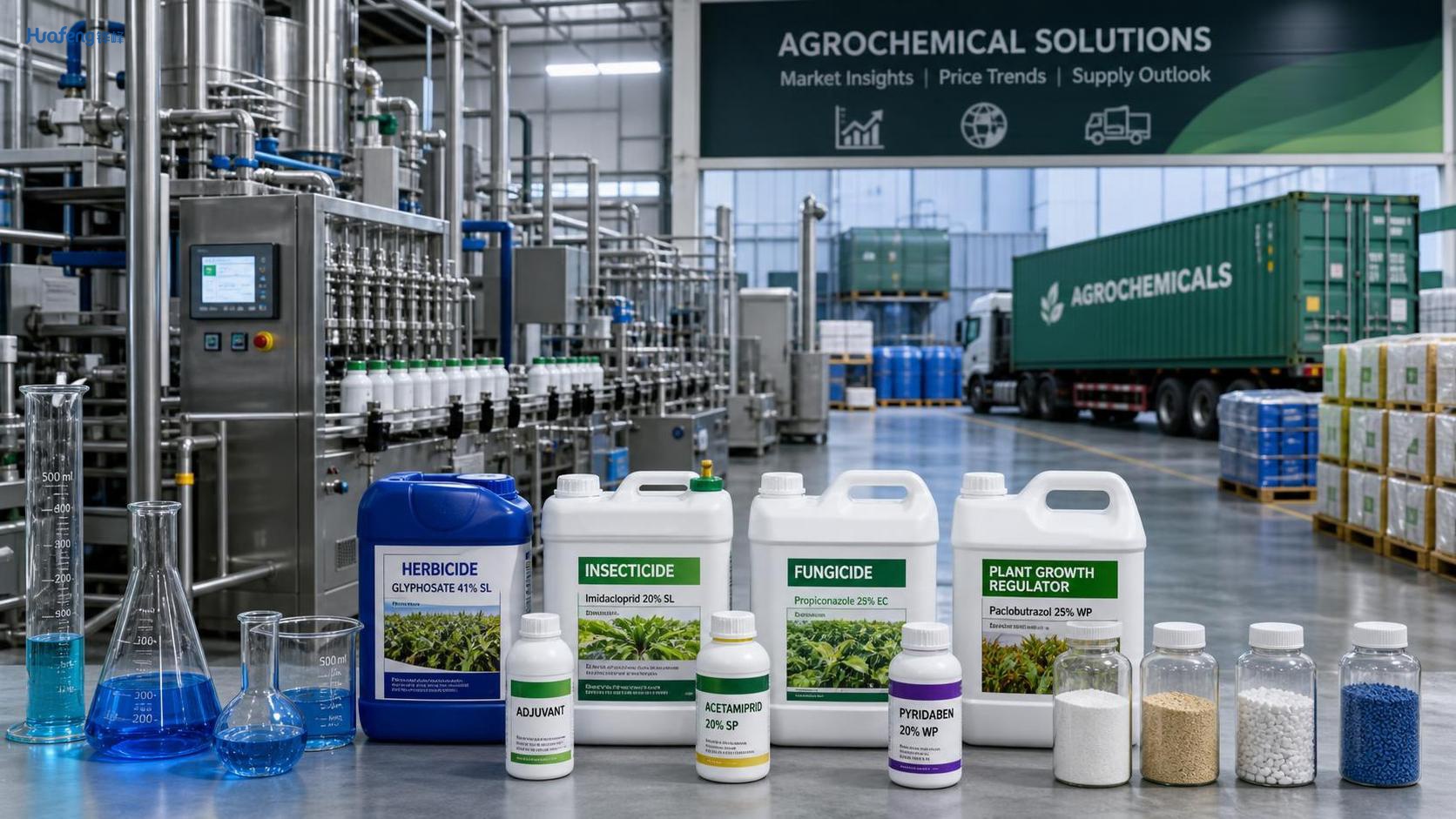
Agricultural Chemicals Price Trends and Supply Outlook for 2026
When buyers talk about Agricultural Chemicals, they are rarely discussing a single market. They are dealing with a moving set of products that includes crop protection actives, intermediates, formulation materials, solvents, and in some cases fertilizers or specialty adjuvants, each shaped by different feedstocks, different regulatory pressures, and different regional demand cycles. That distinction matters for 2026. A procurement team that treats the category as one price line will almost certainly misread risk.
The central issue is not whether prices will simply rise or fall. It is how volatility will be distributed across the chain. Some products may face softer pricing because inventory remains high after uneven post-pandemic destocking. Others may tighten unexpectedly because registrations change, a key precursor comes under environmental scrutiny, or freight and customs procedures shift in a way that interrupts replenishment. For business decision-makers, the practical question is less about calling the market perfectly and more about understanding which cost drivers are structural and which are temporary.
Why 2026 Looks Different From a Normal Buying Cycle
Agricultural chemical pricing has always been cyclical, but the next planning window is being shaped by three forces at the same time: tighter product oversight, fragmented trade routes, and stronger expectations around supply chain documentation. None of these is new on its own. What has changed is that they now affect negotiations before cargo is booked, not only after a disruption occurs.
Regulation is the most obvious factor. In many export markets, buyers are no longer evaluating only the substance and price. They are checking whether the product dossier, safety documentation, labeling, packaging compliance, and restricted substance status can hold up across customs, downstream distribution, and end-user audit requirements. A supplier that can manufacture but cannot support compliant export execution is no longer fully competitive. This is one reason why established export service capability has become part of the supply equation in chemicals, not just a logistics add-on.
Trade flows are also less predictable than they looked a few years ago. Agricultural input demand still follows planting seasons and weather patterns, but actual availability increasingly depends on where the product is formulated, how quickly raw materials can move, and whether destination markets impose additional checks or anti-dumping scrutiny. That creates a gap between nominal capacity and usable supply. Buyers who rely only on global capacity headlines may be surprised by localized tightness.
What Will Shape Price Trends
For 2026, price direction in Agricultural Chemicals is likely to be decided by a narrower set of practical variables than broad commodity commentary suggests.
The first is feedstock exposure. Many agrochemical actives and intermediates remain sensitive to upstream petrochemical and fine chemical costs. If energy prices, aromatic chains, or selected chlorinated and nitrated intermediates move sharply, downstream quotations can adjust quickly even when finished product inventories appear comfortable. This is especially true where the manufacturing route depends on a limited number of compliant precursor suppliers.
The second is environmental and safety enforcement at the manufacturing level. In China, India, and other major producing regions, plant operating rates can be influenced by inspections, emissions control requirements, or hazardous material management rules. Market participants often describe these events as temporary, but temporary interruptions can reset pricing if buyers enter the market at the same time. The effect is usually strongest in technically concentrated products rather than high-volume, broadly substitutable materials.
The third is demand timing. Agricultural chemicals do not move on an even monthly curve. Restocking ahead of crop seasons, weather-driven shifts in acreage, and distributor caution after volatile years can all distort the market. A weak quarter does not automatically mean oversupply for the year. It may simply mean demand was deferred.
There is also a quieter factor: financing discipline. Importers and distributors are more cautious about holding expensive inventory than they were during periods of aggressive forward buying. That tends to suppress panic purchasing, but it can also create sharper rebounds when stock positions become too lean. In other words, softer sentiment does not always produce stable low prices. Sometimes it delays the price move and compresses it into a shorter window.
Supply Outlook: Capacity Is Not the Same as Reliability
The broad supply outlook for 2026 is not one of universal shortage. In several product groups, there may be enough headline capacity. The more useful distinction is between available production and dependable export-ready supply. Buyers increasingly need suppliers that can do three things at once: maintain production continuity, provide compliant technical documentation, and respond quickly when destination requirements change.
This is where exporter capability becomes commercially relevant. Shandong remains one of China’s important chemical industry regions, with strong manufacturing depth and access to supporting logistics and industrial infrastructure. For overseas buyers, that matters less as a geographic label than as a practical sourcing advantage: the ability to consolidate product lines, coordinate documentation, and shorten response time when there are changes in specification, packaging, or shipping requirements. Companies such as Huafeng Chemical are increasingly valued in this context because foreign trade execution has become part of supply security itself.
A common mistake is to assume that diversification automatically means using more suppliers in more countries. In chemicals, diversification only helps if those suppliers can actually meet the same regulatory and operational threshold. Otherwise, the buyer has more names on paper but no real backup capacity. For 2026, resilient sourcing will depend more on verified alternatives within qualified supply networks than on superficial supplier count.
Where Buyers Often Misread the Market
One recurring misunderstanding is that a lower offer always signals a better buying window. In Agricultural Chemicals, a discounted quote can reflect many things: excess stock, weaker raw material costs, an attempt to secure cash flow, or a gap in documentation quality that will surface later. Price needs to be read together with lead time, certificate readiness, packaging compliance, and whether the supplier can support repeat shipments on the same standard.
Another is the assumption that regulatory compliance is a binary issue. In reality, there are layers. A product may be legally manufacturable in the country of origin but still difficult to place smoothly in the destination market because of local registration requirements, hazard communication rules, or distributor-level documentation standards. Buyers who separate commercial sourcing from regulatory review too late in the process often end up paying for avoidable delays.
There is also a tendency to focus on active ingredient pricing while underestimating the role of formulation and delivery. Yet for many end uses, the real commercial product is not just the active but the supplied form, the consistency of batches, the packaging integrity, and the logistical suitability for the target channel. That is why a technically comparable product may still generate different landed-cost outcomes.
How to Read 2026 Procurement Signals More Accurately
A more disciplined view of the market usually starts with a few basic questions:
- Is the product exposed to a concentrated intermediate chain?
- Does the destination market require documentation or approvals that narrow the supplier pool?
- How replaceable is the current source in terms of both chemistry and export execution?
- Are current prices supported by sustainable operating conditions, or by short-term inventory pressure?
Those questions are more useful than trying to reduce the market to a single bullish or bearish view. They help separate products that may remain competitively supplied from those that could tighten with little warning.
For many enterprises, 2026 planning should probably include a mix of contracting strategies rather than one position across the portfolio. Stable, high-volume materials with broad supplier availability may suit shorter pricing cycles. More sensitive products, especially those linked to strict compliance pathways or narrower manufacturing bases, often justify earlier qualification work and firmer allocation planning. The exact balance depends on the business model, but the principle is consistent: sourcing strategy should reflect product-specific risk, not category-level averages.
What This Means for Supply Partners
By 2026, a credible agricultural chemicals supplier will be judged on more than capacity and quotation speed. Buyers increasingly expect supply partners to understand customs practice, product stewardship expectations, and the documentation burden of cross-border chemical trade. That favors companies with organized export processes and a broad enough product base to support continuity when a single line becomes constrained.
Huafeng Chemical’s position is relevant here not because the market needs another generic exporter, but because overseas customers are placing more value on integrated foreign trade capability. In a chemical environment where compliance and responsiveness shape whether cargo moves on time, that capability can be just as important as nominal price. The supplier that answers quickly but cannot resolve a documentation issue is not actually more responsive in commercial terms.
The most practical reading of the 2026 outlook is this: Agricultural Chemicals are likely to remain a negotiable market, but not a simple one. Prices may stay under pressure in some segments, yet dependable supply will continue to command attention where regulation, feedstock concentration, or export complexity narrows real options. Buyers who define the market only by last month’s quote may miss that distinction. Buyers who map regulatory fit, supply continuity, and tradable availability together will make better decisions when the market turns.
Send Us Your Inquiry Today
